Department of Neurology, Chinese PLA General Hospital, 28 Fuxing Road, 100853, Beijing, China.
Chinese PLA Medical School, 100853, Beijing, China.
J Headache Pain. 2021 Sep 9;22(1):107. doi: 10.1186/s10194-021-01318-3.
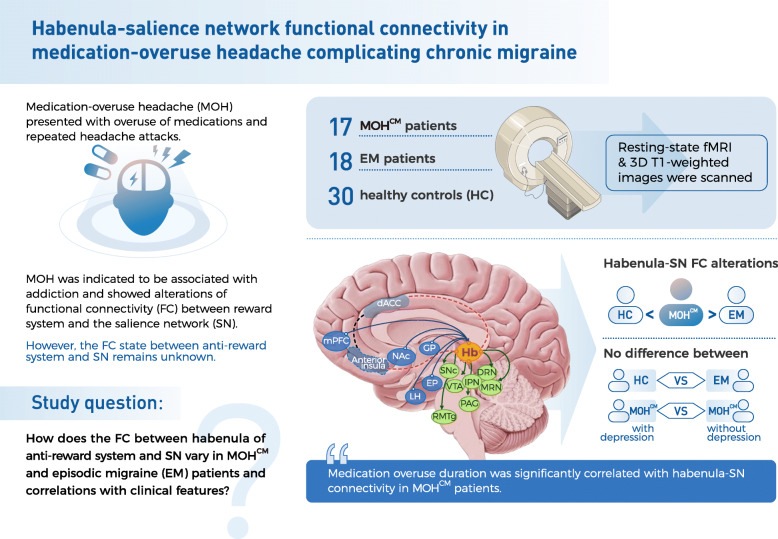
Medication-overuse headache (MOH) is a relatively frequently occurring secondary headache caused by overuse of analgesics and/or acute migraine medications. It is believed that MOH is associated with dependence behaviors and substance addiction, in which the salience network (SN) and the habenula may play an important role. This study aims to investigate the resting-state (RS) functional connectivity between the habenula and the SN in patients with MOH complicating chronic migraine (CM) compared with those with episodic migraine (EM) and healthy controls (HC).
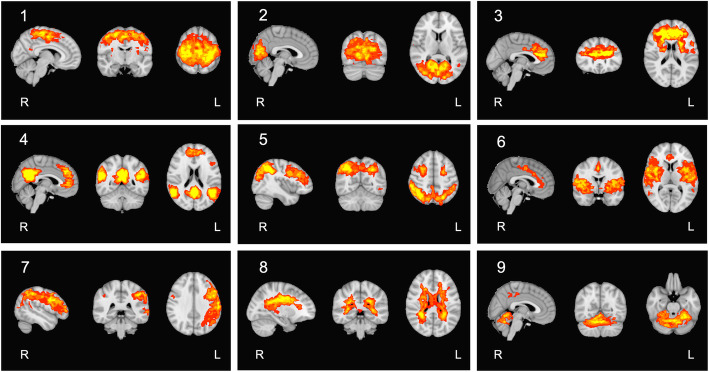
RS-fMRI and 3-dimensional T1-weighted images of 17 patients with MOH + CM, 18 patients with EM and 30 matched healthy HC were obtained. The RS-fMRI data were analyzed using the independent component analysis (ICA) method to investigate the group differences of functional connectivity between the habenula and the SN in three groups. Correlation analysis was performed thereafter with all clinical variables by Pearson correlation.
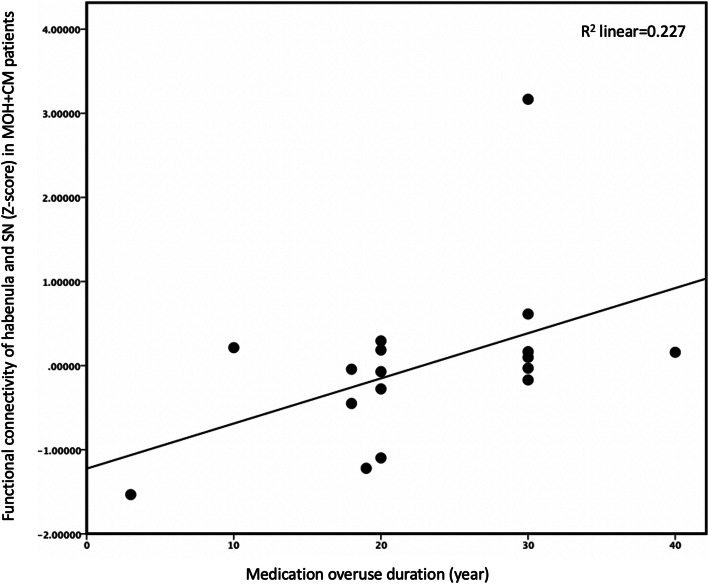
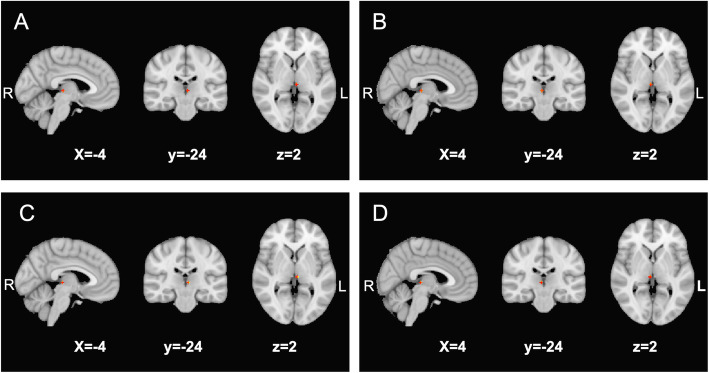
Increased functional connectivity between bilateral habenula and SN was detected in patients with MOH + CM compared with patients with EM and HC respectively. Correlation analysis showed significant correlation between medication overuse duration and habenula-SN connectivity in MOH + CM patients.
The current study supported MOH to be lying within a spectrum of dependence and addiction disorder. The enhanced functional connectivity of the habenula with SN may correlate to the development or chronification of MOH. Furthermore, the habenula may be an indicator or treatment target for MOH for its integrative role involved in multiple aspects of MOH.
药物过度使用性头痛(MOH)是一种由过度使用镇痛药和/或急性偏头痛药物引起的相对常见的继发性头痛。据信,MOH 与依赖行为和物质成瘾有关,其中突显网络(SN)和缰核可能发挥重要作用。本研究旨在比较伴有慢性偏头痛(CM)的 MOH 患者与发作性偏头痛(EM)患者和健康对照者(HC)之间缰核与 SN 之间的静息态(RS)功能连接。
对 17 例 MOH+CM 患者、18 例 EM 患者和 30 例匹配的健康 HC 患者进行 RS-fMRI 和三维 T1 加权成像。采用独立成分分析(ICA)方法分析 RS-fMRI 数据,以研究三组患者缰核与 SN 之间功能连接的组间差异。之后,采用 Pearson 相关分析,将所有临床变量与功能连接进行相关性分析。
与 EM 患者和 HC 相比,MOH+CM 患者双侧缰核与 SN 之间的功能连接增加。相关性分析显示,MOH+CM 患者药物过度使用时间与缰核-SN 连接呈显著相关。
本研究支持 MOH 属于依赖和成瘾障碍谱。缰核与 SN 的功能连接增强可能与 MOH 的发生或慢性化有关。此外,缰核可能是 MOH 的一个指标或治疗靶点,因为它在 MOH 的多个方面具有整合作用。