Department of Veterinary Population Medicine, University of Minnesota, Saint Paul, MN, 55108, USA.
School of Environment and Natural Resources, The Ohio State University, Columbus, OH, 43210, USA.
Parasit Vectors. 2021 Sep 9;14(1):464. doi: 10.1186/s13071-021-04958-1.
Urbanization can have profound effects on ecological interactions. For host-pathogen interactions, differences have been detected between urban and non-urban landscapes. However, host-pathogen interactions may also differ within highly heterogeneous, urbanized landscapes.
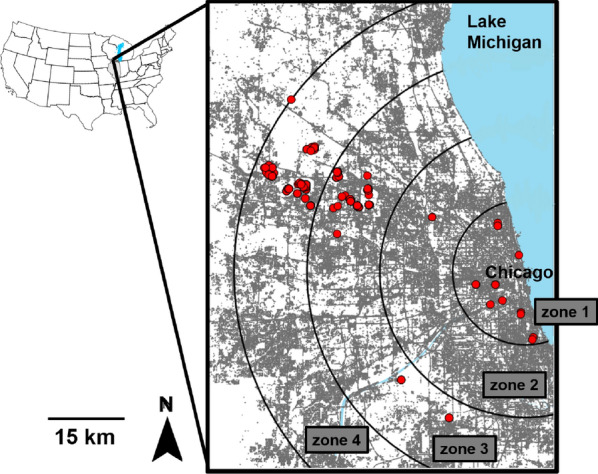
We investigated differences in infection risk (i.e., probability of infection) within urbanized landscapes using the coyote (Canis latrans) and mosquito-borne nematode, Dirofilaria immitis (the causative agent for canine heartworm), as a case study. We focused on a coyote population in Chicago for which extensive behavioral and heartworm infection data has been collected between 2001 and 2016. Our objectives were to: (i) determine how onset and duration of the heartworm transmission season varied over the 16-year period and across the urban-suburban gradient; and (ii) investigate how heartworm infection risk in coyotes varied over the years, across the urban-suburban gradient, by coyote characteristics (e.g., age, sex, resident status), and coyote use of the urbanized landscape (e.g., use of urban areas, mosquito habitats).
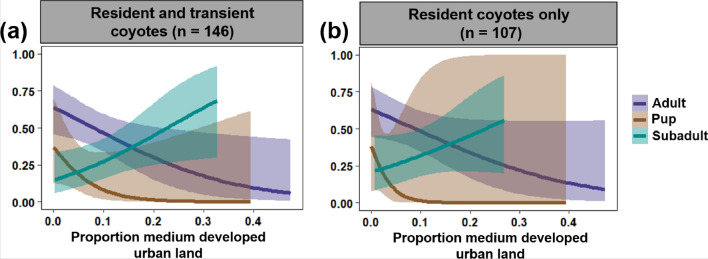
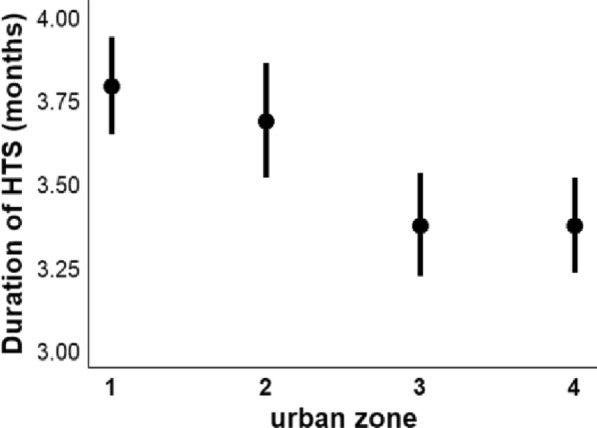
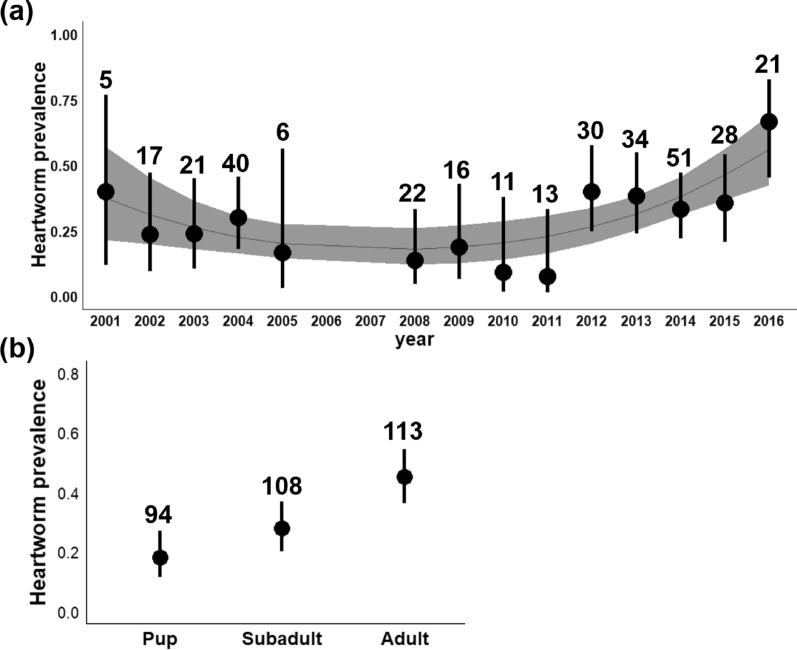
While onset of the heartworm transmission season differed neither by year nor across the urban-suburban gradient, it was longer closer to the core of Chicago. Of the 315 coyotes sampled, 31.1% were infected with D. immitis. Older coyotes and coyotes sampled in later years (i.e., 2012-2016) were more likely to have heartworm. While coyote location in the urban-suburban gradient was not a significant predictor of infection, the proportion of urban land in coyote home ranges was. Importantly, the size and direction of this association varied by age class. For adults and pups, infection risk declined with urbanization, whereas for subadults it increased. Further, models had a higher predictive power when focusing on resident coyotes (and excluding transient coyotes). The proportion of mosquito habitat in coyote home ranges was not a significant predictor of infection.
Our findings suggest that urbanization may affect host exposure to vectors of D. immitis, that risk of infection can vary within urbanized landscapes, and that urbanization-wildlife infection associations may only be detected for animals with certain characteristics (e.g., age class and resident status).
城市化对生态相互作用会产生深远的影响。对于宿主-病原体相互作用,在城市和非城市景观之间已经检测到了差异。然而,宿主-病原体相互作用在高度异质的城市化景观内也可能有所不同。
我们使用郊狼(Canis latrans)和蚊媒传播的线虫,犬心丝虫(引起犬心丝虫病的病原体)作为案例研究,调查了城市化景观内感染风险(即感染的概率)的差异。我们专注于一个在芝加哥的郊狼群,在 2001 年至 2016 年期间收集了大量关于它们的行为和犬心丝虫感染的数据。我们的目标是:(i)确定 16 年来心脏蠕虫传播季节的开始和持续时间如何在整个城市-郊区梯度上变化;(ii)调查郊狼的犬心丝虫感染风险在这些年中如何变化,以及在城市-郊区梯度上如何变化,包括郊狼的特征(如年龄、性别、居住状态)以及郊狼对城市化景观的使用(如使用城市地区、蚊子栖息地)。
虽然心脏蠕虫传播季节的开始既不受年份影响,也不受城市-郊区梯度的影响,但它在靠近芝加哥核心的地方更长。在 315 只被采样的郊狼中,有 31.1%感染了犬心丝虫。年龄较大的郊狼和在较晚年份(即 2012-2016 年)采样的郊狼更有可能感染犬心丝虫。虽然郊狼在城市-郊区梯度中的位置不是感染的重要预测因素,但郊狼活动范围中的城市土地比例是。重要的是,这种关联的大小和方向因年龄组而异。对于成年和幼崽,感染风险随着城市化而降低,而对于亚成年则增加。此外,当专注于居住的郊狼(并排除过境郊狼)时,模型的预测能力更高。郊狼活动范围中的蚊子栖息地比例不是感染的重要预测因素。
我们的研究结果表明,城市化可能会影响犬心丝虫的宿主暴露程度,感染风险可能在城市化景观内有所不同,并且城市化-野生动物感染的关联可能仅在具有某些特征的动物(如年龄组和居住状态)中检测到。