Center for Reproductive Medicine, Peking University Third Hospital, Beijing, China.
Department of Obstetrics and Gynecology, Peking University Third Hospital, Beijing, China.
JAMA Netw Open. 2021 Sep 1;4(9):e2123634. doi: 10.1001/jamanetworkopen.2021.23634.
Twin pregnancy is a common occurrence in pregnancies conceived with in vitro fertilization (IVF), but the absolute risk of adverse obstetric outcomes stratified by IVF, twin or singleton pregnancy, and maternal age are unknown.
To estimate the absolute risk of adverse obstetric outcomes at each maternal age among twin pregnancies conceived with IVF.
DESIGN, SETTING, AND PARTICIPANTS: This retrospective cohort study included pregnant women with infants born from January 1, 2013, to December 31, 2018, based on the Hospital Quality Monitoring System in China. Data were analyzed from September 1, 2020, to June 30, 2021.
Twin pregnancy with IVF (IVF-T), singleton pregnancy with IVF (IVF-S), twin pregnancy with non-IVF (nIVF-T), and singleton pregnancy with non-IVF (nIVF-S).
Sixteen obstetric outcomes, including 10 maternal complications (gestational hypertension, eclampsia and preeclampsia, gestational diabetes, placenta previa, placental abruption, placenta accreta, preterm birth, dystocia, cesarean delivery, and postpartum hemorrhage) and 6 neonatal complications (fetal growth restriction, low birth weight, very low birth weight, macrosomia, malformation, and stillbirth).
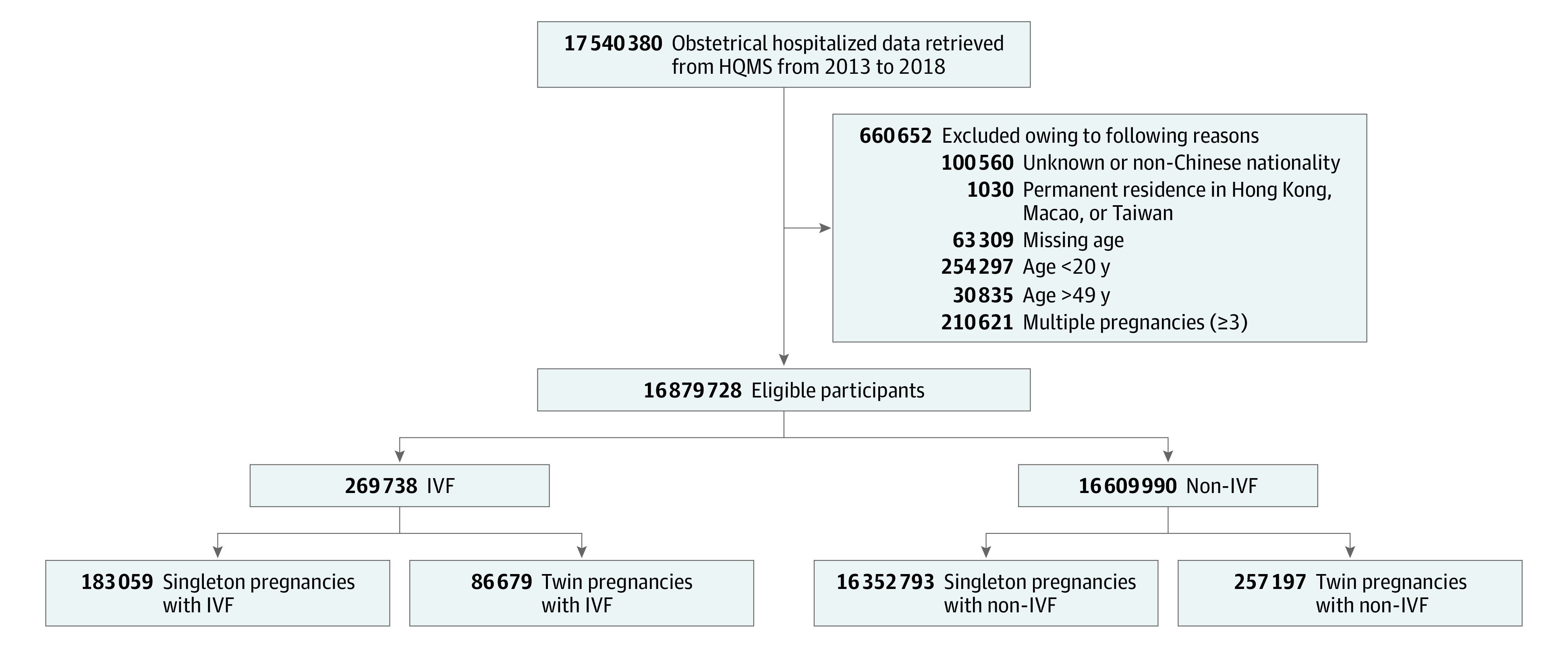
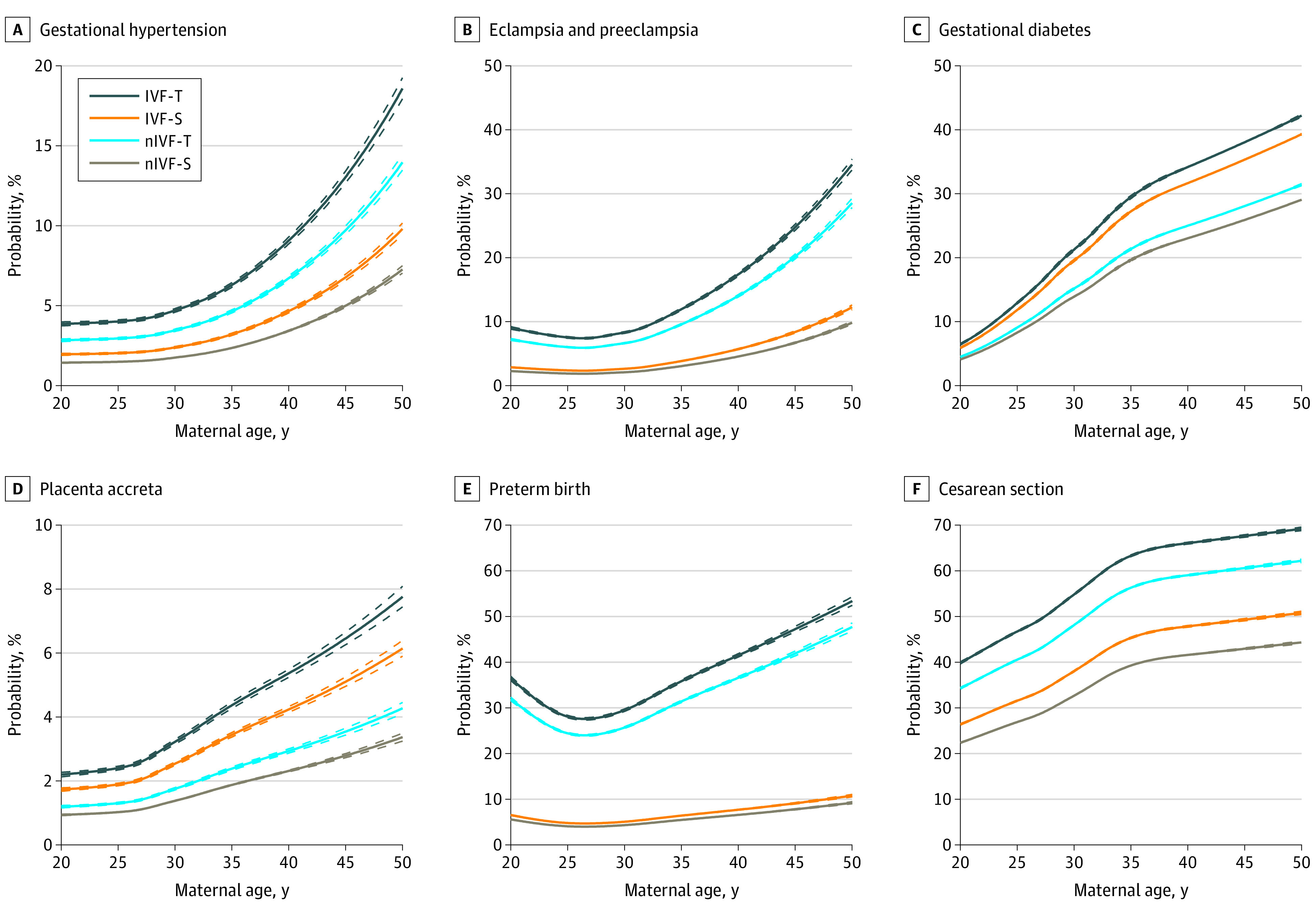
Among 16 879 728 pregnant women aged 20 to 49 years (mean [SD] age, 29.2 [4.7] years), the twin-pregnancy rates were 32.1% in the IVF group and 1.5% in the non-IVF group (relative risk, 20.8; 95% CI, 20.6-20.9). The most common adverse obstetric outcomes after pregnancy conceived with IVF were cesarean delivery (88.8%), low birth weight (43.8%), preterm birth (39.6%), gestational diabetes (20.5%), gestational hypertension and preeclampsia and eclampsia (17.5%), dystocia (16.8%), and postpartum hemorrhage (11.9%). The absolute risk of most adverse obstetric outcomes in each subgroup presented in 2 dominant patterns: Pattern A indicated the absolute risk ranging from IVF-T to nIVF-T to IVF-S to nIVF-S, and pattern B indicated the absolute risk ranging from IVF-T to IVF-S to nIVF-T to nIVF-S. Both patterns showed an elevated obstetric risk with increasing maternal age in each subgroup.
In this cohort study, twin pregnancy, IVF, and advanced maternal age were independently associated with adverse obstetric outcomes. Given these findings, promotion of the elective single embryo transfer strategy is needed to reduce multiple pregnancies following IVF technologies. Unnecessary cesarean delivery shouldh be avoided in all pregnant women.
体外受精(IVF)妊娠中双胎妊娠很常见,但按 IVF、双胎或单胎妊娠和产妇年龄分层的不良产科结局的绝对风险尚不清楚。
估计 IVF 妊娠中双胎妊娠的每个产妇年龄的不良产科结局的绝对风险。
设计、地点和参与者:这是一项回顾性队列研究,基于中国医院质量监测系统,纳入了 2013 年 1 月 1 日至 2018 年 12 月 31 日期间出生婴儿的孕妇。数据于 2020 年 9 月 1 日至 2021 年 6 月 30 日进行分析。
IVF 双胎妊娠(IVF-T)、IVF 单胎妊娠(IVF-S)、非 IVF 双胎妊娠(nIVF-T)和非 IVF 单胎妊娠(nIVF-S)。
16 种产科结局,包括 10 种母体并发症(妊娠高血压、子痫前期、妊娠期糖尿病、前置胎盘、胎盘早剥、胎盘植入、早产、难产、剖宫产和产后出血)和 6 种新生儿并发症(胎儿生长受限、低出生体重、极低出生体重、巨大儿、畸形和死产)。
在 16879728 名 20 至 49 岁的孕妇中(平均[标准差]年龄为 29.2[4.7]岁),IVF 组的双胎妊娠率为 32.1%,非 IVF 组为 1.5%(相对风险,20.8;95%置信区间,20.6-20.9)。IVF 妊娠后最常见的不良产科结局是剖宫产(88.8%)、低出生体重(43.8%)、早产(39.6%)、妊娠期糖尿病(20.5%)、妊娠高血压和子痫前期(17.5%)、难产(16.8%)和产后出血(11.9%)。每个亚组中大多数不良产科结局的绝对风险呈现出 2 种主要模式:模式 A 表示 IVF-T 至 nIVF-T 至 IVF-S 至 nIVF-S 的绝对风险范围,模式 B 表示 IVF-T 至 IVF-S 至 nIVF-T 至 nIVF-S 的绝对风险范围。在每个亚组中,随着产妇年龄的增加,这两种模式都显示出较高的产科风险。
在这项队列研究中,双胎妊娠、IVF 和产妇年龄增加均与不良产科结局独立相关。鉴于这些发现,需要推广选择性单胚胎移植策略,以减少 IVF 技术后的多胎妊娠。所有孕妇都应避免不必要的剖宫产。