WorldPop, School of Geography and Environmental Science, University of Southampton, Southampton, UK.
Department of Social Statistics and Demography, University of Southampton, Southampton, UK.
BMC Health Serv Res. 2021 Sep 13;21(Suppl 1):370. doi: 10.1186/s12913-021-06370-y.
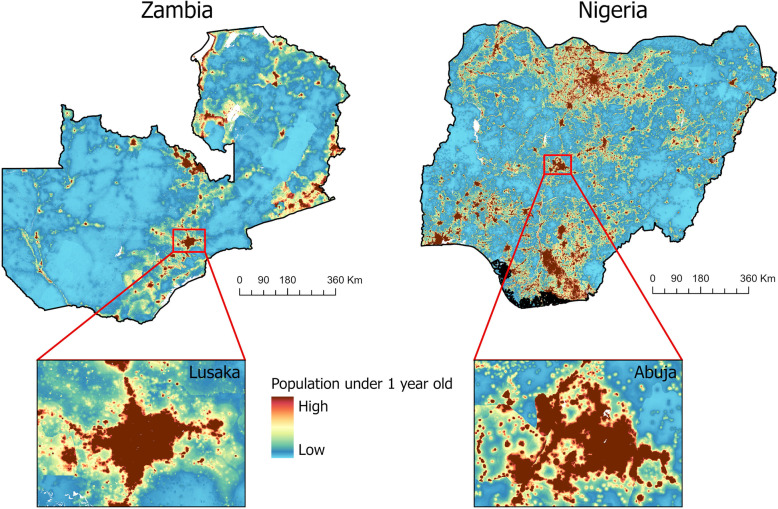
Household survey data are frequently used to measure reproductive, maternal, newborn, child and adolescent health (RMNCAH) service utilisation in low and middle income countries. However, these surveys are typically only undertaken every 5 years and tend to be representative of larger geographical administrative units. Investments in district health management information systems (DHMIS) have increased the capability of countries to collect continuous information on the provision of RMNCAH services at health facilities. However, reliable and recent data on population distributions and demographics at subnational levels necessary to construct RMNCAH coverage indicators are often missing. One solution is to use spatially disaggregated gridded datasets containing modelled estimates of population counts. Here, we provide an overview of various approaches to the production of gridded demographic datasets and outline their potential and their limitations. Further, we show how gridded population estimates can be used as alternative denominators to produce RMNCAH coverage metrics in combination with data from DHMIS, using childhood vaccination as examples.
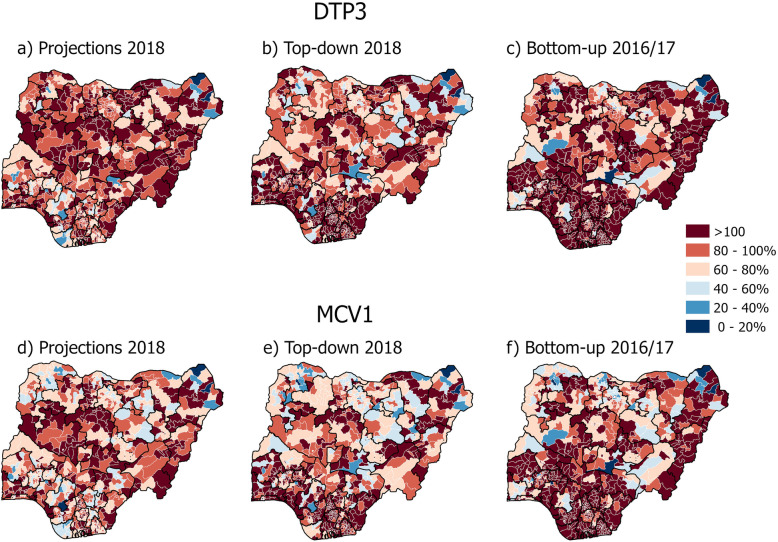
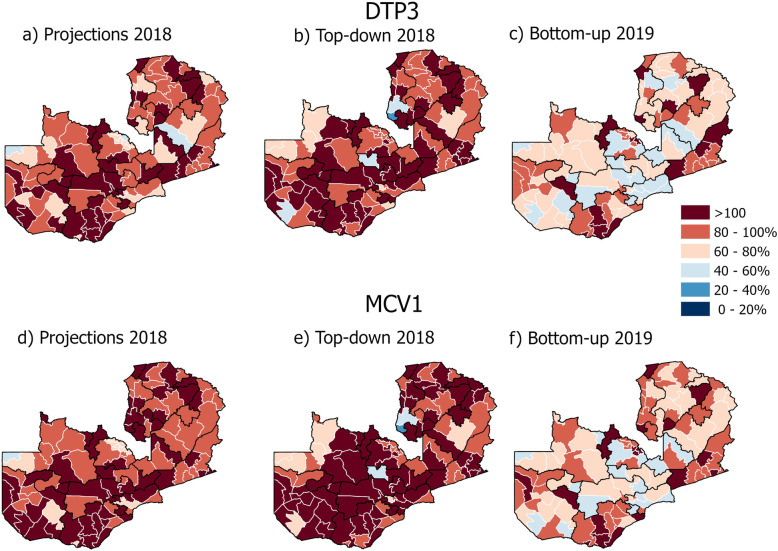
We constructed indicators on the percentage of children one year old for diphtheria, pertussis and tetanus vaccine dose 3 (DTP3) and measles vaccine dose (MCV1) in Zambia and Nigeria at district levels. For the numerators, information on vaccines doses was obtained from each country's respective DHMIS. For the denominators, the number of children was obtained from 3 different sources including national population projections and aggregated gridded estimates derived using top-down and bottom-up geospatial methods.
In Zambia, vaccination estimates utilising the bottom-up approach to population estimation substantially reduced the number of districts with > 100% coverage of DTP3 and MCV1 compared to estimates using population projection and the top-down method. In Nigeria, results were mixed with bottom-up estimates having a higher number of districts > 100% and estimates using population projections performing better particularly in the South.
Gridded demographic data utilising traditional and novel data sources obtained from remote sensing offer new potential in the absence of up to date census information in the estimation of RMNCAH indicators. However, the usefulness of gridded demographic data is dependent on several factors including the availability and detail of input data.
家庭调查数据常用于衡量中低收入国家的生殖、孕产妇、新生儿、儿童和青少年健康(RMNCAH)服务利用情况。然而,这些调查通常每 5 年进行一次,并且往往代表较大的地理行政单位。对地区卫生管理信息系统(DHMIS)的投资增加了各国在卫生机构收集 RMNCAH 服务提供情况的连续信息的能力。然而,在构建 RMNCAH 覆盖指标方面,往往缺乏有关次国家级别人口分布和人口统计数据的可靠和最新数据。一种解决方案是使用包含人口计数模型估计值的空间分解网格化数据集。在这里,我们提供了各种生产网格化人口数据集的方法概述,并概述了它们的潜力和局限性。此外,我们展示了如何使用网格化人口估计值作为替代分母,结合 DHMIS 数据,以儿童疫苗接种为例,生成 RMNCAH 覆盖指标。
我们在赞比亚和尼日利亚的地区一级构建了关于一岁儿童白喉、百日咳和破伤风疫苗第 3 剂(DTP3)和麻疹疫苗第 1 剂(MCV1)接种率的指标。对于分子,疫苗剂量信息从每个国家的 DHMIS 中获得。对于分母,儿童人数从包括国家人口预测和使用自上而下和自下而上地理空间方法得出的汇总网格化估计值在内的 3 个不同来源获得。
在赞比亚,利用人口估计的自下而上方法进行疫苗接种估计,与利用人口预测和自上而下方法相比,大大减少了 DTP3 和 MCV1 覆盖率超过 100%的地区数量。在尼日利亚,结果参差不齐,自下而上的估计值有更多的地区超过 100%,而利用人口预测的估计值表现更好,尤其是在南部。
在缺乏最新人口普查信息的情况下,利用遥感获取的传统和新型数据源的网格化人口数据在 RMNCAH 指标估计方面提供了新的潜力。然而,网格化人口数据的有用性取决于几个因素,包括输入数据的可用性和详细程度。