Reed Fennis J, Gaughan Andrea E, Stevens Forrest R, Yetman Greg, Sorichetta Alessandro, Tatem Andrew J
Geography and Geosciences, University of Louisville, Louisville, KY 40292, USA;
CIESIN, Columbia University, Palisades, NY 10964, USA.
Data (Basel). 2018 Sep 4;3:33. doi: 10.3390/data3030033.
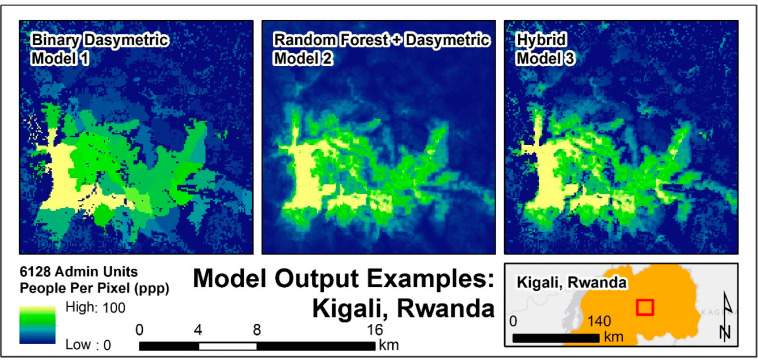
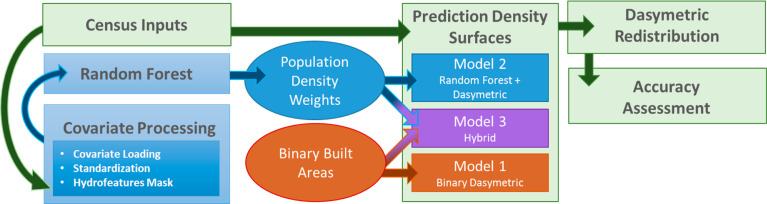
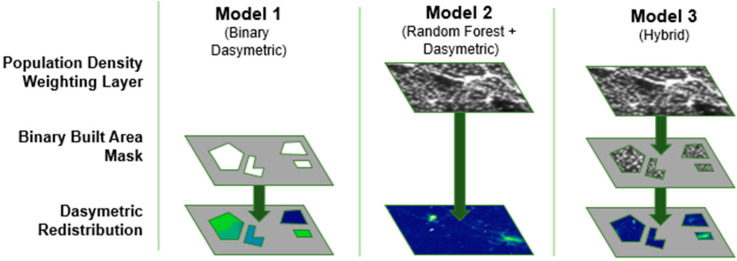
The spatial distribution of humans on the earth is critical knowledge that informs many disciplines and is available in a spatially explicit manner through gridded population techniques. While many approaches exist to produce specialized gridded population maps, little has been done to explore how remotely sensed, built-area datasets might be used to dasymetrically constrain these estimates. This study presents the effectiveness of three different high-resolution built area datasets for producing gridded population estimates through the dasymetric disaggregation of census counts in Haiti, Malawi, Madagascar, Nepal, Rwanda, and Thailand. Modeling techniques include a binary dasymetric redistribution, a random forest with a dasymetric component, and a hybrid of the previous two. The relative merits of these approaches and the data are discussed with regards to studying human populations and related spatially explicit phenomena. Results showed that the accuracy of random forest and hybrid models was comparable in five of six countries.
地球上人类的空间分布是一项至关重要的知识,它为许多学科提供信息,并且可以通过网格化人口技术以空间明确的方式获取。虽然有许多方法可以生成专门的网格化人口地图,但在探索如何利用遥感建成区数据集以非对称方式约束这些估计方面却做得很少。本研究展示了三种不同的高分辨率建成区数据集通过对海地、马拉维、马达加斯加、尼泊尔、卢旺达和泰国的人口普查计数进行非对称分解来生成网格化人口估计的有效性。建模技术包括二元非对称再分配、具有非对称成分的随机森林以及前两者的混合。就研究人类人口和相关空间明确现象而言,讨论了这些方法和数据的相对优点。结果表明,在六个国家中的五个国家,随机森林模型和混合模型的准确性相当。