West Africa Regional Office, African Population and Health Research Center, Dakar, Senegal.
Post-Graduate Programme in Epidemiology, Universidade Federal de Pelotas, Pelotas, Brazil.
BMJ Glob Health. 2020 Jan 26;5(1):e002232. doi: 10.1136/bmjgh-2019-002232. eCollection 2020.
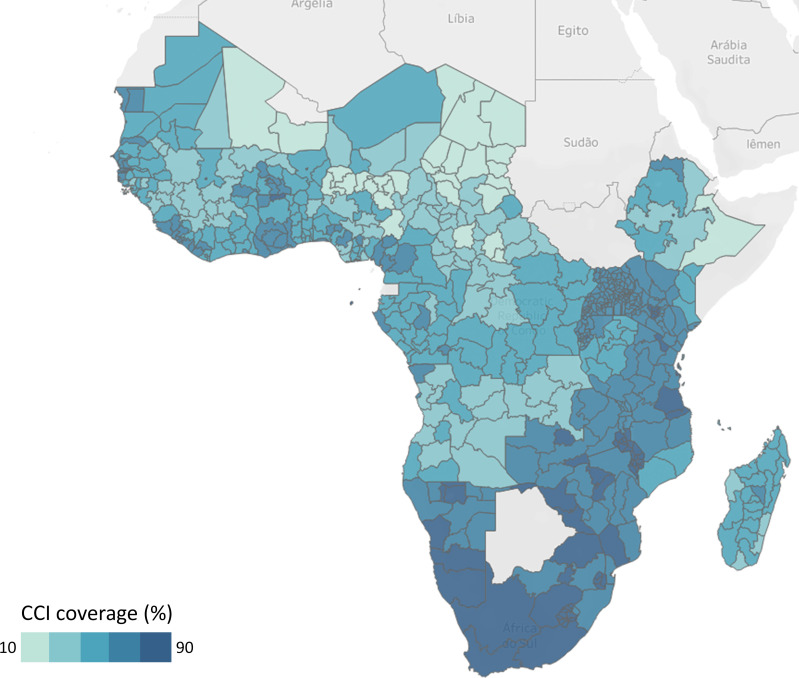
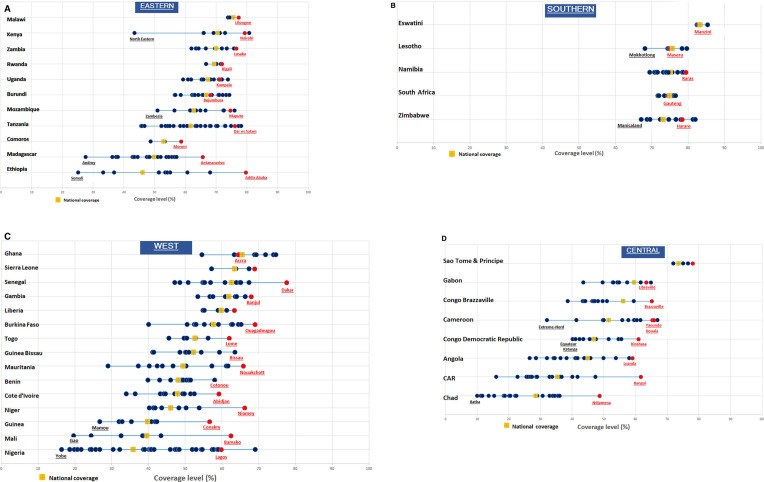
Subnational inequalities have received limited attention in the monitoring of progress towards national and global health targets during the past two decades. Yet, such data are often a critical basis for health planning and monitoring in countries, in support of efforts to reach all with essential interventions. Household surveys provide a rich basis for interventions coverage indicators on reproductive, maternal, newborn and child health (RMNCH) at the country first administrative level (regions or provinces). In this paper, we show the large subnational inequalities that exist in RMNCH coverage within 39 countries in sub-Saharan Africa, using a composite coverage index which has been used extensively by Countdown to 2030 for Women's, Children's and Adolescent's Health. The analyses show the wide range of subnational inequality patterns such as low overall national coverage with very large top inequality involving the capital city, intermediate national coverage with bottom inequality in disadvantaged regions, and high coverage in all regions with little inequality. Even though nearly half of the 34 countries with surveys around 2004 and again around 2015 appear to have been successful in reducing subnational inequalities in RMNCH coverage, the general picture shows persistence of large inequalities between subnational units within many countries. Poor governance and conflict settings were identified as potential contributing factors. Major efforts to reduce within-country inequalities are required to reach all women and children with essential interventions.
在过去二十年的国家和全球卫生目标监测中,次国家级不平等问题受到的关注有限。然而,此类数据通常是国家卫生规划和监测的重要基础,有助于努力为所有人提供基本干预措施。家庭调查为在国家一级的第一个行政级别(地区或省份)提供了生殖、孕产妇、新生儿和儿童健康(RMNCH)干预覆盖指标的丰富基础。在本文中,我们使用倒计时 2030 年妇女、儿童和青少年健康广泛使用的综合覆盖指数,展示了撒哈拉以南非洲 39 个国家中 RMNCH 覆盖方面存在的巨大次国家级不平等。分析表明,存在着广泛的次国家级不平等模式,例如全国总体覆盖率低,但首都涉及的不平等程度非常大;中等全国覆盖率,劣势地区处于劣势;所有地区的高覆盖率和低不平等程度。尽管近一半的国家在 2004 年左右和 2015 年左右再次进行了调查,似乎成功地降低了 RMNCH 覆盖方面的次国家级不平等,但总体情况表明,许多国家内部的次国家级单位之间仍然存在着巨大的不平等。不良治理和冲突环境被确定为潜在的促成因素。需要做出重大努力来减少国内不平等,以确保所有妇女和儿童都能获得基本干预措施。