Chiou Wei-Chung, Lu Hsu-Feng, Hsu Nung-Yu, Chang Tein-Yao, Chin Yuan-Fan, Liu Ping-Cheng, Lo Jir-Mehng, Wu Yeh B, Yang Jinn-Moon, Huang Cheng
Department of Biotechnology and Laboratory Science in Medicine, National Yang Ming Chiao Tung University, Taipei City, Taiwan.
Department of Medical Laboratory Science and Biotechnology, Asia University, Taichung City, Taiwan.
Front Pharmacol. 2021 Aug 26;12:720018. doi: 10.3389/fphar.2021.720018. eCollection 2021.
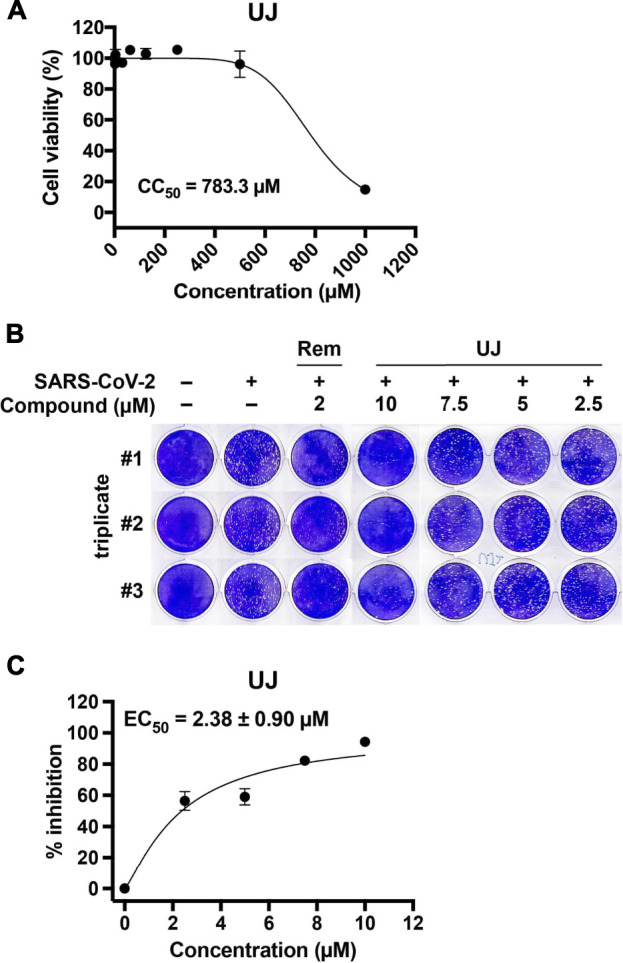
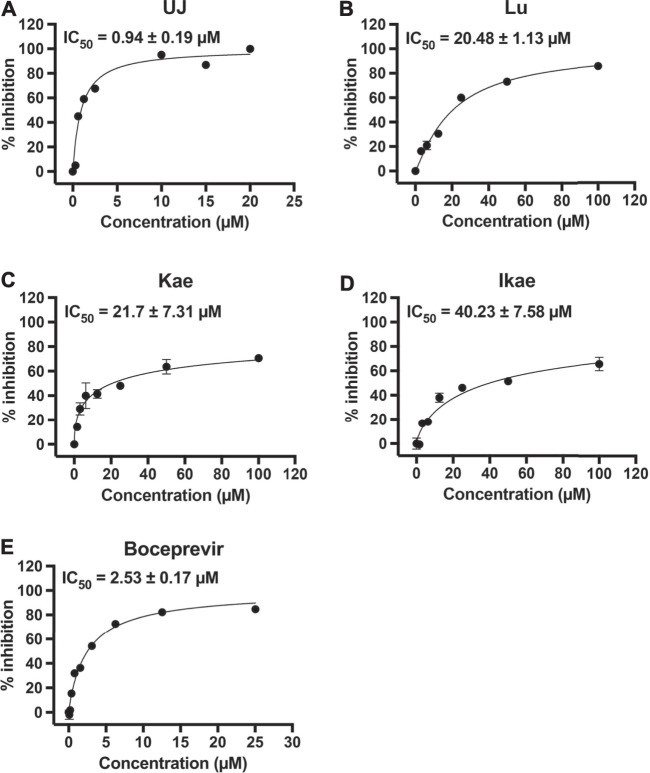
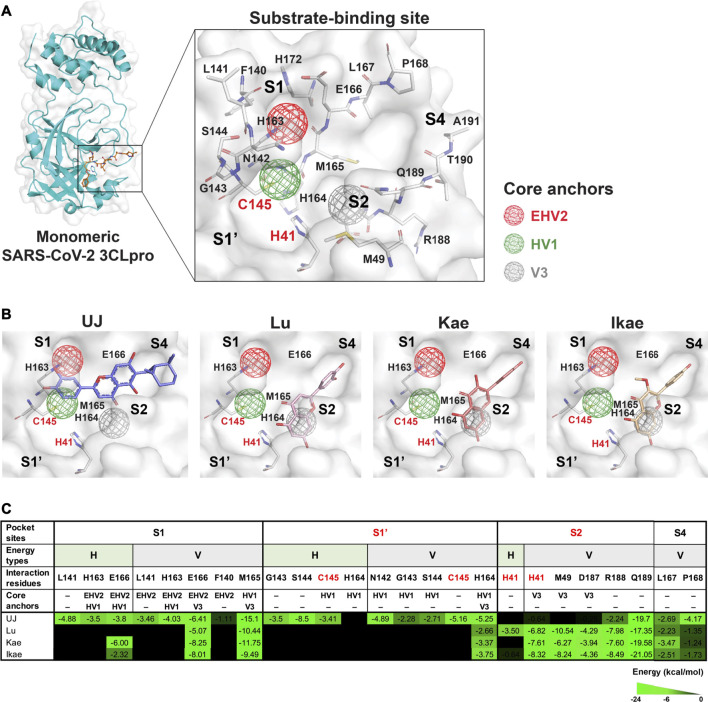
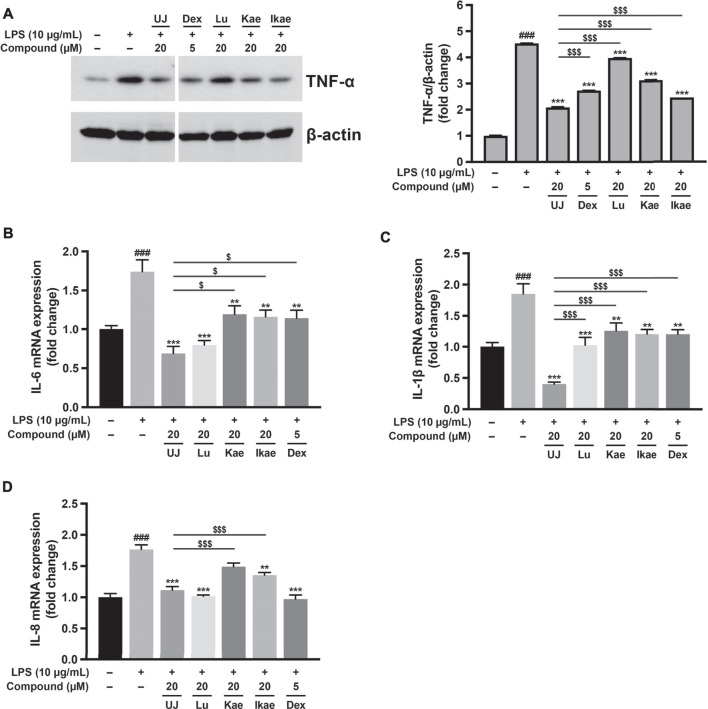
Severe acute respiratory syndrome coronavirus 2 (SARS-CoV-2) infection causes severe "flu-like" symptoms that can progress to acute respiratory distress syndrome (ARDS), pneumonia, renal failure, and death. From the therapeutic perspective, 3-chymotrypsin-like protein (3CLpro) is a plausible target for direct-acting antiviral agents because of its indispensable role in viral replication. The flavonoid ugonin J (UJ) has been reported to have antioxidative and anti-inflammatory activities. However, the potential of UJ as an antiviral agent remains unexplored. In this study, we investigated the therapeutic activity of UJ against SARS-CoV-2 infection. Importantly, UJ has a distinct inhibitory activity against SARS-CoV-2 3CLpro, compared to luteolin, kaempferol, and isokaempferide. Specifically, UJ blocks the active site of SARS-CoV-2 3CLpro by forming hydrogen bonding and van der Waals interactions with H163, M165 and E166, G143 and C145, Q189, and P168 in subsites S1, S1', S2, and S4, respectively. In addition, UJ forms strong, stable interactions with core pharmacophore anchors of SARS-CoV-2 3CLpro in a computational model. UJ shows consistent anti-inflammatory activity in inflamed human alveolar basal epithelial A549 cells. Furthermore, UJ has a 50% cytotoxic concentration (CC) and a 50% effective concentration (EC values of about 783 and 2.38 µM, respectively, with a selectivity index (SI) value of 329, in SARS-CoV-2-infected Vero E6 cells. Taken together, UJ is a direct-acting antiviral that obstructs the activity of a fundamental protease of SARS-CoV-2, offering the therapeutic potential for SARS-CoV-2 infection.
严重急性呼吸综合征冠状病毒2(SARS-CoV-2)感染会引发严重的“流感样”症状,这些症状可能会发展为急性呼吸窘迫综合征(ARDS)、肺炎、肾衰竭和死亡。从治疗角度来看,3-糜蛋白酶样蛋白(3CLpro)因其在病毒复制中不可或缺的作用,是直接作用抗病毒药物的一个合理靶点。黄酮类化合物乌索酸J(UJ)已被报道具有抗氧化和抗炎活性。然而,UJ作为抗病毒药物的潜力尚未得到探索。在本研究中,我们研究了UJ对SARS-CoV-2感染的治疗活性。重要的是,与木犀草素、山奈酚和异山奈酚相比,UJ对SARS-CoV-2 3CLpro具有独特的抑制活性。具体而言,UJ通过分别与亚位点S1、S1'、S2和S4中的H163、M165和E166、G143和C145、Q189以及P168形成氢键和范德华相互作用,阻断SARS-CoV-2 3CLpro的活性位点。此外,在一个计算模型中,UJ与SARS-CoV-2 3CLpro的核心药效团锚形成了强烈、稳定的相互作用。UJ在发炎的人肺泡基底上皮A549细胞中表现出一致的抗炎活性。此外,在感染SARS-CoV-2的Vero E6细胞中,UJ的50%细胞毒性浓度(CC)和50%有效浓度(EC)值分别约为783和2.38µM,选择性指数(SI)值为329。综上所述,UJ是一种直接作用的抗病毒药物,可阻碍SARS-CoV-2一种基本蛋白酶的活性,为SARS-CoV-2感染提供了治疗潜力。