Carranza Claudia, Pedraza-Sanchez Sigifredo, de Oyarzabal-Mendez Eleane, Torres Martha
Departamento de Microbiología, Instituto Nacional de Enfermedades Respiratorias, Mexico City, Mexico.
Unidad de Bioquímica Instituto Nacional de Ciencias Médicas y Nutrición, Salvador Zubirán, Mexico City, Mexico.
Front Immunol. 2020 Sep 10;11:2006. doi: 10.3389/fimmu.2020.02006. eCollection 2020.
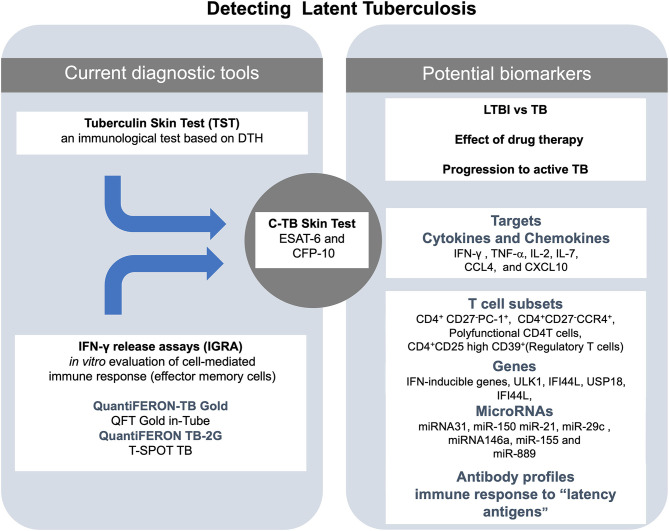
Latent tuberculosis infection (LTBI) is a subclinical mycobacterial infection defined on the basis of cellular immune response to mycobacterial antigens. The tuberculin skin test (TST) and the interferon gamma release assay (IGRA) are currently used to establish the diagnosis of LTB. However, neither TST nor IGRA is useful to discriminate between active and latent tuberculosis. Moreover, these tests cannot be used to predict whether an individual with LTBI will develop active tuberculosis (TB) or whether therapy for LTBI could be effective to decrease the risk of developing active TB. Therefore, in this article, we review current approaches and some efforts to identify an immunological marker that could be useful in distinguishing LTBI from TB and in evaluating the effectiveness of treatment of LTB on the risk of progression to active TB.
潜伏性结核感染(LTBI)是一种基于对分枝杆菌抗原的细胞免疫反应而定义的亚临床分枝杆菌感染。结核菌素皮肤试验(TST)和干扰素γ释放试验(IGRA)目前用于确立LTBI的诊断。然而,TST和IGRA都无助于区分活动性结核和潜伏性结核。此外,这些检测不能用于预测LTBI个体是否会发展为活动性结核病(TB),也不能用于预测LTBI治疗是否能有效降低发展为活动性TB的风险。因此,在本文中,我们综述了目前用于识别一种免疫标志物的方法及一些相关研究工作,该免疫标志物有助于区分LTBI和TB,并评估LTBI治疗对进展为活动性TB风险的治疗效果。