K.G. Jebsen Center for Genetic Epidemiology, Department of Public Health and Nursing, NTNU, Norwegian University of Science and Technology, Trondheim, Norway.
Department of Public Health and Nursing, Faculty of Medicine and Health Science, NTNU, Norwegian University of Science and Technology, Trondheim, Norway.
Eur J Epidemiol. 2021 Nov;36(11):1169-1177. doi: 10.1007/s10654-021-00803-y. Epub 2021 Sep 13.
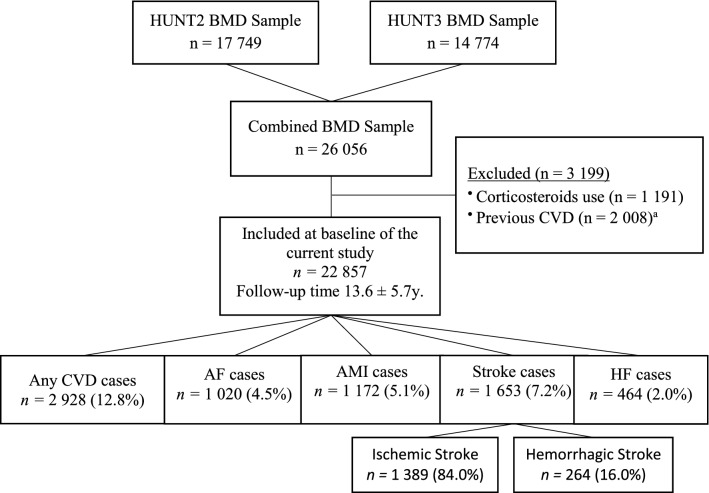
The association between bone mineral density (BMD) and cardiovascular disease (CVD) is not fully understood. We evaluated BMD as a risk factor for cardiovascular disease and specifically atrial fibrillation (AF), acute myocardial infarction (AMI), ischemic (IS) and hemorrhagic stroke (HS) and heart failure (HF) in men and women. This prospective population cohort utilized data on 22 857 adults from the second and third surveys of the HUNT Study in Norway free from CVD at baseline. BMD was measured using single and dual-energy X-ray absorptiometry in the non-dominant distal forearm and T-score was calculated. Hazard ratios (HR) and 95% confidence intervals (CI) were calculated from adjusted cox proportional hazards models. The analyses were sex-stratified, and models were adjusted for age, age-squared, BMI, physical activity, smoking status, alcohol use, and education level. Additionally, in women, we adjusted for estrogen use and postmenopause. During a mean follow-up of 13.6 ± 5.7 years, 2 928 individuals (12.8%) developed fatal or non-fatal CVD, 1 020 AF (4.5%), 1 172 AMI (5.1%), 1 389 IS (6.1%), 264 HS (1.1%), and 464 HF (2.0%). For every 1 unit decrease in BMD T-score the HR for any CVD was 1.01 (95% CI 0.98 to 1.04) in women and 0.99 (95% CI 0.94 to 1.03) in men. Point estimates for the four cardiovascular outcomes ranged from slightly protective (HR 0.95 for AF in men) to slightly deleterious (HR 1.12 for HS in men). We found no evidence of association of lower distal forearm BMD with CVD, AF, AMI, IS, HS, and HF.
骨密度(BMD)与心血管疾病(CVD)之间的关联尚未完全阐明。我们评估了 BMD 作为心血管疾病风险因素,特别是心房颤动(AF)、急性心肌梗死(AMI)、缺血性(IS)和出血性中风(HS)以及心力衰竭(HF)的风险因素,在男性和女性中。这项前瞻性人群队列研究利用了挪威 HUNT 研究第二和第三次调查中 22857 名成年人的数据,这些人在基线时无 CVD。使用非优势远端前臂的单能和双能 X 射线吸收法测量 BMD,并计算 T 评分。使用调整后的 Cox 比例风险模型计算危险比(HR)和 95%置信区间(CI)。分析按性别分层,模型调整了年龄、年龄平方、BMI、身体活动、吸烟状况、饮酒和教育水平。此外,在女性中,我们还调整了雌激素使用和绝经后情况。在平均 13.6±5.7 年的随访期间,2928 人(12.8%)发生了致命或非致命的 CVD、1020 例 AF(4.5%)、1172 例 AMI(5.1%)、1389 例 IS(6.1%)、264 例 HS(1.1%)和 464 例 HF(2.0%)。在女性中,BMD T 评分每降低 1 个单位,任何 CVD 的 HR 为 1.01(95%CI 0.98 至 1.04),男性为 0.99(95%CI 0.94 至 1.03)。四项心血管结局的点估计值范围从略具保护作用(男性 AF 的 HR 为 0.95)到略具有害作用(男性 HS 的 HR 为 1.12)。我们没有发现较低的远端前臂 BMD 与 CVD、AF、AMI、IS、HS 和 HF 之间存在关联的证据。