Zhejiang Provincial Key Laboratory of Geriatrics, Department of Geriatrics, Zhejiang Hospital.
Institute of Materia Medica, Zhejiang Academy of Medical Sciences, Hangzhou, China.
Clin Interv Aging. 2018 Feb 27;13:343-353. doi: 10.2147/CIA.S154356. eCollection 2018.
This study aimed to verify the existing relationship between bone mineral density (BMD) and chronic heart failure (CHF) by meta-analysis.
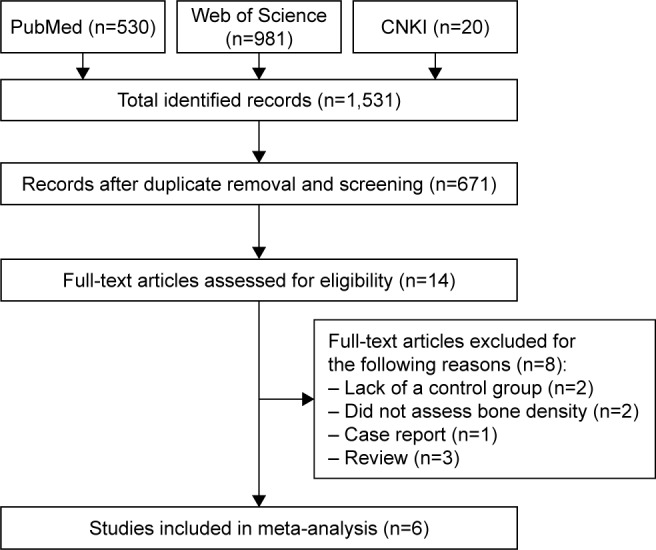
Databases, including PubMed, Web of Science, and Chinese National Knowledge Infrastructure, published in English or Chinese up to February 28, 2017, were searched for studies on the association between CHF and BMD. Two independent reviewers collected the relevant articles. The standard mean deviation (SMD) and 95% confidence interval were calculated for BMD with fixed- and random-effect models. Subgroup and sensitivity analyses were also conducted.
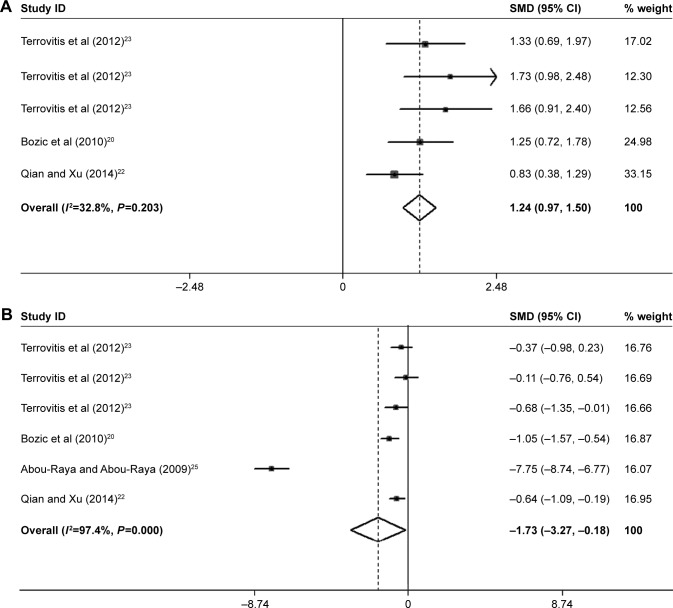
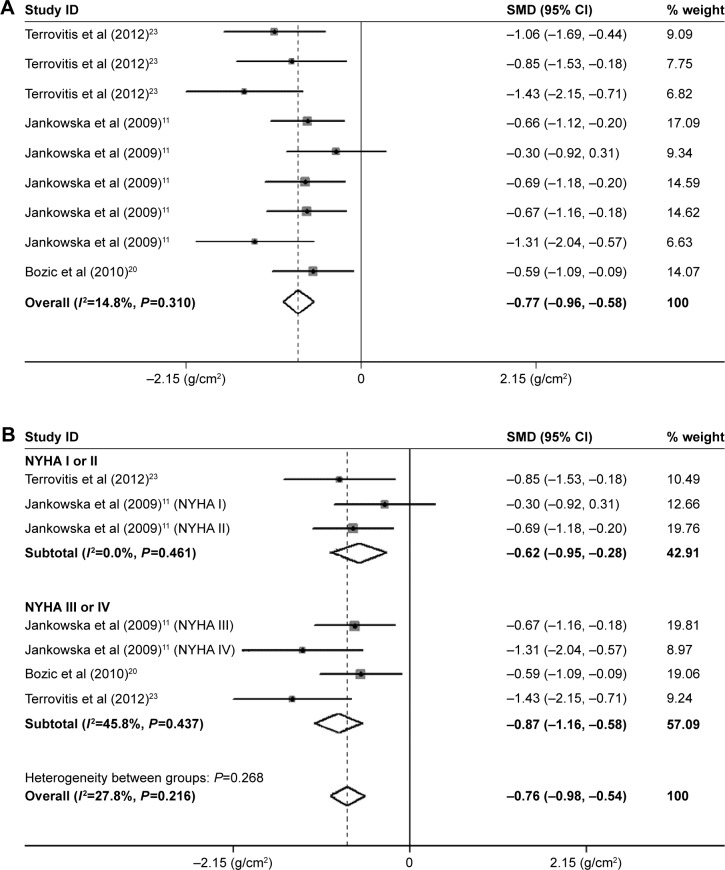
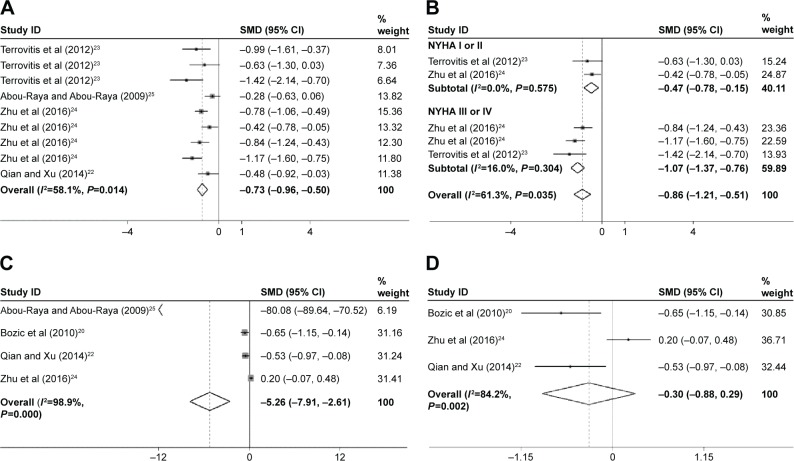
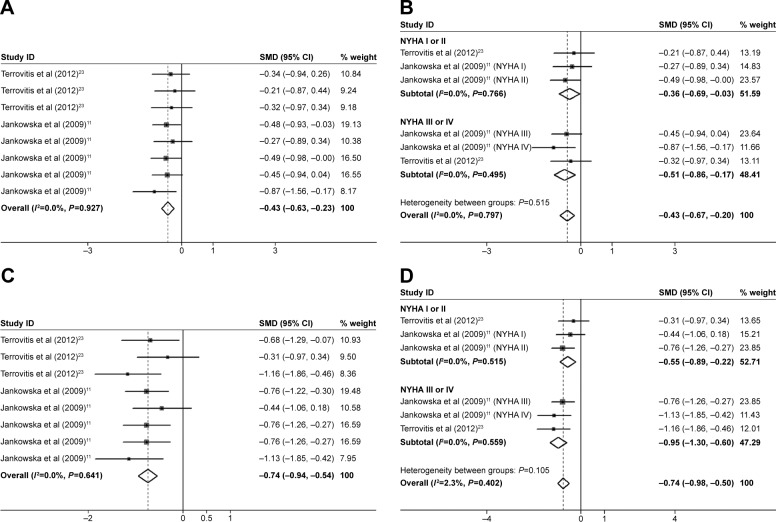
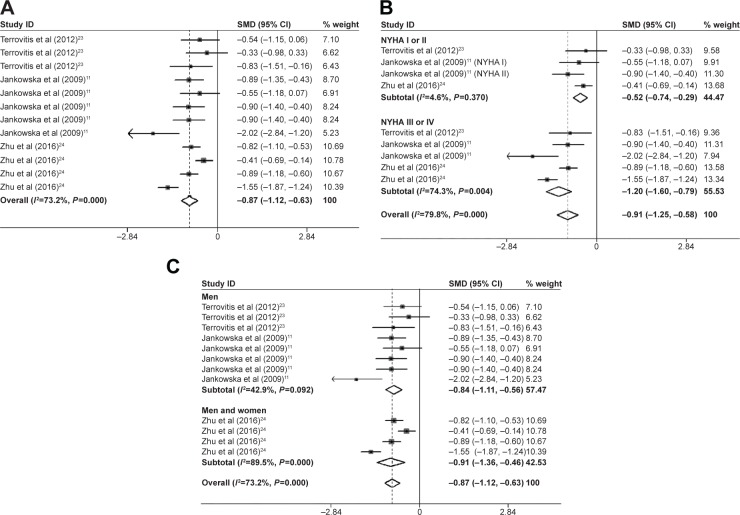
A total of six studies (552 CHF and 243 non-CHF patients) were included. The results indicated that the patients with CHF had a lower total BMD compared with the non-CHF patients. Similar effects were also observed for femoral neck, arm, leg, and trunk BMD. However, no difference was observed in the lumbar spine BMD. The SMD of total BMD in New York Heart Association classes I or II (NYHA I or II) patients was -0.62, while that in NYHA III or IV patients was -0.87, and the SMD of femoral bone mineral density in NYHA I or II patients was -0.47, while that in NYHA III or IV patients was -1.07. Moreover, vitamin D and parathyroid hormone (PTH) were also found to be associated with CHF.
Patients with CHF had a lower total BMD and femoral neck, arm, leg, or trochanter BMD than patients with non-CHF. Vitamin D reduced, whereas PTH increased, with the severity of CHF. The clinical significance of the present findings remains uncertain and should be confirmed by future studies.
通过荟萃分析验证骨密度(BMD)与慢性心力衰竭(CHF)之间的现有关系。
检索了英文和中文数据库,包括 PubMed、Web of Science 和中国国家知识基础设施,检索截至 2017 年 2 月 28 日发表的关于 CHF 与 BMD 相关性的研究。两名独立的评审员收集了相关文章。使用固定效应模型和随机效应模型计算 BMD 的标准均数差(SMD)和 95%置信区间。还进行了亚组和敏感性分析。
共纳入 6 项研究(552 例 CHF 和 243 例非 CHF 患者)。结果表明,与非 CHF 患者相比,CHF 患者的总 BMD 较低。在股骨颈、手臂、腿部和躯干 BMD 中也观察到类似的效果。然而,腰椎 BMD 没有差异。纽约心脏协会(NYHA)I 或 II 级(NYHA I 或 II)患者的总 BMD 的 SMD 为-0.62,而 NYHA III 或 IV 级患者的 SMD 为-0.87,NYHA I 或 II 级患者的股骨骨密度的 SMD 为-0.47,而 NYHA III 或 IV 级患者的 SMD 为-1.07。此外,还发现维生素 D 和甲状旁腺激素(PTH)与 CHF 有关。
与非 CHF 患者相比,CHF 患者的总 BMD 以及股骨颈、手臂、腿部或转子间 BMD 较低。维生素 D 随着 CHF 的严重程度而降低,而 PTH 则增加。这些发现的临床意义尚不确定,需要进一步的研究来证实。