Department of Anthropology, University of California San Diego, La Jolla, California, USA
Department of Health and Wellness, Somali Family Service of San Diego, San Diego, CA, USA.
BMJ Open. 2021 Sep 14;11(9):e051184. doi: 10.1136/bmjopen-2021-051184.
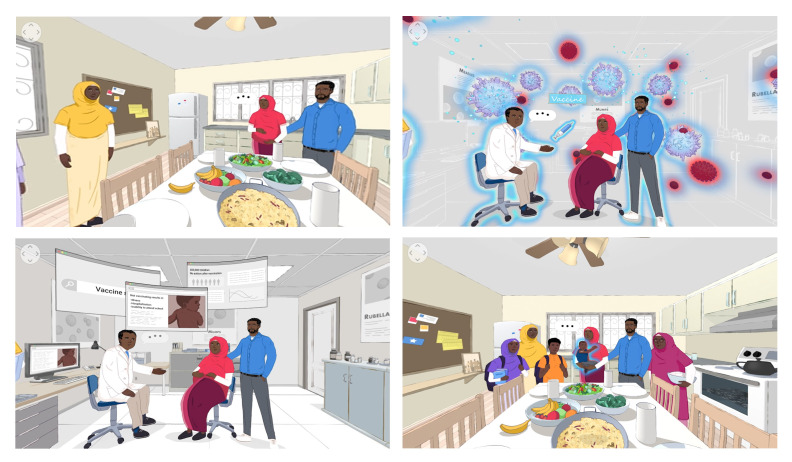
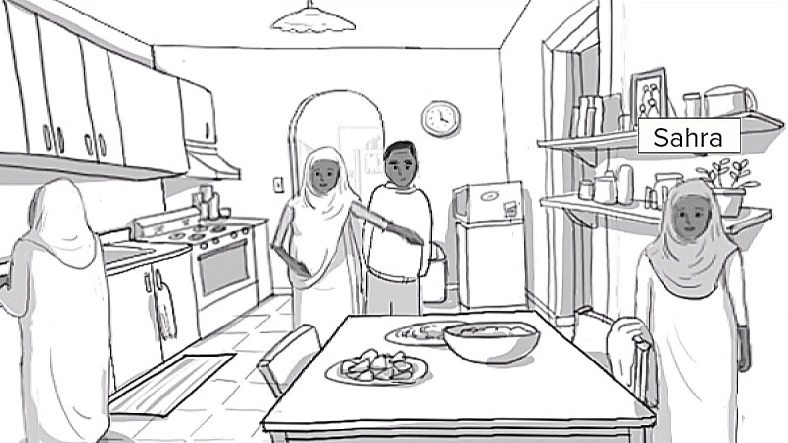
To combat misinformation, engender trust and increase health literacy, we developed a culturally and linguistically appropriate virtual reality (VR) vaccination education platform using community-engaged approaches within a Somali refugee community.
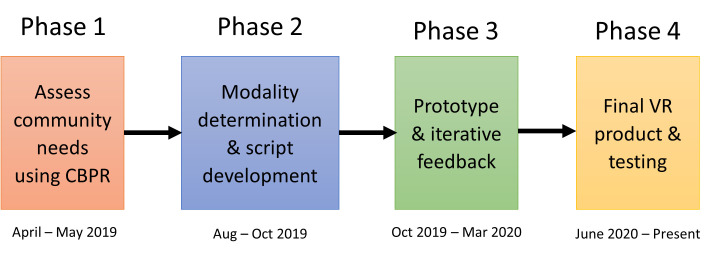
Community-based participatory research (CBPR) methods including focus group discussions, interviews, and surveys were conducted with Somali community members and expert advisors to design the educational content. Co-design approaches with community input were employed in a phased approach to develop the VR storyline.
60 adult Somali refugees and seven expert advisors who specialise in healthcare, autism research, technology development and community engagement.
Somali refugees participated at the offices of a community-based organisation, Somali Family Service, in San Diego, California and online. Expert advisors responded to surveys virtually.
We find that a CBPR approach can be effectively used for the co-design of a VR educational programme. Additionally, cultural and linguistic sensitivities can be incorporated within a VR educational programme and are essential factors for effective community engagement. Finally, effective VR utilisation requires flexibility so that it can be used among community members with varying levels of health and technology literacy.
We describe using community co-design to create a culturally and linguistically sensitive VR experience promoting vaccination within a refugee community. Our approach to VR development incorporated community members at each step of the process. Our methodology is potentially applicable to other populations where cultural sensitivities and language are common health education barriers.
为了打击错误信息,建立信任并提高健康素养,我们采用社区参与的方法,在索马里难民社区内开发了一个具有文化和语言适应性的虚拟现实 (VR) 疫苗接种教育平台。
采用社区参与式研究 (CBPR) 方法,包括与索马里社区成员和专家顾问进行焦点小组讨论、访谈和调查,以设计教育内容。采用共同设计方法,在分阶段的方法中结合社区投入来开发 VR 故事情节。
60 名成年索马里难民和 7 名专家顾问,他们专门从事医疗保健、自闭症研究、技术开发和社区参与。
索马里难民在加利福尼亚州圣地亚哥的一个社区组织——索马里家庭服务处的办公室内和在线参与。专家顾问通过虚拟方式回复调查。
我们发现,CBPR 方法可有效地用于共同设计 VR 教育计划。此外,在 VR 教育计划中可以纳入文化和语言敏感性,这是有效社区参与的重要因素。最后,有效的 VR 使用需要灵活性,以便可以在具有不同健康和技术素养水平的社区成员中使用。
我们描述了使用社区共同设计来创建一个具有文化和语言敏感性的 VR 体验,以在难民社区中促进疫苗接种。我们的 VR 开发方法在整个过程的每个步骤中都纳入了社区成员。我们的方法可能适用于其他存在文化敏感性和语言障碍的常见健康教育培训人群。