State Key Laboratory of Rice Biology and Chinese National Center for Rice Improvement, China National Rice Research Institute, Hangzhou, 310006, China.
State Key Laboratory of Subtropical Silviculture, Zhejiang A&F University, Lin'an, 311300, Zhejiang Province, China.
Sci Rep. 2021 Sep 14;11(1):18252. doi: 10.1038/s41598-021-97622-8.
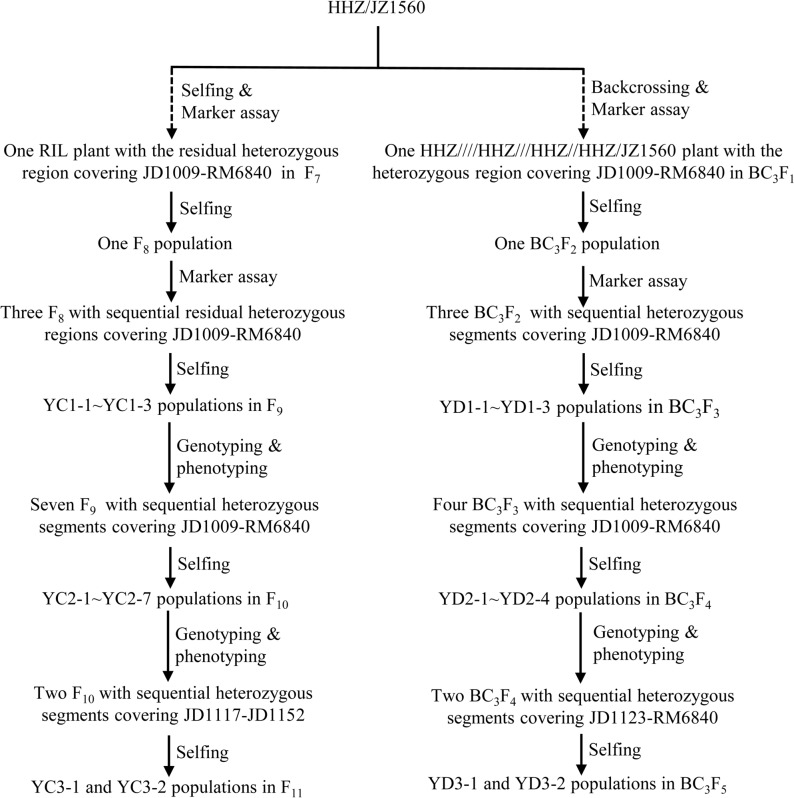
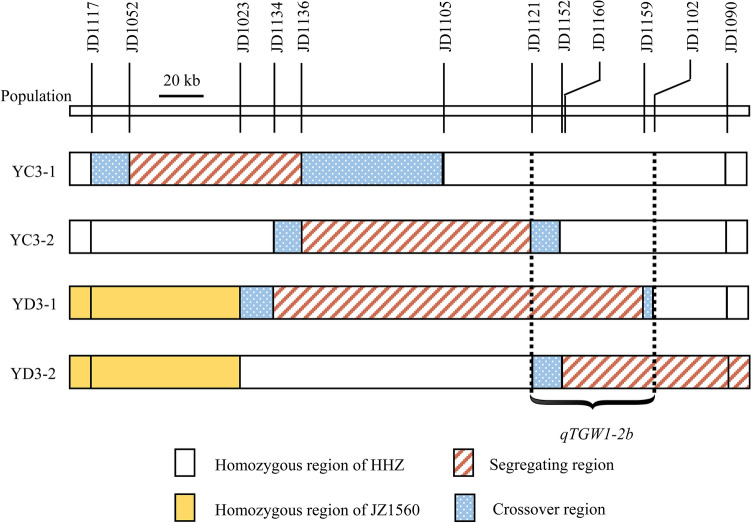
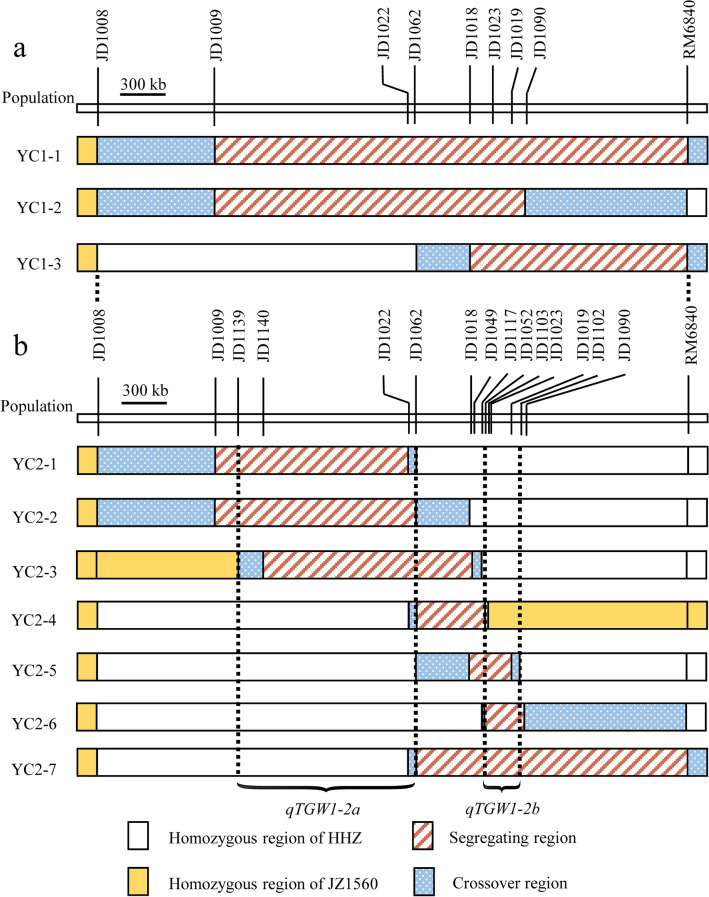
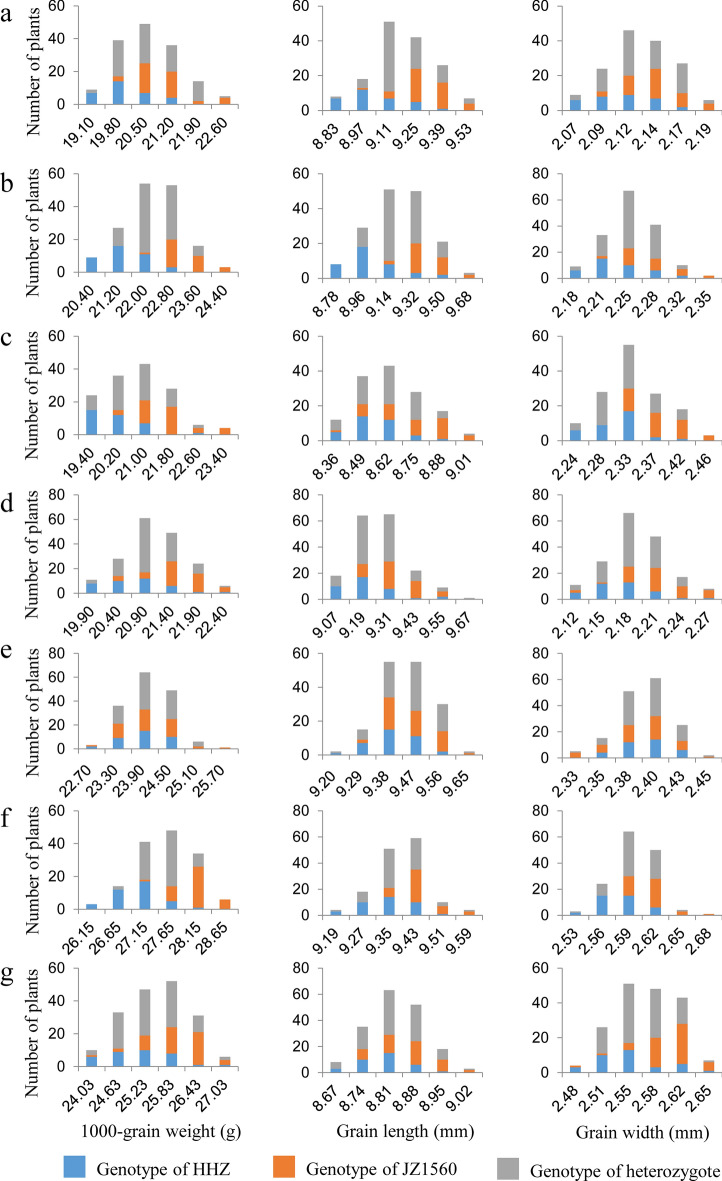
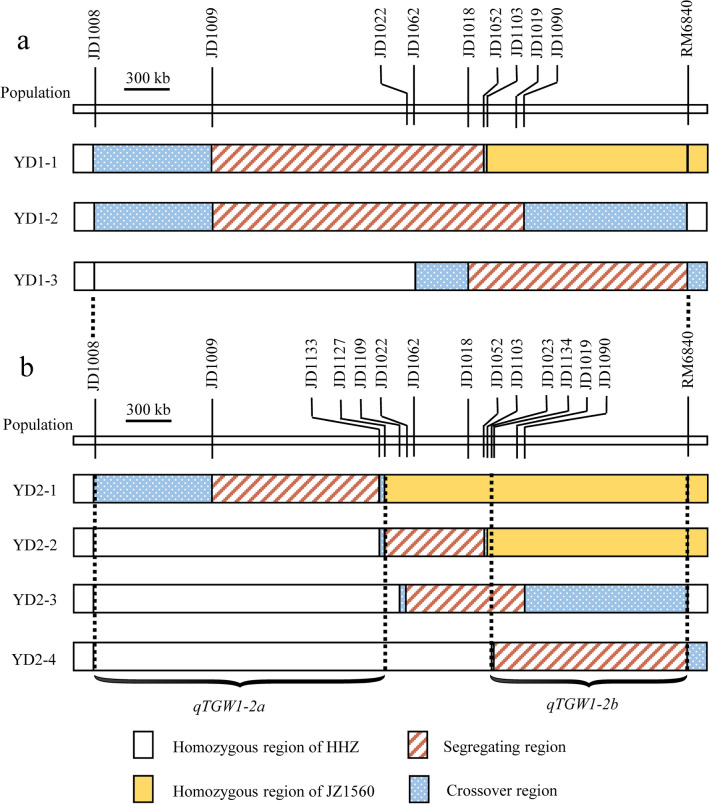
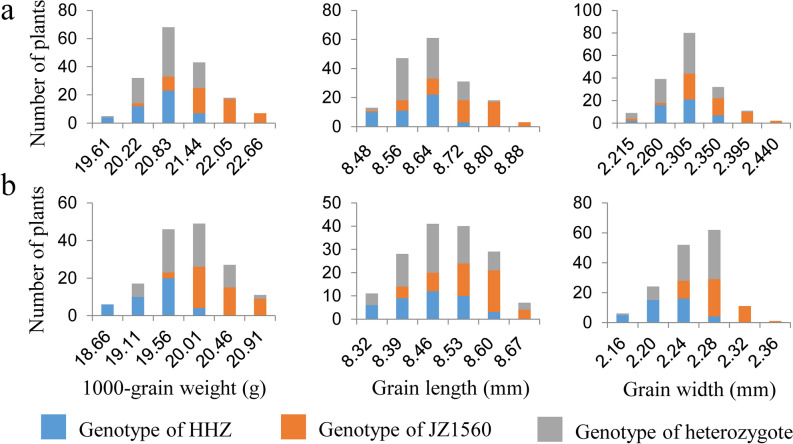
Grain size and weight are the key traits determining rice quality and yield and are mainly controlled by quantitative trait loci (QTL). In this study, one minor QTL that was previously mapped in the marker interval of JD1009-JD1019 using the Huanghuazhan/Jizi1560 (HHZ/JZ1560) recombinant inbred line (RIL) population, qTGW1-2, was validated to regulate grain size and weight across four rice-growing seasons using twenty-one near isogenic line (NIL)-F populations. The twenty-one populations were in two types of genetic background that were derived from the same parents HHZ and JZ1560. Twelve F, F or F NIL-F populations with the sequential residual heterozygous regions covering JD1009-RM6840 were developed from one residual heterozygote (RH) in the HHZ/JZ1560 RIL population, and the remaining nine BCF, BCF or BCF NIL-F populations with the sequential residual heterozygous regions covering JD1009-RM6840 were constructed through consecutive backcrosses to the recurrent parent HHZ followed with marker assistant selection in each generation. Based on the QTL analysis of these genetic populations, qTGW1-2 was successfully confirmed to control grain length, width and weight and further dissected into two QTLs, qTGW1-2a and qTGW1-2b, which were respectively narrowed down to the marker intervals of JD1139-JD1127 (~ 978.2-kb) and JD1121-JD1102 (~ 54.8-kb). Furthermore, the two types of NIL-F populations were proved to be able to decrease the genetic background noise and increase the detection power of minor QTL. These results provided an important basis for further map-based cloning and molecular design breeding with the two QTLs in rice.
粒型和粒重是决定水稻品质和产量的关键性状,主要受数量性状位点(QTL)控制。本研究利用黄华占/吉资 1560(HHZ/JZ1560)重组自交系(RIL)群体在标记区间 JD1009-JD1019 上定位到一个以前的微效 QTL qTGW1-2,该 QTL 调控四个水稻种植季节的粒型和粒重。利用 21 个近等基因系(NIL)-F 群体对其进行了验证。这 21 个群体有两种遗传背景,均来自黄华占和吉资 1560 的相同亲本。从 HHZ/JZ1560 RIL 群体中的一个残余杂合体(RH)中,开发了 12 个具有覆盖 JD1009-RM6840 的连续剩余杂合区域的 F1、F2 或 F3 NIL-F 群体,而剩余的 9 个具有覆盖 JD1009-RM6840 的连续剩余杂合区域的 BCF1、BCF2 或 BCF3 NIL-F 群体则是通过连续回交到轮回亲本 HHZ 并在每一代进行标记辅助选择构建的。基于这些遗传群体的 QTL 分析,成功地确认 qTGW1-2 控制粒长、粒宽和粒重,并进一步将其分为两个 QTL,qTGW1-2a 和 qTGW1-2b,分别被缩小到标记区间 JD1139-JD1127(978.2-kb)和 JD1121-JD1102(54.8-kb)。此外,两种类型的 NIL-F 群体被证明能够减少遗传背景噪声并提高微效 QTL 的检测能力。这些结果为进一步利用水稻中的两个 QTL 进行基于图谱的克隆和分子设计育种提供了重要依据。