Norcia Luiz Fernando, Kiappe Olívia Pereira, Jorge Eliane Chaves
Botucatu Medical School, São Paulo State University (UNESP), Botucatu, São Paulo, Brazil.
Department of Surgical Specialties and Anesthesiology (Ophthalmology Division), Botucatu Medical School, São Paulo State University (UNESP), Botucatu, São Paulo, Brazil.
Clin Ophthalmol. 2021 Sep 7;15:3765-3776. doi: 10.2147/OPTH.S322445. eCollection 2021.
Noninfectious pediatric uveitis is a potentially blinding disease often associated with systemic conditions. In cases of chronic anterior uveitis without adequate response to steroids and immunosuppressants, biological response modifiers would be viable therapeutic options. Still, evidence is lacking on the safety of the long-term use of these drugs in children. Therefore, this study aimed to evaluate the efficacy and safety of biological therapy to treat noninfectious pediatric uveitis.
A systematic review was performed to identify original studies involving biological therapy for children diagnosed with noninfectious uveitis. Quality of evidence was assessed using the Grading of Recommendations, Assessment, Development, and Evaluation (GRADE) classification system.
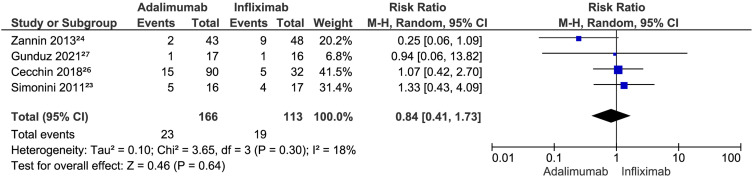
Nine studies involving 526 children were eligible. Adalimumab was superior to placebo in reducing inflammatory activity (risk ratio (RR) 3.21 [95% confidence interval (CI) 1.65-6.27]; P = 0.0006; I = 0%) and steroid use (RR 2.27 [95% CI 1.03-4.99]; P = 0.04; I = 0%, low-certainty evidence). There was no difference between adalimumab and placebo in the occurrence of systemic adverse events (RR 2.51 [95% CI 0.74-8.54]; P = 0.14; I = 48%) and local events (RR 1.15 [95% CI 0.46-2.88]; P= 0.76; I = 1%). There was no difference between adalimumab and infliximab in response to treatment (RR 1.18 [95% CI 0.69-2.03]; P= 0.55; I = 91%, very low-certainty evidence) and in the occurrence of adverse effects (RR 0.84 [95% CI 0.41-1.73]; P= 0.64; I = 18%, low-certainty evidence).
There is low to very-low evidence that biological therapy is effective and safe in managing noninfectious pediatric uveitis. Future large randomized trials may provide more substantial evidence to confirm these results.
非感染性儿童葡萄膜炎是一种潜在致盲性疾病,常与全身性疾病相关。对于慢性前葡萄膜炎,若对类固醇和免疫抑制剂反应不佳,生物反应调节剂可能是可行的治疗选择。然而,目前缺乏关于这些药物在儿童中长期使用安全性的证据。因此,本研究旨在评估生物疗法治疗非感染性儿童葡萄膜炎的疗效和安全性。
进行系统综述,以确定涉及生物疗法治疗诊断为非感染性葡萄膜炎儿童的原始研究。使用推荐分级、评估、制定和评价(GRADE)分类系统评估证据质量。
9项研究涉及526名儿童,符合纳入标准。在降低炎症活动方面,阿达木单抗优于安慰剂(风险比(RR)3.21 [95%置信区间(CI)1.65 - 6.27];P = 0.0006;I² = 0%)以及在减少类固醇使用方面(RR 2.27 [95% CI 1.03 - 4.99];P = 0.04;I² = 0%,低确定性证据)。阿达木单抗与安慰剂在全身不良事件发生率(RR 2.51 [95% CI 0.74 - 8.54];P = 0.14;I² = 48%)和局部事件发生率上无差异(RR 1.15 [95% CI 0.46 - 2.88];P = 0.76;I² = 1%)。在治疗反应方面,阿达木单抗与英夫利昔单抗无差异(RR 1.18 [95% CI 0.69 - 2.03];P = 0.55;I² = 91%,极低确定性证据),在不良反应发生率方面也无差异(RR 0.84 [95% CI 0.41 - 1.73];P = 0.64;I² = 18%,低确定性证据)。
低至极低质量的证据表明生物疗法在治疗非感染性儿童葡萄膜炎方面有效且安全。未来的大型随机试验可能会提供更充分的证据来证实这些结果。