Herbert Wertheim School of Public Health and Human Longevity Science, University of California, San Diego, La Jolla, CA, USA.
Los Angeles County Department of Mental Health, Los Angeles, CA, USA.
BMC Public Health. 2021 Sep 16;21(1):1681. doi: 10.1186/s12889-021-11723-7.
Trauma is a significant public health issue, negatively impacting a range of health outcomes. Providers and administrators in public mental health systems recognize the widespread experience of trauma, as well as their limited ability to address trauma within their communities. In response, the Los Angeles County Department of Mental Health funded nine regionally based community partnerships to build capacity to address trauma. We describe partnership and community capacity-building efforts and examine community impact, defined as successful linkages to resources and changes in stress tolerance capacities among community members.
We conceptualized community capacity-building as dissemination of trauma-informed education and training, community outreach and engagement, and linkage of community members to resources. We measured trauma-informed trainings among partnership members (N = 332) using the Trauma-Informed Organizational Toolkit. Outreach, engagement and linkages were documented using Event and Linkage Trackers. We examined changes in the type of successful linkage after the issuance of statewide mandatory restrictions in response to COVID-19. We examined changes in stress tolerance capacities among community members (N = 699) who were engaged in ongoing partnership activities using the 10-item Conner-Davidson Resilience Scale; the 28-item Coping Orientation to Problems; and the pictorial Inclusion of Community in Self Scale.
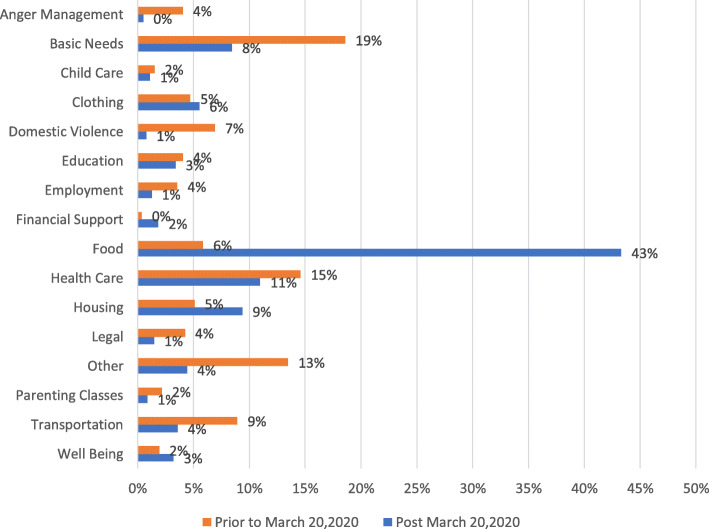
Training and education opportunities were widespread: 66% of members reported opportunities for training in 13 or more trauma-informed practices. Partnerships conducted over 7800 community capacity-building events with over 250,000 attendees. Nearly 14,000 successful linkages were made for a wide range of resources, with consistent linkage success prior to (85%) and during (87%) the pandemic. In response to COVID-19, linkage type significantly shifted from basic services and health care to food distribution (p < .01). Small but significant improvements occurred in coping through emotional and instrumental support; and sense of community connectedness (p < .05 each).
Community-based partnerships demonstrated effective capacity-building strategies. Despite the pandemic, community members did not report reduced stress tolerance, instead demonstrating gains in external help-seeking (use of emotional and instrumental supports) and perception of community connectedness. Future work will use qualitative methods to examine the impact of community capacity-building and the sustainability of this approach for addressing the impact of trauma within communities.
创伤是一个重大的公共卫生问题,对一系列健康结果产生负面影响。公共心理健康系统的提供者和管理人员认识到创伤的广泛存在,以及他们在社区内解决创伤的能力有限。有鉴于此,洛杉矶县心理健康部为九个基于区域的社区合作关系提供资金,以建立解决创伤问题的能力。我们描述了合作伙伴关系和社区能力建设工作,并研究了社区影响,定义为成功建立资源联系以及社区成员的压力容忍能力的变化。
我们将社区能力建设概念化为传播创伤知情教育和培训、社区外展和参与,以及将社区成员与资源联系起来。我们使用创伤知情组织工具包(Trauma-Informed Organizational Toolkit)衡量合作伙伴成员(N=332)的创伤知情培训。使用事件和联系跟踪器记录外展、参与和联系。我们检查了在全州范围内强制实施限制措施以应对 COVID-19 之后,成功联系类型的变化。我们使用 10 项康纳-戴维森韧性量表、28 项问题应对取向量表和自我包容社区的图片量表,检查了正在参与持续伙伴关系活动的社区成员(N=699)的压力容忍能力的变化。
培训和教育机会广泛:66%的成员报告说有机会接受 13 项或更多创伤知情实践的培训。合作伙伴关系举办了超过 7800 次社区能力建设活动,有超过 25 万名参与者。近 14000 次成功的联系是为各种资源建立的,在大流行之前(85%)和期间(87%)都有持续的联系成功。针对 COVID-19,联系类型从基本服务和医疗保健显著转变为食品分发(p<.01)。在通过情感和工具支持以及社区归属感来应对方面,出现了较小但显著的改善(p<.05 各)。
基于社区的合作伙伴关系展示了有效的能力建设策略。尽管受到大流行的影响,社区成员并没有报告压力容忍度降低,而是在寻求外部帮助(使用情感和工具支持)和社区归属感方面表现出了提高。未来的工作将使用定性方法来研究社区能力建设的影响以及这种方法在解决社区内创伤影响方面的可持续性。