Altundal Omer Faruk, Haslak Zeynep Pinar, Keskin Seda
Department of Chemical and Biological Engineering, Koc University, Rumelifeneri Yolu, Sariyer, 34450 Istanbul, Turkey.
Ind Eng Chem Res. 2021 Sep 8;60(35):12999-13012. doi: 10.1021/acs.iecr.1c01742. Epub 2021 Aug 25.
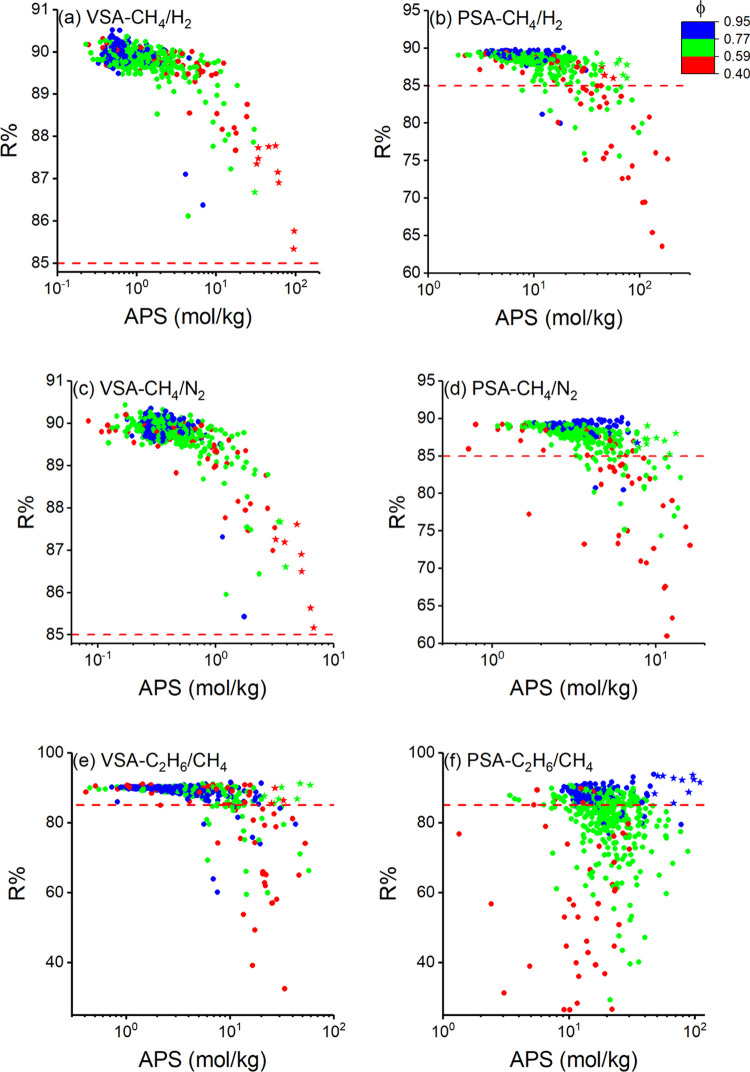
Covalent organic frameworks (COFs) are promising materials for gas storage and separation; however, the potential of COFs for separation of CH from industrially relevant gases such as H, N, and CH is yet to be investigated. In this work, we followed a multiscale computational approach to unlock both the adsorption- and membrane-based CH/H, CH/N, and CH/CH separation potentials of 572 COFs by combining grand canonical Monte Carlo (GCMC) and molecular dynamics (MD) simulations and density functional theory (DFT) calculations. Adsorbent performance evaluation metrics of COFs, adsorption selectivity, working capacity, regenerability, and adsorbent performance score were calculated for separation of equimolar CH/H, CH/N, and CH/CH mixtures at vacuum swing adsorption (VSA) and pressure swing adsorption (PSA) conditions to identify the best-performing COFs for each mixture. Results showed that COFs could achieve selectivities of 2-85, 1-7, and 2-23 for PSA-based CH/H, CH/N, and CH/CH separations, respectively, outperforming conventional adsorbents such as zeolites and activated carbons for each mixture. Structure-performance relations revealed that COFs with pore sizes <10 Å are promising adsorbents for all mixtures. We identified the gas adsorption sites in the three top-performing COFs commonly identified for each mixture by DFT calculations and computed the binding strength of gases, which were found to be on the order of CH > CH > N > H, supporting the GCMC results. Nucleus-independent chemical shift (NICS) indexes of aromaticity for adsorption sites were calculated, and the results revealed that the degree of linker aromaticity could be a measure for the selection or design of highly alkane-selective COF adsorbents over N and H. Finally, COF membranes were shown to achieve high H permeabilities, 4.57 × 10 1.25 × 10 Barrer, and decent membrane selectivities, as high as 4.3, outperforming polymeric and MOF-based membranes for separation of H from CH.
共价有机框架(COFs)是用于气体存储和分离的有前景的材料;然而,COFs 用于从工业相关气体(如 H₂、N₂ 和 CH₄)中分离 CH₄ 的潜力尚未得到研究。在这项工作中,我们采用了多尺度计算方法,通过结合巨正则蒙特卡罗(GCMC)和分子动力学(MD)模拟以及密度泛函理论(DFT)计算,来揭示 572 种 COFs 在基于吸附和膜的 CH₄/H₂、CH₄/N₂ 和 CH₄/CH₄ 分离方面的潜力。计算了 COFs 的吸附剂性能评估指标、吸附选择性、工作容量、可再生性以及吸附剂性能得分,用于在变压吸附(VSA)和变温吸附(PSA)条件下分离等摩尔的 CH₄/H₂、CH₄/N₂ 和 CH₄/CH₄ 混合物,以确定每种混合物中性能最佳的 COFs。结果表明,对于基于 PSA 的 CH₄/H₂、CH₄/N₂ 和 CH₄/CH₄ 分离,COFs 分别可实现 2 - 85、1 - 7 和 2 - 23 的选择性,在每种混合物中均优于传统吸附剂,如沸石和活性炭。结构 - 性能关系表明,孔径小于 10 Å 的 COFs 对所有混合物都是有前景的吸附剂。我们通过 DFT 计算确定了每种混合物中通常确定的三种性能最佳的 COFs 中的气体吸附位点,并计算了气体的结合强度,发现其顺序为 CH₄ > CH₄ > N₂ > H₂,这支持了 GCMC 结果。计算了吸附位点的芳香性的核独立化学位移(NICS)指数,结果表明连接体芳香性程度可以作为选择或设计对 N₂ 和 H₂ 具有高烷烃选择性的 COF 吸附剂的一种度量。最后,COF 膜显示出高的 H₂ 渗透率,4.57×10⁻¹.²⁵×10 Barrer,以及良好的膜选择性,高达 4.3,在从 CH₄ 中分离 H₂ 方面优于聚合物膜和基于 MOF 的膜。