Meumann Ella M, Horan Kristy, Ralph Anna P, Farmer Belinda, Globan Maria, Stephenson Elizabeth, Popple Tracy, Boyd Rowena, Kaestli Mirjam, Seemann Torsten, Vandelannoote Koen, Lowbridge Christopher, Baird Robert W, Stinear Timothy P, Williamson Deborah A, Currie Bart J, Krause Vicki L
Global and Tropical Health Division, Menzies School of Health Research, Charles Darwin University, Darwin, Australia.
Department of Infectious Diseases, Division of Medicine, Royal Darwin Hospital, Darwin, Australia.
Lancet Reg Health West Pac. 2021 Jul 31;15:100229. doi: 10.1016/j.lanwpc.2021.100229. eCollection 2021 Oct.
The Northern Territory (NT) has the highest tuberculosis (TB) rate of all Australian jurisdictions. We combined TB public health surveillance data with genomic sequencing of isolates in the tropical 'Top End' of the NT to investigate trends in TB incidence and transmission.
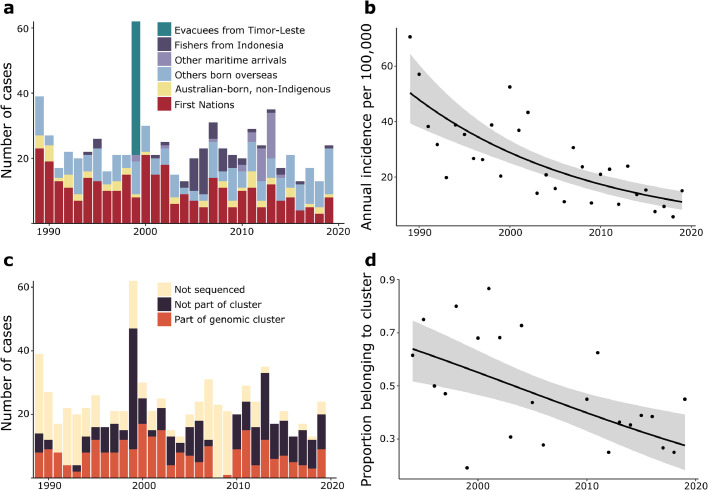
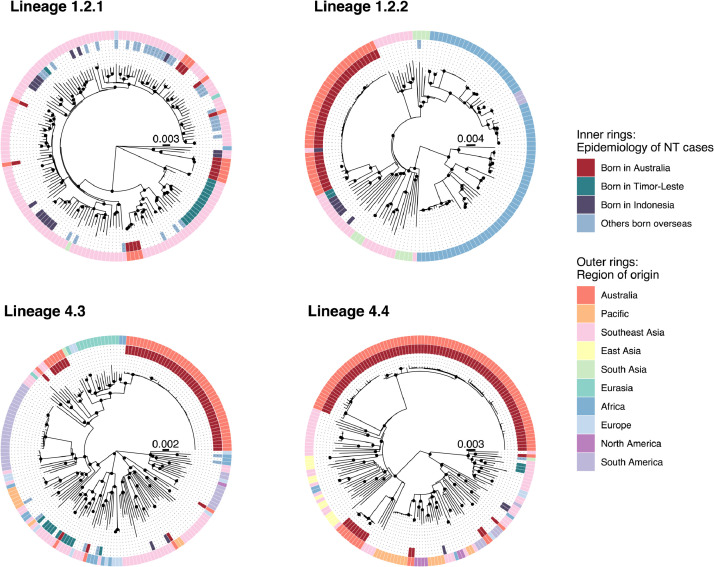
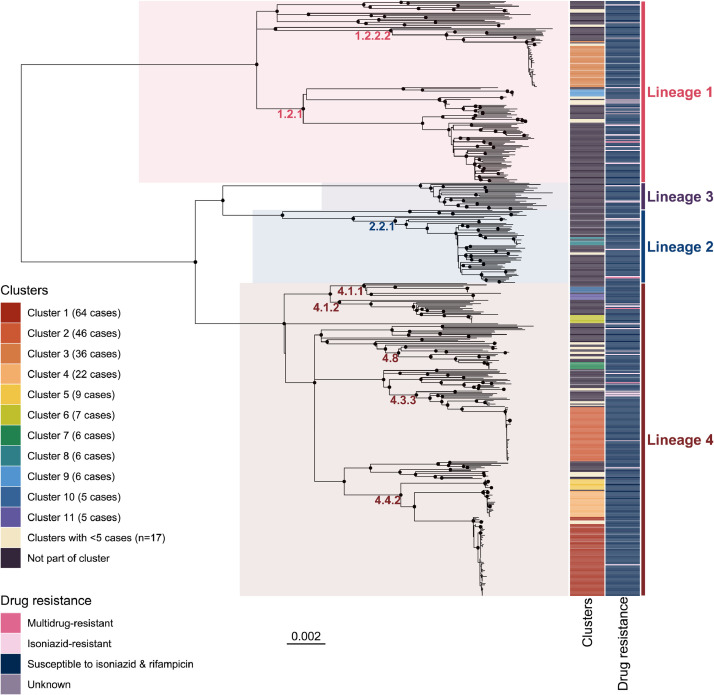
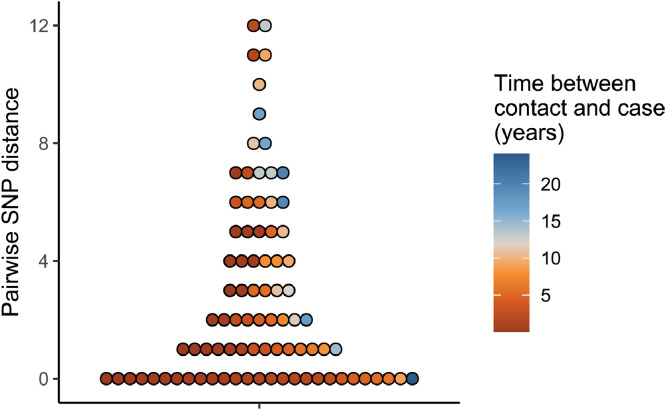
This retrospective observational study included all 741 culture-confirmed cases of TB in the Top End over three decades from 1989-2020. All 497 available isolates were sequenced. We used contact tracing data to define a threshold pairwise SNP distance for hierarchical single linkage clustering, and examined putative transmission clusters in the context of epidemiologic information.
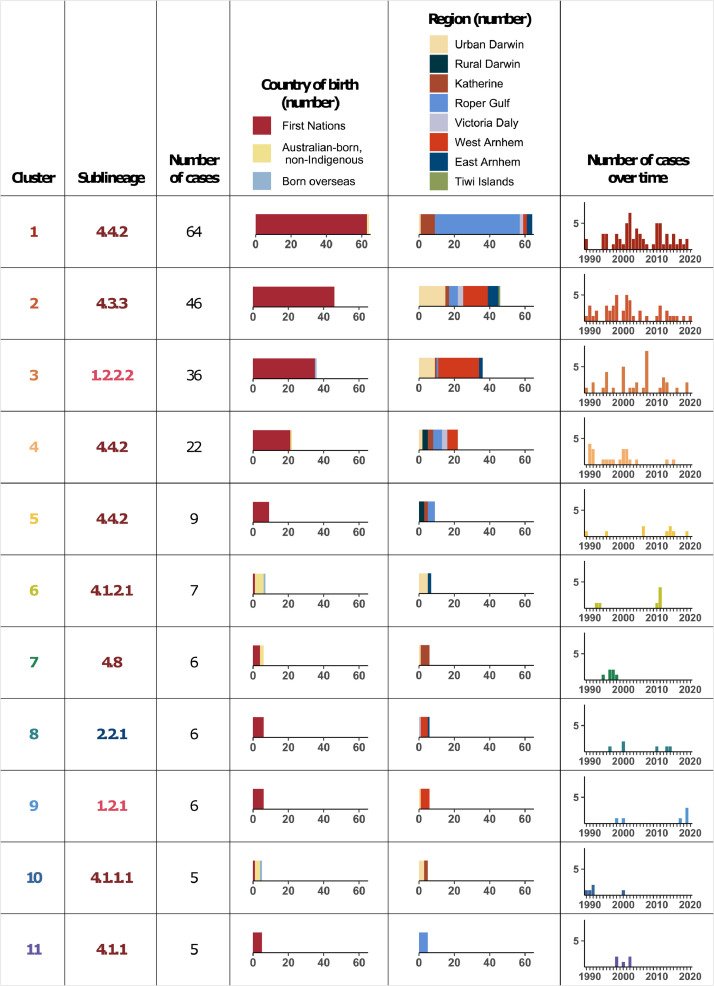
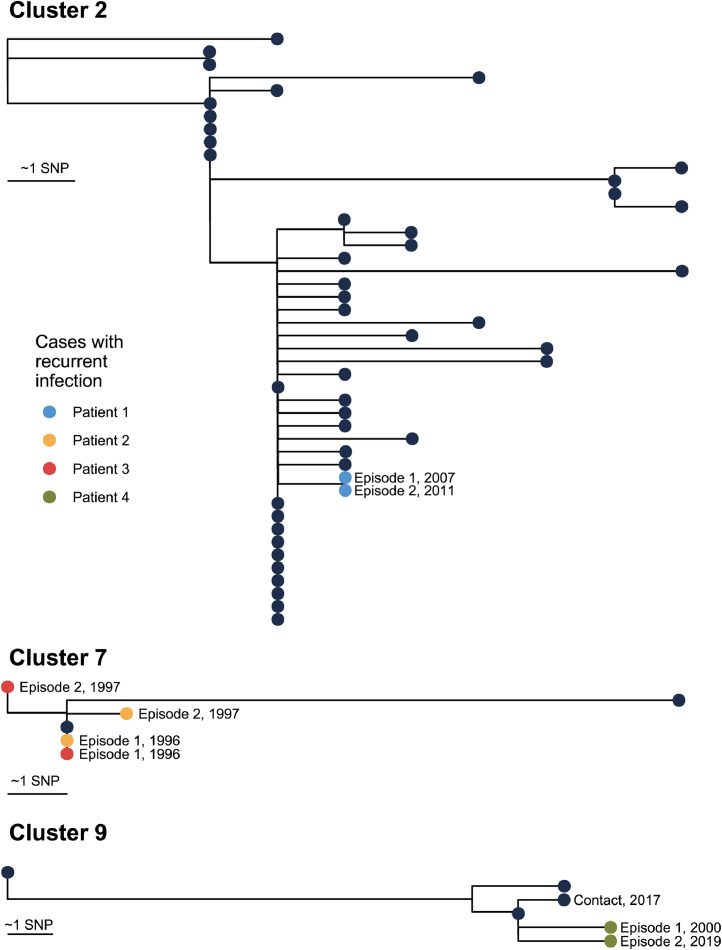
There were 359 (48%) cases born overseas, 329 (44%) cases among Australian First Nations peoples, and 52 (7%) cases were Australian-born and non-Indigenous. The annual incidence in First Nations peoples from 1989-2019 fell from average 50.4 to 11.0 per 100,000 (P<0·001). First Nations cases were more likely to die from TB (41/329, 12·5%) than overseas-born cases (11/359, 3·1%; P<0·001). Using a threshold of ≤12 SNPs, 28 clusters of between 2-64 individuals were identified, totalling 250 cases; 214 (86%) were First Nations cases and 189 (76%) were from a remote region. The time between cases and past epidemiologically- and genomically-linked contacts ranged from 4·5 months to 24 years.
Our findings support prioritisation of timely case detection, contact tracing augmented by genomic sequencing, and latent TB treatment to break transmission chains in Top End remote hotspot regions.
北领地(NT)是澳大利亚所有司法管辖区中结核病(TB)发病率最高的地区。我们将结核病公共卫生监测数据与北领地热带“顶端地区”分离株的基因组测序相结合,以调查结核病发病率和传播趋势。
这项回顾性观察性研究纳入了1989年至2020年三十年间顶端地区所有741例经培养确诊的结核病病例。对所有497株可用分离株进行了测序。我们使用接触者追踪数据来定义用于层次单连锁聚类的成对单核苷酸多态性(SNP)距离阈值,并在流行病学信息背景下检查推定的传播集群。
359例(48%)病例出生在海外,329例(44%)病例为澳大利亚原住民,52例(7%)病例为在澳大利亚出生的非原住民。1989年至2019年期间,原住民的年发病率从每10万人平均50.4例降至11.0例(P<0.001)。原住民病例死于结核病的可能性(41/329,12.5%)高于出生在海外的病例(11/359,3.1%;P<0.001)。使用≤12个SNP的阈值,确定了28个集群,每个集群有2至64人,共计250例病例;214例(86%)为原住民病例,189例(76%)来自偏远地区。病例与过去经流行病学和基因组学关联的接触者之间的时间间隔为4.5个月至24年。
我们的研究结果支持优先进行及时的病例检测、通过基因组测序加强接触者追踪以及进行潜伏性结核病治疗,以打破顶端地区偏远热点地区的传播链。