Department of Pediatrics, Qilu Hospital, Cheeloo College of Medicine, Shandong University, Jinan, Shandong 250012, P.R. China.
Int J Mol Med. 2021 Nov;48(5). doi: 10.3892/ijmm.2021.5035. Epub 2021 Sep 16.
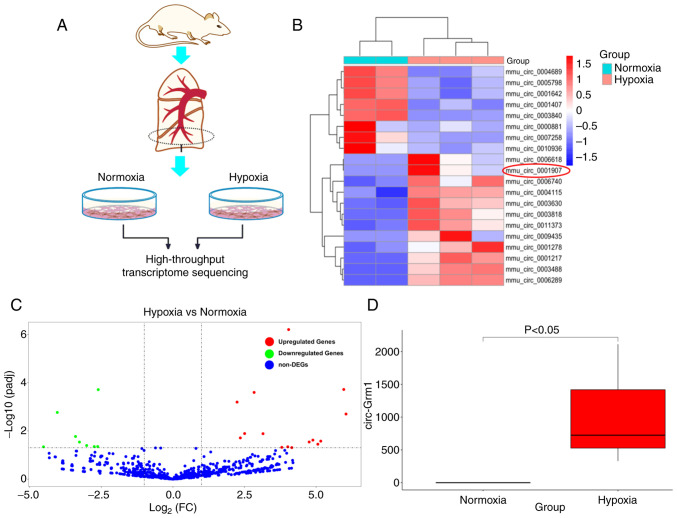
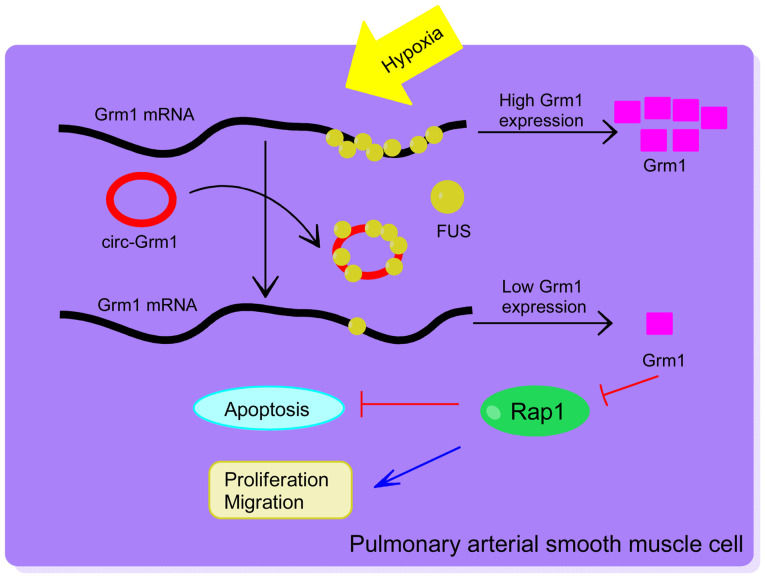
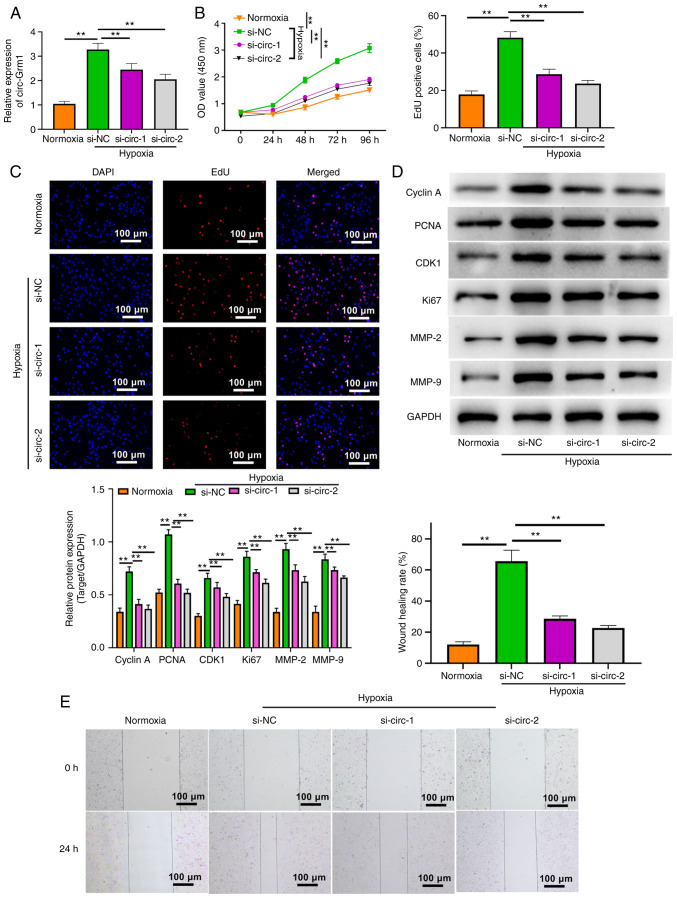
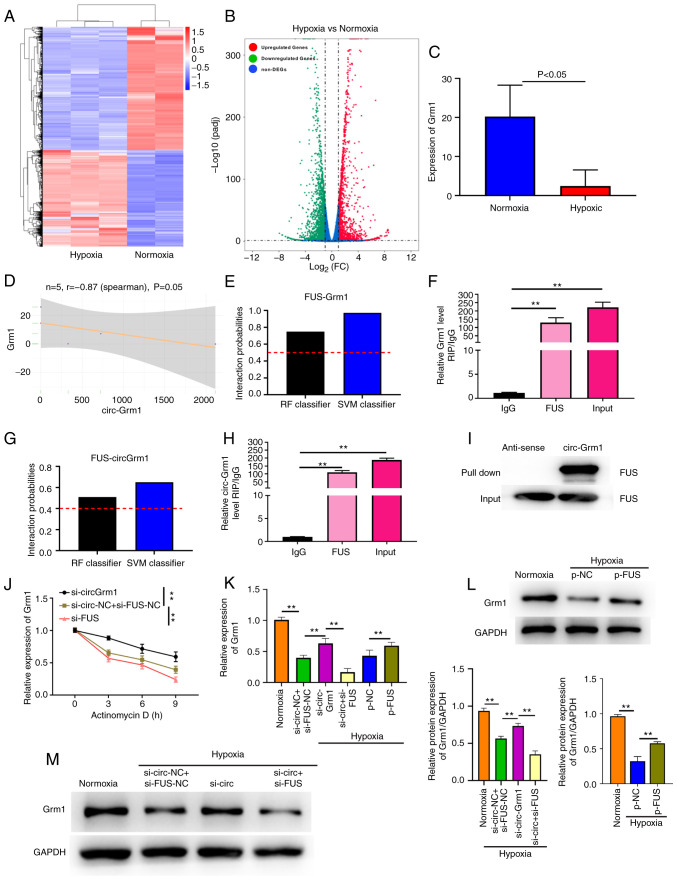
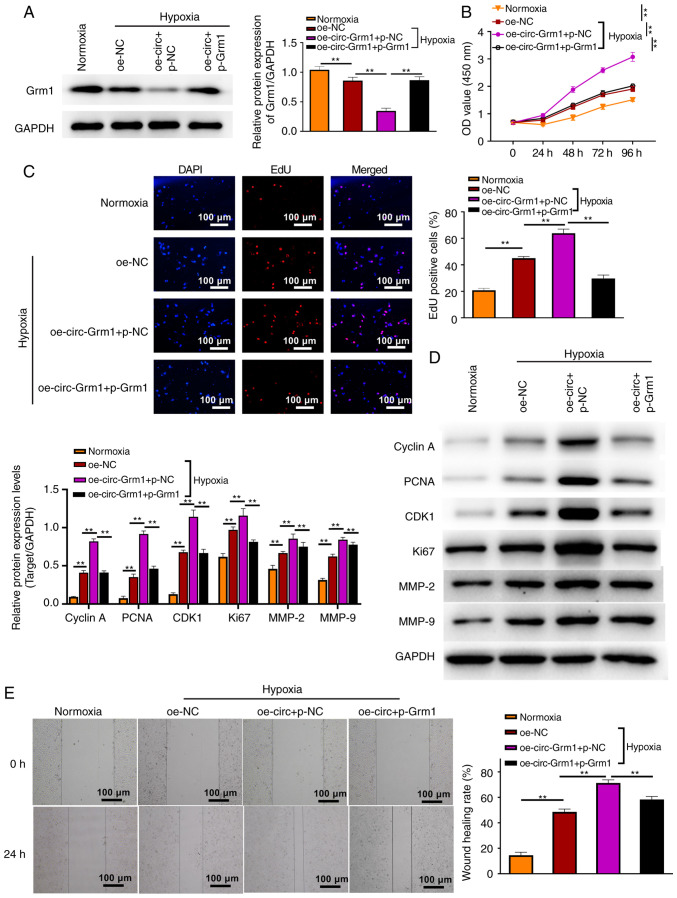
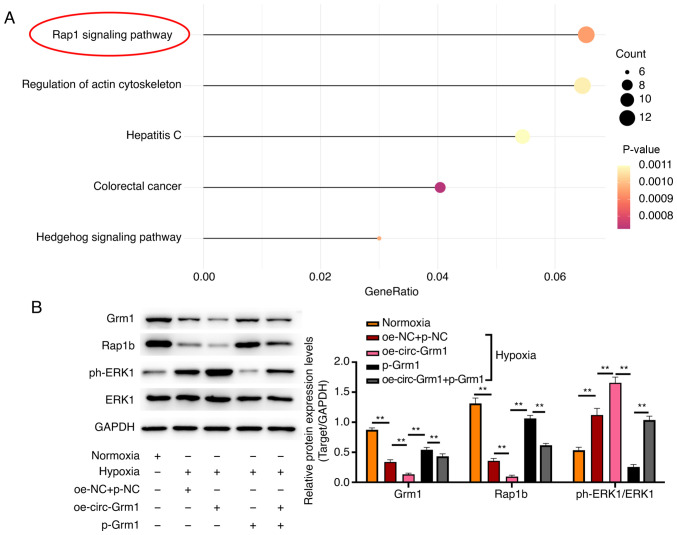
Pulmonary arterial hypertension is a progressive and fatal disease. Recent studies suggest that circular RNA (circRNAs/circs) can regulate various biological processes, including cell proliferation. Therefore, it is possible that circRNA may have important roles in pulmonary artery smooth muscle cell proliferation in hypoxic pulmonary hypertension (HPH). The aim of the present study was to determine the role and mechanism of circRNA‑glutamate metabotropic receptor 1 (circ‑Grm1; mmu_circ_0001907) in pulmonary artery smooth muscle cell (PASMC) proliferation and migration in HPH. High‑throughput transcriptome sequencing was used to screen circRNAs and targeted genes involved in HPH. Cell Counting Kit‑8 (CCK‑8), 5‑ethynyl‑2‑deoxyuridine and wound healing assays were employed to assess cell viability and migration. Reverse transcription‑quantitative PCR and western blotting were used to detect target gene expression in different groups. Bioinformatical approaches were used to predict the interaction probabilities of circ‑Grm1 and Grm1 with FUS RNA binding protein (FUS). The interactions of circ‑Grm1, Grm1 and FUS were evaluated using RNA silencing and RNA immunoprecipitation assays. The results demonstrated that circ‑Grm1 was upregulated in hypoxic PASMCs. Further experiments revealed that the knockdown of circ‑Grm1 could suppress the proliferation and migration of hypoxic PASMCs. Transcriptome sequencing revealed that Grm1 could be the target gene of circ‑Grm1. It was found that circ‑Grm1 could competitively bind to FUS and consequently downregulate Grm1. Moreover, Grm1 could inhibit the function of circ‑Grm1 by promoting the proliferative and migratory abilities of hypoxic PASMCs. The results also demonstrated that circ‑Grm1 influenced the biological functions of PASMCs via the Rap1/ERK pathway by regulating Grm1. Overall, the current results suggested that circ‑Grm1 was associated with HPH and promoted the proliferation and migration of PASMCs via suppression of Grm1 expression through FUS.
肺动脉高压是一种进行性和致命性疾病。最近的研究表明,环状 RNA(circRNA/ circs)可以调节多种生物过程,包括细胞增殖。因此,circRNA 可能在低氧性肺动脉高压(HPH)中的肺动脉平滑肌细胞增殖中发挥重要作用。本研究旨在确定环状 RNA-谷氨酸代谢型受体 1(circ-Grm1; mmu_circ_0001907)在 HPH 中肺动脉平滑肌细胞(PASMC)增殖和迁移中的作用和机制。高通量转录组测序用于筛选 HPH 中涉及的 circRNA 和靶向基因。使用细胞计数试剂盒-8(CCK-8)、5-乙炔基-2-脱氧尿苷和划痕愈合实验评估细胞活力和迁移。逆转录-定量 PCR 和蛋白质印迹法用于检测不同组中靶基因的表达。生物信息学方法用于预测 circ-Grm1 和 Grm1 与 FUS RNA 结合蛋白(FUS)的相互作用概率。使用 RNA 沉默和 RNA 免疫沉淀测定评估 circ-Grm1、Grm1 和 FUS 的相互作用。结果表明,circ-Grm1 在低氧 PASMC 中上调。进一步的实验表明,circ-Grm1 的敲低可抑制低氧 PASMC 的增殖和迁移。转录组测序显示,Grm1 可能是 circ-Grm1 的靶基因。结果发现,circ-Grm1 可以通过与 FUS 竞争结合并进而下调 Grm1 来发挥作用。此外,Grm1 通过促进低氧 PASMC 的增殖和迁移能力来抑制 circ-Grm1 的功能。结果还表明,circ-Grm1 通过调节 Grm1 影响 PASMC 的生物学功能,进而影响 Rap1/ERK 通路。总之,目前的研究结果表明,circ-Grm1 与 HPH 有关,并通过抑制 Grm1 表达通过 FUS 促进 PASMC 的增殖和迁移。