Black Dog Institute, Randwick, Australia.
University of New South Wales, Randwick, Australia.
J Med Internet Res. 2021 Sep 16;23(9):e28369. doi: 10.2196/28369.
Digital mental health interventions stand to play a critical role in managing the mental health impact of the COVID-19 pandemic. Thus, enhancing their uptake is a key priority. General practitioners (GPs) are well positioned to facilitate access to digital interventions, but tools that assist GPs in identifying suitable patients are lacking.
This study aims to evaluate the suitability of a web-based mental health screening and treatment recommendation tool (StepCare) for improving the identification of anxiety and depression in general practice and, subsequently, uptake of digital mental health interventions.
StepCare screens patients for symptoms of depression (9-item Patient Health Questionnaire) and anxiety (7-item Generalized Anxiety Disorder scale) in the GP waiting room. It provides GPs with stepped treatment recommendations that include digital mental health interventions for patients with mild to moderate symptoms. Patients (N=5138) from 85 general practices across Australia were invited to participate in screening.
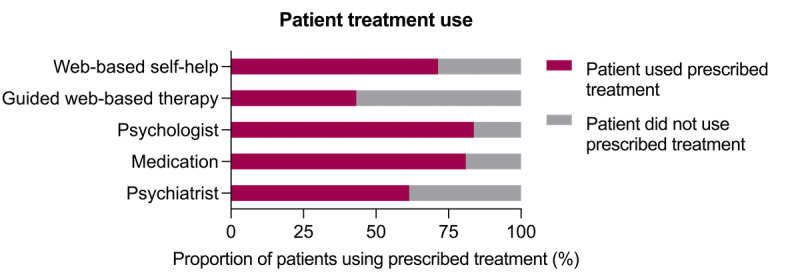
Screening identified depressive or anxious symptoms in 43.09% (1428/3314) of patients (one-quarter were previously unidentified or untreated). The majority (300/335, 89.6%) of previously unidentified or untreated patients had mild to moderate symptoms and were candidates for digital mental health interventions. Although less than half were prescribed a digital intervention by their GP, when a digital intervention was prescribed, more than two-thirds of patients reported using it.
Implementing web-based mental health screening in general practices can provide important opportunities for GPs to improve the identification of symptoms of mental illness and increase patient access to digital mental health interventions. Although GPs prescribed digital interventions less frequently than in-person psychotherapy or medication, the promising rates of uptake by GP-referred patients suggest that GPs can play a critical role in championing digital interventions and maximizing the associated benefits.
数字心理健康干预措施在应对 COVID-19 大流行对心理健康的影响方面发挥着关键作用。因此,提高其利用率是一个关键优先事项。全科医生(GP)非常适合促进获得数字干预措施,但缺乏帮助 GP 识别合适患者的工具。
本研究旨在评估基于网络的心理健康筛查和治疗推荐工具(StepCare)是否适合提高全科医疗中焦虑和抑郁的识别率,以及随后提高数字心理健康干预措施的利用率。
StepCare 在 GP 候诊室对患者进行抑郁(9 项患者健康问卷)和焦虑(7 项广泛性焦虑症量表)症状筛查。它为 GP 提供阶梯式治疗建议,包括轻度至中度症状患者的数字心理健康干预措施。来自澳大利亚 85 家全科诊所的 5138 名患者被邀请参与筛查。
筛查发现 43.09%(1428/3314)的患者存在抑郁或焦虑症状(四分之一为先前未被识别或未经治疗的患者)。大多数(300/335,89.6%)以前未被识别或未经治疗的患者存在轻度至中度症状,是数字心理健康干预措施的候选者。尽管不到一半的患者被 GP 开了数字干预处方,但当 GP 开了数字干预处方时,超过三分之二的患者表示使用了它。
在全科诊所实施基于网络的心理健康筛查可以为 GP 提供重要机会,以改善对精神疾病症状的识别,并增加患者获得数字心理健康干预措施的机会。尽管 GP 开具数字干预处方的频率低于面对面心理治疗或药物治疗,但 GP 转介患者的高使用率表明,GP 可以在倡导数字干预措施和最大化相关益处方面发挥关键作用。