Levine Sheen S, Reypens Charlotte, Stark David
The University of Texas at Dallas, Richardson, TX 75080, USA.
Columbia University, New York, NY 10027, USA.
Sci Adv. 2021 Sep 17;7(38):eabg9508. doi: 10.1126/sciadv.abg9508.
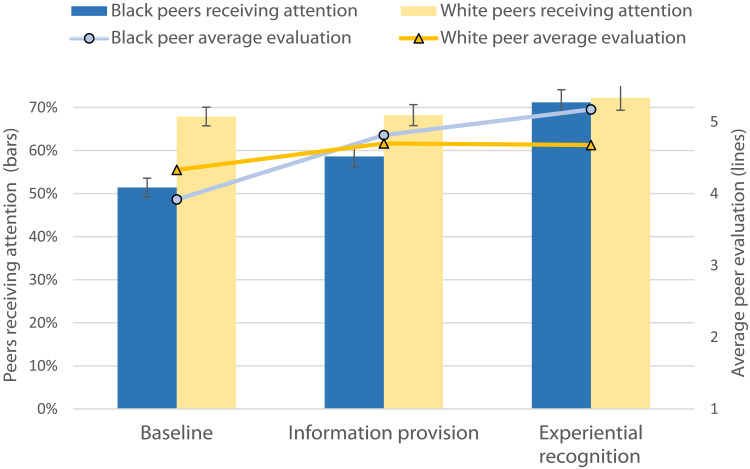
Despite efforts toward equity in organizations and institutions, minority members report that they are often ignored, their contributions undervalued. Against this backdrop, we conduct a large-sample, multiyear experimental study to investigate patterns of attention. The findings provide causal evidence of a racial attention deficit: Even when in their best interest, White Americans pay less attention to Black peers. In a baseline study, we assign an incentivized puzzle to participants and examine their willingness to follow the example of their White and Black peers. White participants presume that Black peers are less competent—and fail to learn from their choices. We then test two interventions: Providing information about past accomplishments reduces the disparity in evaluations of Black peers, but the racial attention deficit persists. When Whites can witness the accomplishments of Black peers, rather than being told about them, the racial attention deficit subsides. We suggest that such a deficit can explain racial gaps documented in science, education, health, and law.
尽管各组织和机构都在努力实现公平,但少数族裔成员报告称,他们常常被忽视,其贡献也被低估。在此背景下,我们开展了一项大样本、多年期的实验研究,以调查关注模式。研究结果提供了种族关注不足的因果证据:即使符合自身最大利益,美国白人对黑人同伴的关注也较少。在一项基线研究中,我们给参与者分配了一个有奖励的谜题,并考察他们效仿白人同伴和黑人同伴的意愿。白人参与者认为黑人同伴能力较差,且没有从他们的选择中学习。然后我们测试了两种干预措施:提供过去成就的信息减少了对黑人同伴评价的差距,但种族关注不足仍然存在。当白人能够亲眼目睹黑人同伴的成就,而不是被告知这些成就时,种族关注不足就会消退。我们认为,这种关注不足可以解释在科学、教育、健康和法律领域记录的种族差距。