Gardener Samantha L, Rainey-Smith Stephanie R, Weinborn Michael, Bondonno Catherine P, Martins Ralph N
School of Medical and Health Sciences, Edith Cowan University, Joondalup, WA, Australia.
Australian Alzheimer's Research Foundation, Ralph and Patricia Sarich Neuroscience Research Institute, Nedlands, WA, Australia.
Front Aging Neurosci. 2021 Sep 3;13:640381. doi: 10.3389/fnagi.2021.640381. eCollection 2021.
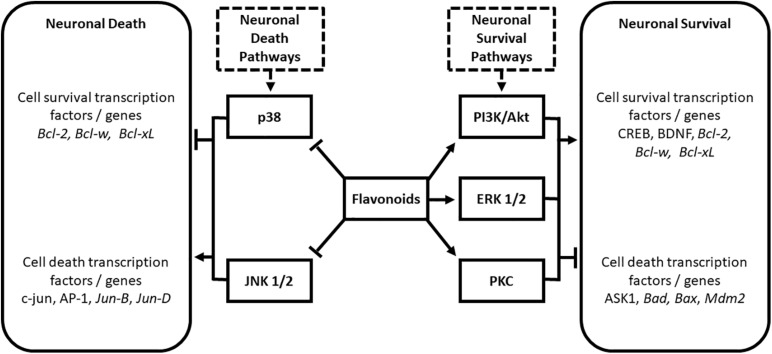
The purpose of this review is to examine human research studies published within the past 6 years which evaluate the role of anthocyanin, flavanol, and flavanone consumption in cognitive function, and to discuss potential mechanisms of action underlying any observed benefits. Evidence to date suggests the consumption of flavonoid-rich foods, such as berries and cocoa, may have the potential to limit, or even reverse, age-related declines in cognition. Over the last 6 years, the flavonoid subgroups of anthocyanins, flavanols, and flavanones have been shown to be beneficial in terms of conferring neuroprotection. The mechanisms by which flavonoids positively modulate cognitive function are yet to be fully elucidated. Postulated mechanisms include both direct actions such as receptor activation, neurotrophin release and intracellular signaling pathway modulation, and indirect actions such as enhancement of cerebral blood flow. Further intervention studies conducted in diverse populations with sufficient sample sizes and long durations are required to examine the effect of consumption of flavonoid groups on clinically relevant cognitive outcomes. As populations continue to focus on adopting healthy aging strategies, dietary interventions with flavonoids remains a promising avenue for future research. However, many questions are still to be answered, including identifying appropriate dosage, timeframes for intake, as well as the best form of flavonoids, before definitive conclusions can be drawn about the extent to which their consumption can protect the aging brain.
本综述的目的是审视过去6年内发表的关于评估花青素、黄烷醇和黄烷酮摄入对认知功能作用的人体研究,并探讨任何观察到的益处背后的潜在作用机制。迄今为止的证据表明,食用富含类黄酮的食物,如浆果和可可,可能有潜力限制甚至逆转与年龄相关的认知能力下降。在过去6年中,花青素、黄烷醇和黄烷酮这几类类黄酮已被证明在提供神经保护方面具有益处。类黄酮正向调节认知功能的机制尚未完全阐明。推测的机制包括直接作用,如受体激活、神经营养因子释放和细胞内信号通路调节,以及间接作用,如增强脑血流量。需要在不同人群中进行样本量充足且持续时间长的进一步干预研究,以检验类黄酮摄入对临床相关认知结果的影响。随着人们继续关注采取健康的衰老策略,类黄酮饮食干预仍是未来研究的一个有前景的途径。然而,在就类黄酮摄入对衰老大脑的保护程度得出明确结论之前,仍有许多问题有待解答,包括确定合适的剂量、摄入时间框架以及类黄酮的最佳形式。