Vera San Juan Norha, Gronholm Petra C, Heslin Margaret, Lawrence Vanessa, Bain Matthew, Okuma Ayako, Evans-Lacko Sara
Health Service & Population Research Department, Institute of Psychiatry, Psychology and Neuroscience, King's College London, London, United Kingdom.
Department of Psychology, University of Warwick, Coventry, United Kingdom.
Front Psychiatry. 2021 Sep 1;12:712026. doi: 10.3389/fpsyt.2021.712026. eCollection 2021.
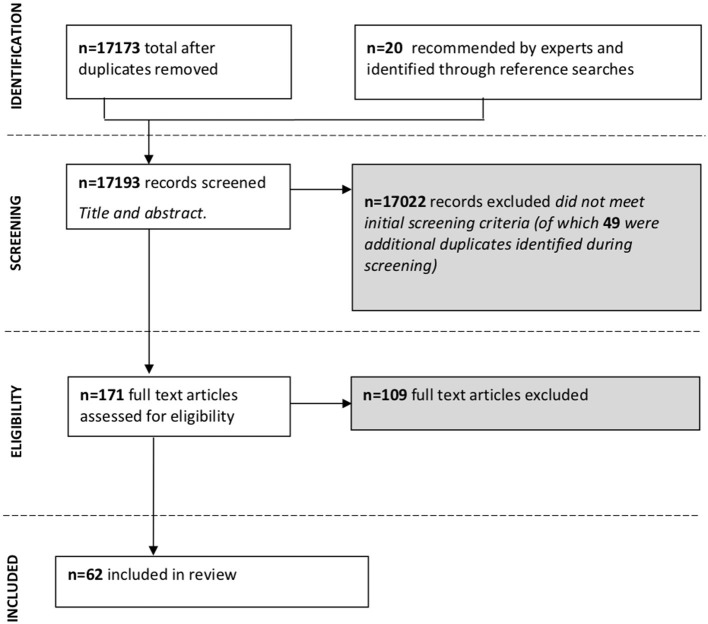
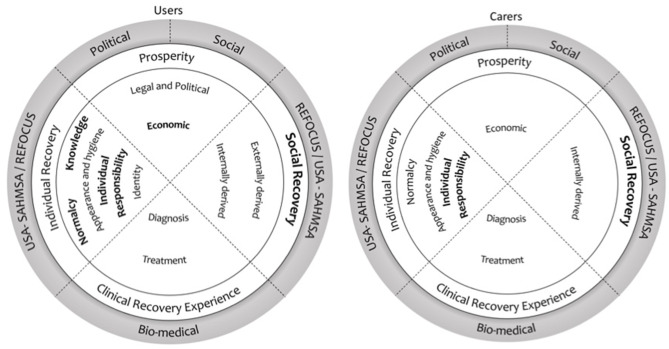
The recovery approach aims to have users' perspectives at the heart of service development and research; it is a holistic perspective that considers social needs, personal growth and inclusion. In the last decade recovery-oriented research and practice has increased greatly, however, a comprehensive model of recovery considering exclusively the perspectives of people with lived experience has not been devised. This review aimed to develop a framework and contextualize service users' and informal caregivers' understanding of recovery from severe mental health problems. We systematically searched 6 databases including key terms related to knowledge, experience and narratives AND mental health AND personal recovery. The search was supplemented with reference sourcing through gray literature, reference tracking and expert consultation. Data analysis consisted of a qualitative meta-synthesis using constant comparative methods. Sixty-two studies were analyzed. A pattern emerged regarding the recovery paradigms that the studies used to frame their findings. The resulting recovery framework included the domains Social recovery; Prosperity (Legal, political, and economic recovery); Individual Recovery; and Clinical Recovery Experience (SPICE). Service users' definitions of recovery tended to prioritize social aspects, particularly being accepted and connecting with others, while caregivers focused instead on clinical definitions of recovery such as symptom remission. Both groups emphasized individual aspects such as becoming self-sufficient and achieving personal goals, which was strongly linked with having economic means for independence. The recovery model provided by this review offers a template for further research in the field and a guide for policy and practice. Predominant definitions of recovery currently reflect understandings of mental health which focus on an individual perspective, while this review found an important emphasis on socio-political aspects. At the same time, only a small number of studies took place in low-income countries, focused on minoritized populations, or included caregivers' perspectives. These are important gaps in the literature that require further attention. : The review protocol was registered on PROSPERO (CRD42017076450); https://www.crd.york.ac.uk/prospero/display_record.php?RecordID=76450.
康复方法旨在将用户的观点置于服务发展和研究的核心;这是一种整体观点,考虑到社会需求、个人成长和包容性。在过去十年中,以康复为导向的研究和实践大幅增加,然而,尚未设计出一个专门考虑有实际生活经验者观点的全面康复模型。本综述旨在构建一个框架,并将服务使用者和非正式照料者对从严重心理健康问题中康复的理解置于具体情境中。我们系统地检索了6个数据库,包括与知识、经验和叙事以及心理健康和个人康复相关的关键词。通过灰色文献、参考文献追踪和专家咨询对检索进行补充。数据分析包括使用持续比较法进行的定性元综合。分析了62项研究。关于这些研究用于构建其研究结果的康复范式出现了一种模式。由此产生的康复框架包括社会康复领域;繁荣(法律、政治和经济康复);个人康复;以及临床康复体验(SPICE)。服务使用者对康复的定义往往优先考虑社会方面,特别是被他人接受并与他人建立联系,而照料者则更关注康复的临床定义,如症状缓解。两组都强调个人方面,如实现自给自足和达成个人目标,这与拥有经济独立手段密切相关。本综述提供的康复模型为该领域的进一步研究提供了一个模板,并为政策和实践提供了指导。目前康复的主要定义反映了对心理健康的理解,这种理解侧重于个人视角,而本综述发现对社会政治方面有重要强调。同时,只有少数研究在低收入国家进行,关注少数群体,或纳入了照料者的观点。这些是文献中的重要空白,需要进一步关注。:该综述方案已在PROSPERO(CRD42017076450)上注册;https://www.crd.york.ac.uk/prospero/display_record.php?RecordID=76450 。