Zhuang Yu, Huang Huijun, Liu Shuang, Liu Feng, Tu Qiang, Yin Yulong, He Shanping
State Key Laboratory of Developmental Biology of Freshwater Fish, Hunan Provincial Key Laboratory of Animal Intestinal Function and Regulation, Hunan Normal University, Changsha, China.
Jiangxi Provincial Key Laboratory for Animal Health, Institute of Animal Population Health, College of Animal Science and Technology, Jiangxi Agricultural University, Nanchang, China.
Front Microbiol. 2021 Sep 3;12:726878. doi: 10.3389/fmicb.2021.726878. eCollection 2021.
Resveratrol (RSV) plays a vital role in alleviating various stresses and improving intestinal health. The current study was conducted to explore whether RSV alleviates weaning stress through improving gut health in a weaning mouse model. Forty 21-day-old weaned mice were randomly assigned to a control group without RSV treatment and three treatment groups with 10, 20, and 50 mg/kg RSV for 28 days.
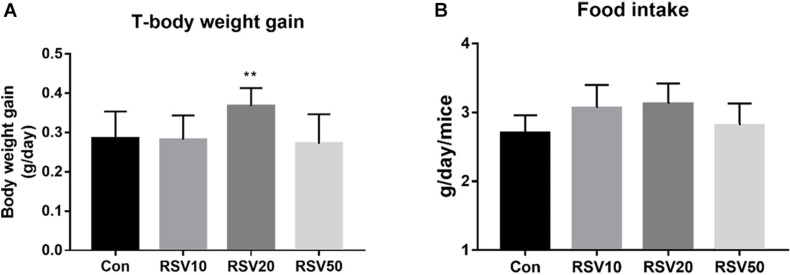
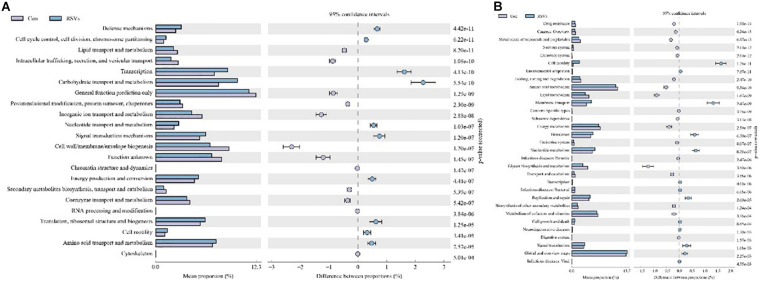
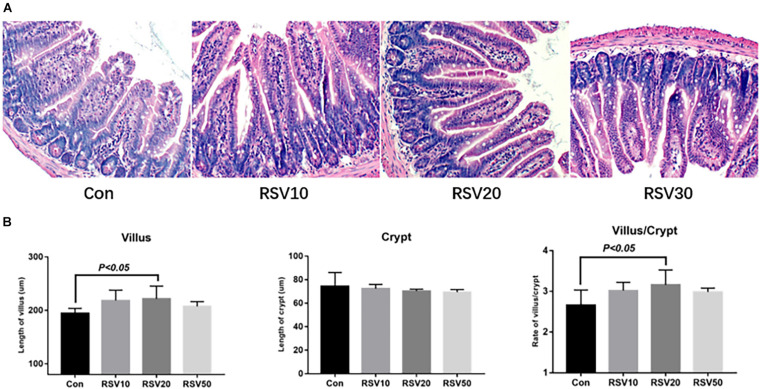
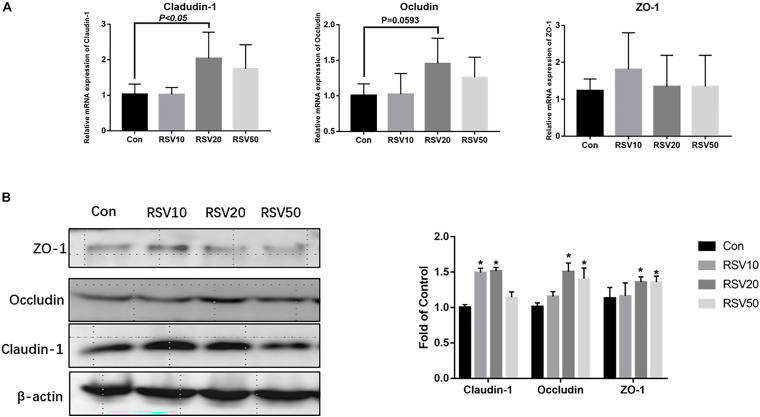
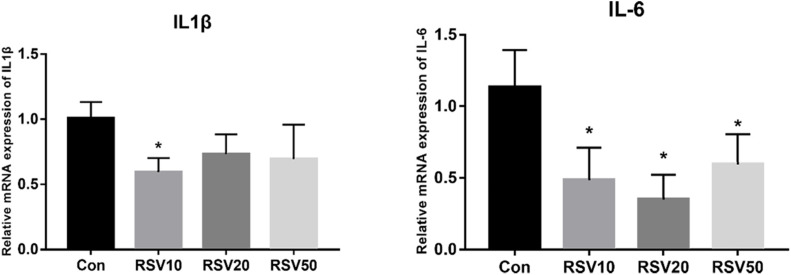
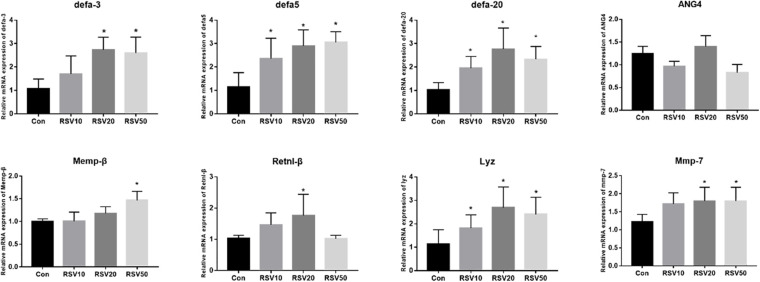
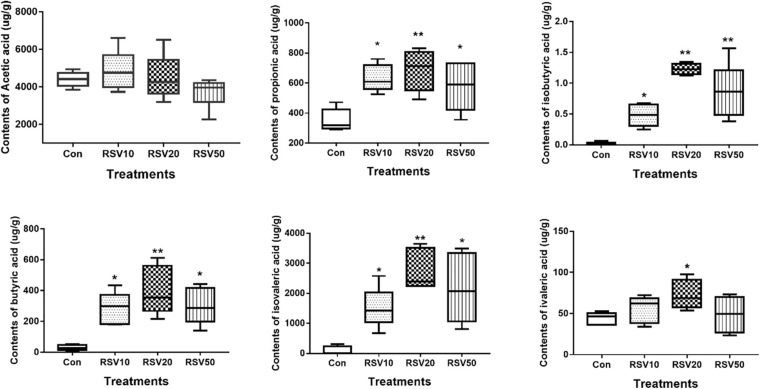
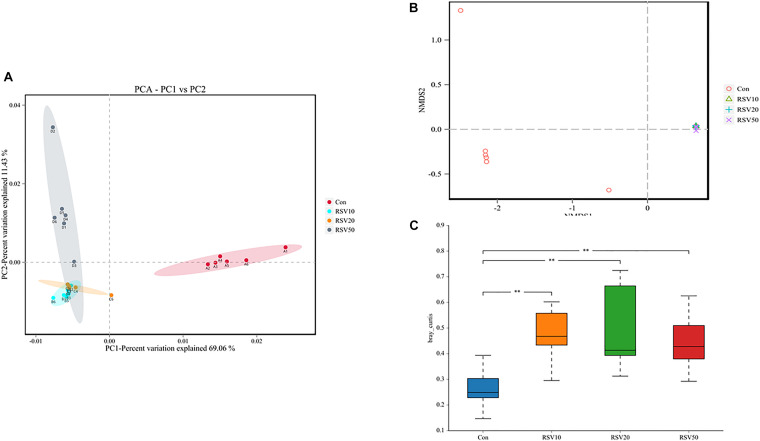
The results showed that RSV at a dose of 20 mg/kg improved total body weight, intestinal morphology (villus length and the ratio of villus length to crypt depth), and the levels of intestinal barrier proteins (claudin-1 and occludin), but had little effect on the food intake, crypt depth, and serum free amino acids of mice. Compared with the control group, mice supplemented with RSV had decreased mRNA expression of genes related to inflammatory cytokines (IL-6 and IL-1β), but increased mRNA expression of genes related to host defense peptides (Defa3, Defa5, Defa20, and Lyz) and short-chain fatty acids (SCFAs) production (propionic acid, isobutyric acid, butyric acid, and isovaleric acid). In addition, 16S rRNA sequencing results showed that RSV supplementation increased the richness indices of intestinal microbiota (Chao, ACE) and shaped the composition of intestinal microbiota (e.g., increased β-diversity of intestinal microbiota community). Meanwhile, RSV supplementation increased genes of , , and , which are producers of SCFAs. Furthermore, RSV supplementation significantly influenced the metabolism of intestinal microbiota, namely, amino acids metabolism, lipid metabolism, and defense mechanisms.
RSV can improve growth performance and intestinal morphology in weaning mice, possibly through improving gut immune response and microbiota function.
白藜芦醇(RSV)在缓解各种应激和改善肠道健康方面发挥着至关重要的作用。本研究旨在探讨RSV是否通过改善断奶小鼠模型的肠道健康来缓解断奶应激。将40只21日龄的断奶小鼠随机分为未接受RSV治疗的对照组和接受10、20和50 mg/kg RSV治疗的三个治疗组,持续28天。
结果表明,20 mg/kg剂量的RSV可改善小鼠的总体重、肠道形态(绒毛长度以及绒毛长度与隐窝深度之比)和肠道屏障蛋白(claudin-1和occludin)水平,但对小鼠的食物摄入量、隐窝深度和血清游离氨基酸影响较小。与对照组相比,补充RSV的小鼠炎症细胞因子相关基因(IL-6和IL-1β)的mRNA表达降低,但宿主防御肽相关基因(Defa3、Defa5、Defa20和Lyz)和短链脂肪酸(SCFAs)产生相关基因(丙酸、异丁酸、丁酸和异戊酸)的mRNA表达增加。此外,16S rRNA测序结果表明,补充RSV可增加肠道微生物群的丰富度指数(Chao、ACE)并塑造肠道微生物群的组成(例如,增加肠道微生物群群落的β多样性)。同时,补充RSV增加了SCFAs产生菌的 、 和 基因。此外,补充RSV显著影响肠道微生物群的代谢,即氨基酸代谢、脂质代谢和防御机制。
RSV可能通过改善肠道免疫反应和微生物群功能来提高断奶小鼠的生长性能和肠道形态。