Fang Ting, Bai Yiwei, Huang Wenxuan, Wu Yueying, Yuan Zhihui, Luan Xiaoyan, Liu Xinlei, Sun Lianjun
State Key Laboratory of Agrobiotechnology, Beijing Key Laboratory for Crop Genetic Improvement and College of Agronomy and Biotechnology, China Agricultural University, Beijing, China.
Institute of Soybean Research, Heilongjiang Provincial Academy of Agricultural Sciences, Harbin, China.
Front Genet. 2021 Sep 1;12:717770. doi: 10.3389/fgene.2021.717770. eCollection 2021.
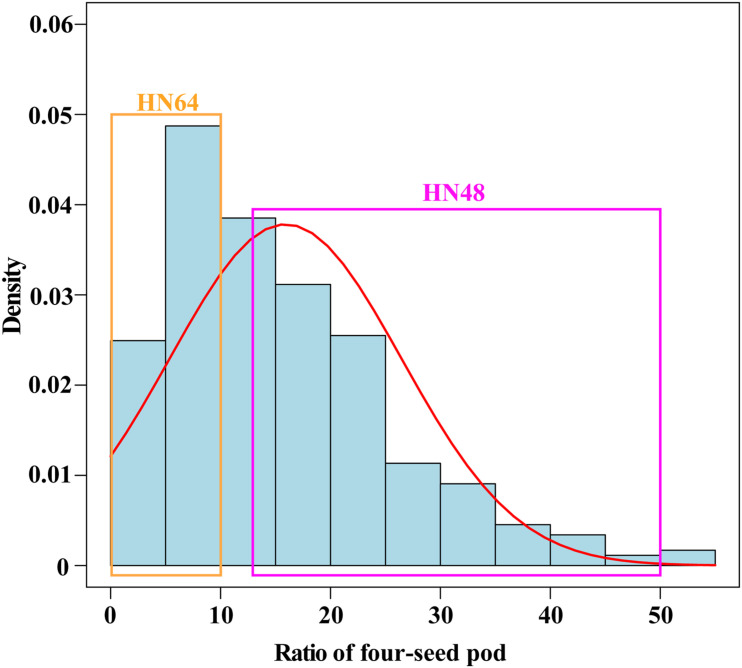
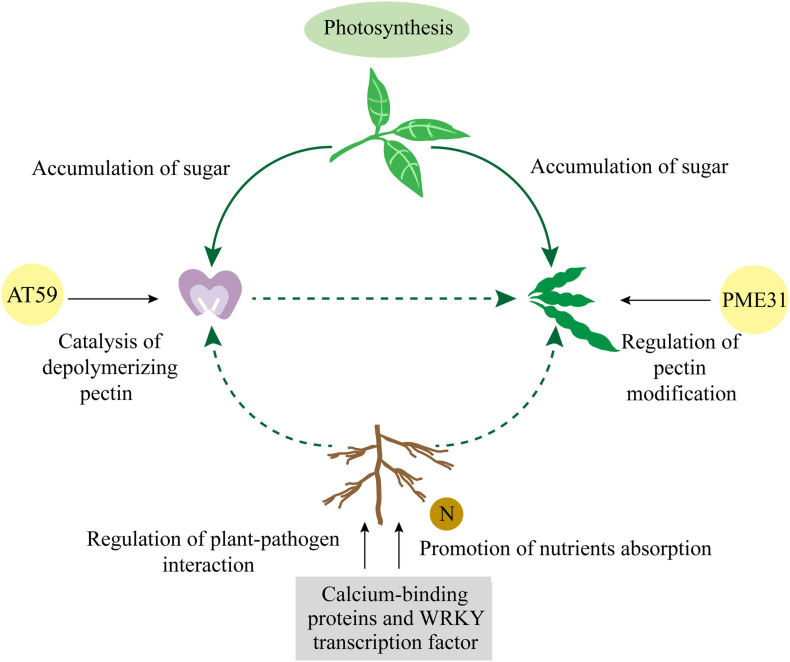
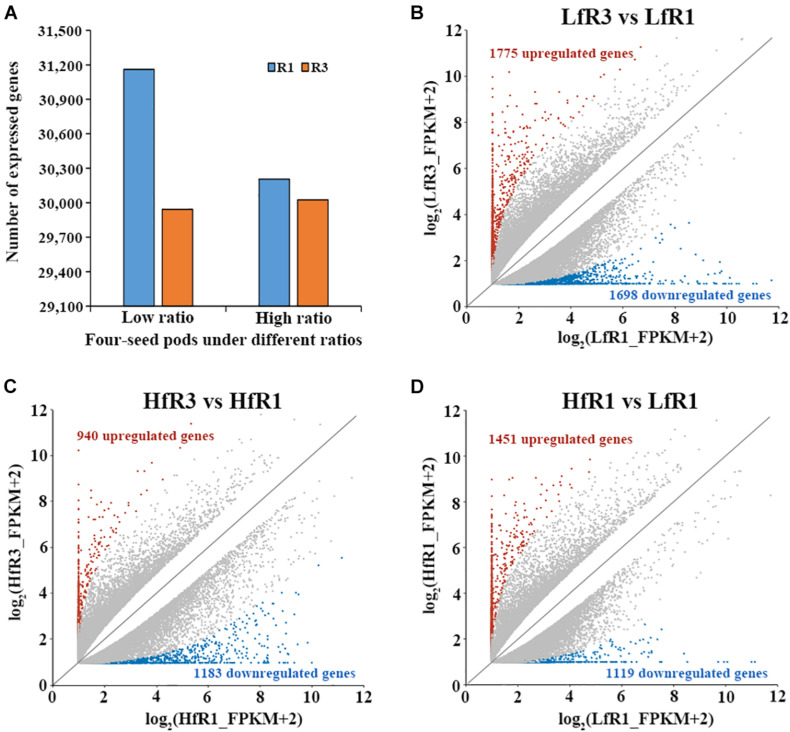
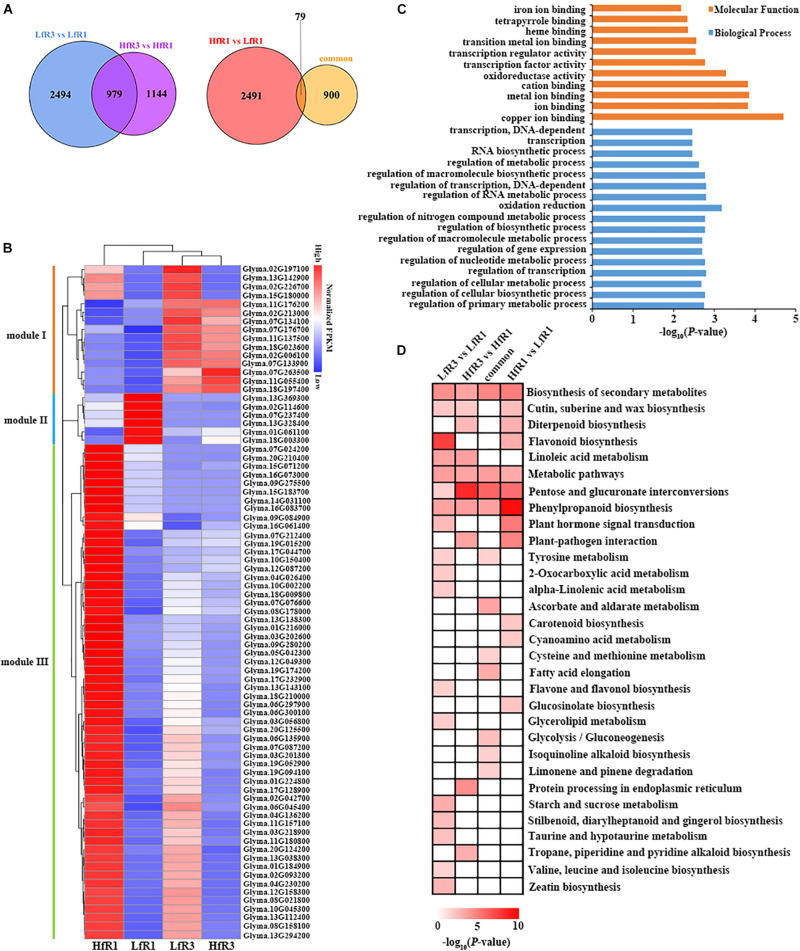
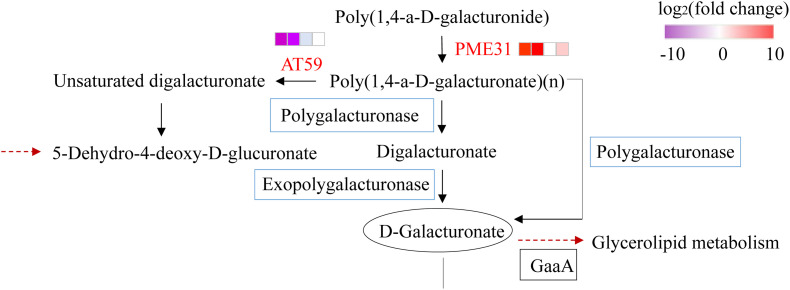
The number of four-seed pods is one of the most important agronomic traits affected by gene and environment that can potentially improve soybean () yield. However, the gene regulatory network that affects the ratio of four-seed pod (the ratio of the number of four-seed pods to the total number of pods in each individual plant) is yet unclear. Here, we performed bulked segregant RNA sequencing (BSR-seq) on a series of recombinant inbred lines (RILs) derived from hybrid progenies between Heinong 48 (HN48), a cultivar with a high ratio of four-seed pod, and Henong 64 (HN64), a cultivar with a low ratio of four-seed pod. Two tissues, flower bud and young pod, at two different growth stages, R1 and R3, were analyzed under the ratios of four-seed pod at less than 10% and greater than 30%, respectively. To identify the potential gene regulation pathways associated with the ratio of soybean four-seed pod, we performed differentially expressed analysis on the four bulked groups. A differentially expressed gene (DEG) encoding a photosystem II 5-kDa protein had the function of participating in the energy conversion of photosynthesis. In addition, 79 common DEGs were identified at different developmental stages and under different ratios of four-seed pod. Among them, four genes encoding calcium-binding proteins and a WRKY transcription factor were enriched in the plant-pathogen interaction pathway, and they showed a high level of expression in roots. Moreover, 10 DEGs were identified in the reported quantitative trait locus (QTL) interval of four-seed pod, and two of them were significantly enriched in the pentose and glucuronate interconversion pathway. These findings provide basic insights into the understanding of the underlying gene regulatory network affected by specific environment and lay the foundation for identifying the targets that affect the ratio of four-seed pod in soybean.
四粒荚数量是受基因和环境影响的最重要农艺性状之一,它有可能提高大豆产量。然而,影响四粒荚比例(每株植物四粒荚数量与总荚数的比例)的基因调控网络尚不清楚。在此,我们对一系列重组自交系(RIL)进行了混合分组RNA测序(BSR-seq),这些重组自交系源自四粒荚比例高的品种黑农48(HN48)与四粒荚比例低的品种黑农64(HN64)之间的杂交后代。分别在R1和R3两个不同生长阶段,对四粒荚比例低于10%和高于30%的两种组织(花芽和幼荚)进行了分析。为了确定与大豆四粒荚比例相关的潜在基因调控途径,我们对四个混合组进行了差异表达分析。一个编码光系统II 5 kDa蛋白的差异表达基因具有参与光合作用能量转换的功能。此外,在不同发育阶段和不同四粒荚比例下鉴定出79个共同的差异表达基因。其中,四个编码钙结合蛋白的基因和一个WRKY转录因子在植物-病原体相互作用途径中富集,并且它们在根中表现出高水平表达。此外,在已报道的四粒荚数量性状位点(QTL)区间内鉴定出10个差异表达基因,其中两个在戊糖和葡糖醛酸相互转化途径中显著富集。这些发现为理解受特定环境影响的潜在基因调控网络提供了基本见解,并为鉴定影响大豆四粒荚比例的靶点奠定了基础。