Edwards Matthew K, Valdivieso Manuel, Leey Julio A, Portillo-Romero Jessica
School of Medicine, Case Western Reserve University, Cleveland, USA.
Medicine, University of Michigan, Ann Arbor, USA.
Cureus. 2021 Aug 16;13(8):e17224. doi: 10.7759/cureus.17224. eCollection 2021 Aug.
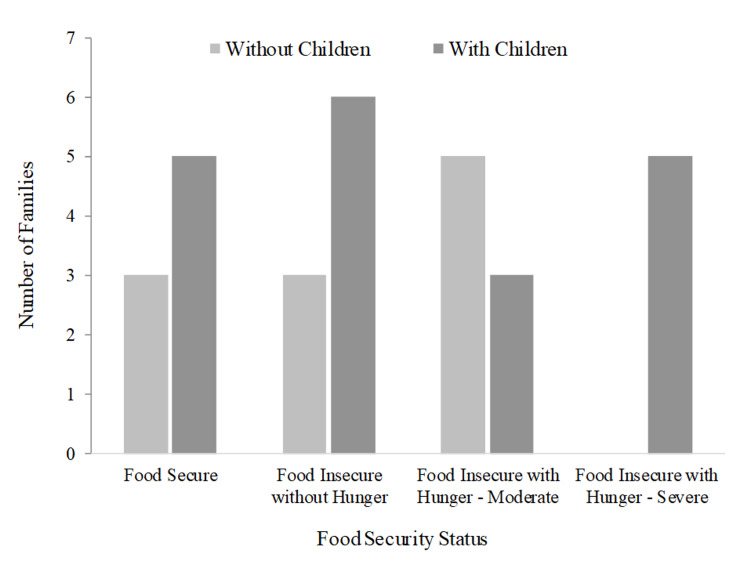
Introduction Food insecurity directly influences health outcomes and is an important consideration for medical missions seeking to address chronic disease, particularly those serving disaster-prone communities. The region of Peru in which we held an inaugural mission is vulnerable to developing food insecurity following natural disasters. We, therefore, sought to evaluate food insecurity to understand the community's needs and inform future public health efforts. Methods In this cross-sectional pilot study, a convenience sample representing the households of patients attending a student-run health fair at the community medical center in Chincha, Peru was assessed for food insecurity. An adult female ( = 30) of each randomly selected family attending the fair was asked to complete the Household Food Security Survey (HFSS) developed by the US Department of Agriculture. The survey items were aggregated into a single, continuous food security scale reflecting the severity of hunger within a household. Results Two-thirds of respondents ( = 20) acknowledged anxiety about having enough food at home over the past 12 months, making it the most common concern. Nearly three in five respondents were concerned about their ability to provide a balanced diet. We found that 16.7% of all households were food insecure with severe hunger, 26.7% were food insecure with moderate hunger, 30% were food insecure without hunger, and 26.7% were food secure. Conclusion Nearly three-quarters of families attending our clinic experience some degree of food insecurity. Families with children were disproportionately affected. The high levels of food insecurity many years after a natural disaster support the development of future social programs such as food pantries. We intend to continue our partnership in Chincha and perform the HFSS survey on a periodic basis to monitor hunger.
引言
粮食不安全直接影响健康结果,对于致力于解决慢性病问题的医疗任务而言,尤其是那些服务于易受灾社区的任务,这是一个重要的考量因素。我们开展首次任务的秘鲁地区在自然灾害后容易出现粮食不安全问题。因此,我们试图评估粮食不安全状况,以了解社区需求并为未来的公共卫生工作提供信息。
方法
在这项横断面试点研究中,我们对秘鲁钦查社区医疗中心一场由学生组织的健康集市上就诊患者家庭的便利样本进行了粮食不安全状况评估。要求每个随机抽取的参加集市家庭中的一名成年女性(n = 30)完成由美国农业部编制的《家庭粮食安全调查》(HFSS)。调查项目被汇总成一个单一的连续粮食安全量表,反映家庭内饥饿的严重程度。
结果
三分之二的受访者(n = 20)承认在过去12个月里担心家里没有足够的食物,这是最常见的担忧。近五分之三的受访者担心自己能否提供均衡饮食。我们发现,所有家庭中有16.7%处于严重饥饿的粮食不安全状态,26.7%处于中度饥饿的粮食不安全状态,30%处于无饥饿的粮食不安全状态,26.7%粮食安全。
结论
在我们诊所就诊的家庭中,近四分之三经历了某种程度的粮食不安全。有孩子的家庭受到的影响尤为严重。自然灾害多年后粮食不安全程度居高不下,这支持了未来诸如食品救济站等社会项目的开展。我们打算继续在钦查开展合作,并定期进行《家庭粮食安全调查》以监测饥饿情况。