Ramalingam Sudha, Radhakrishnan Shanmugasundaram, Kaliappan Tamilarasu, Gopalan Rajendiran, Subrahmanian Meenu, Sankaran Ramalingam
PSG Center for Molecular Medicine and Therapeutics, PSG Institute of Medical Sciences and Research, Coimbatore, Tamil Nadu, India.
Department of Cardiology, PSG Hospitals, Coimbatore, Tamil Nadu, India.
J Clin Transl Res. 2021 Jul 30;7(4):501-510. eCollection 2021 Aug 26.
The incidence of heart failure (HF) is rising to epidemic proportions in developing countries like India. A lack of adequate Indian studies underscores the importance of pursuing research into HF in an Indian population. G protein-coupled receptor kinase 5 ( Gln41>Leu (rs2230345) polymorphism was reported as a genetic modifier associated with survival in HF patients. A prospective study was conducted to investigate the association of Gln41>Leu polymorphism with response to β-blocker therapy in Indian HF patients.
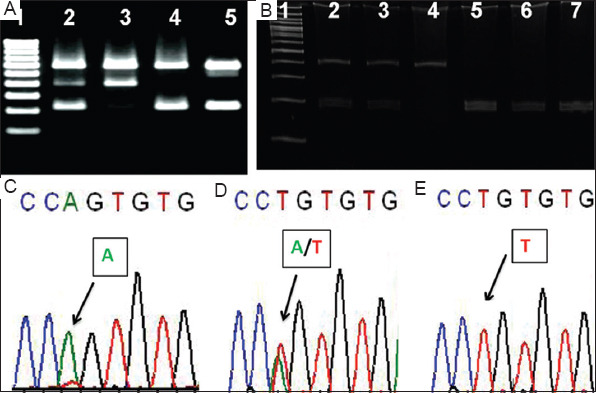
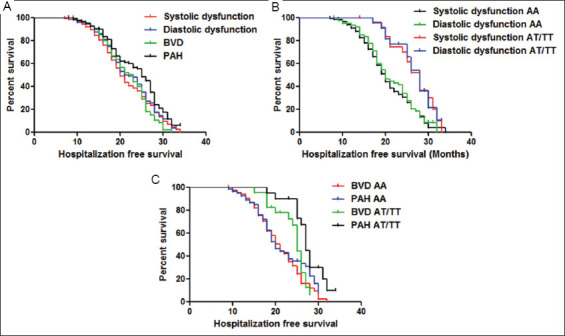
HF patients (=584) were recruited for the study. The patients were genotyped by tetra-primer based allele specific polymerase chain reaction and confirmed with Sanger sequencing. The HF patients were evaluated for gene expression and followed up for ~3 years. Drug dosages, cardiac output and hospitalization-free survival were evaluated as study outcomes. HF subgroups (i.e. systolic or diastolic dysfunction, biventricular dysfunction and pulmonary artery hypertension) were also analyzed in association with hospital-free survival.
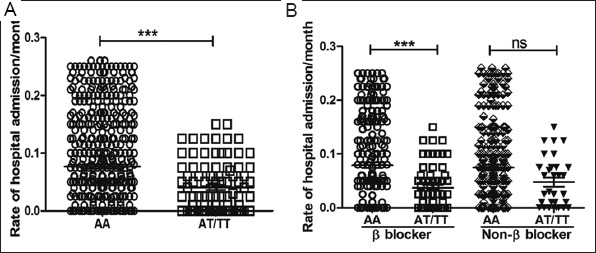
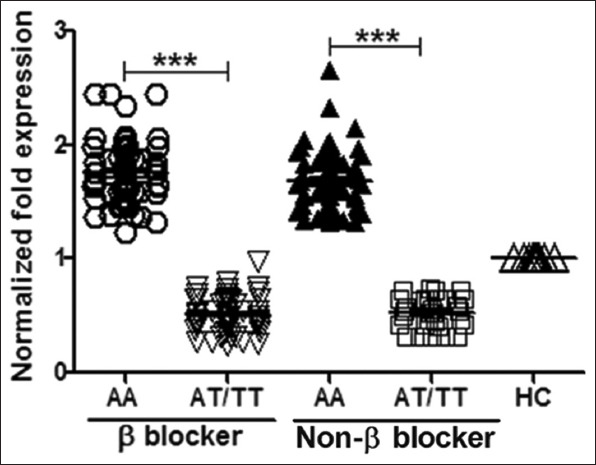
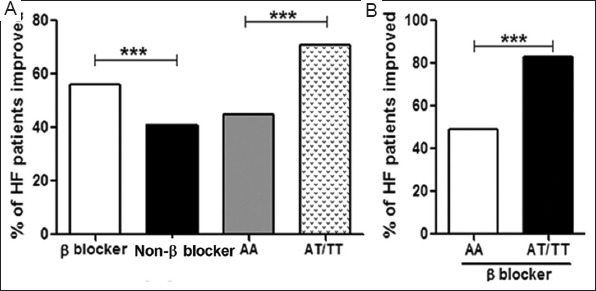
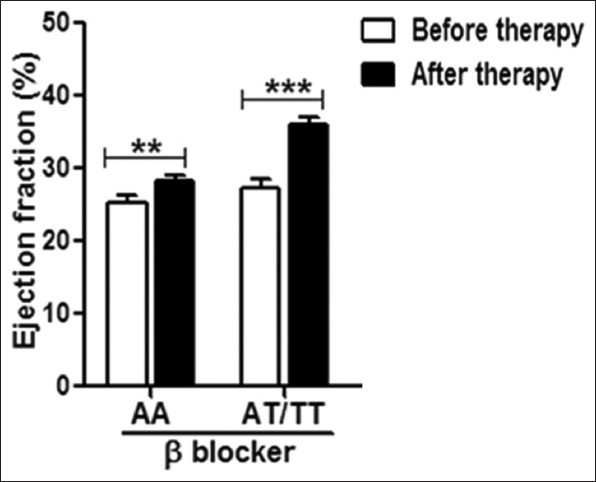
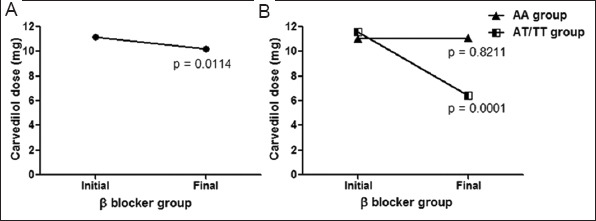
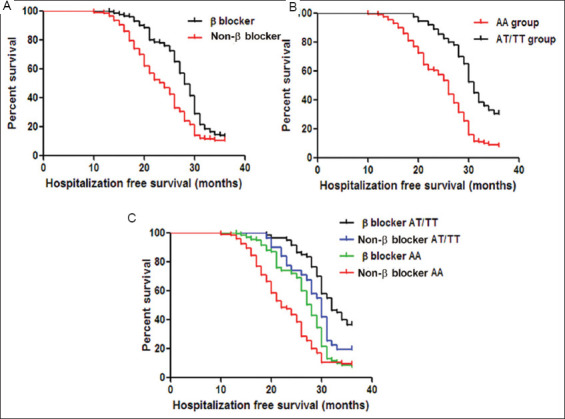
HF patients showed genotype frequencies of AT (15%) and TT (1%). AT/TT genotype carriers showed downregulated gene expression and significant reduction in carvedilol drug dosage (0.0001). Moreover, AT/TT genotype carriers on β-blockers showed improved ejection fraction from 27% to 36% (=0.0007) and increased hospitalization-free survival in comparison to other HF patients. HF patients with AA genotype showed an increased rate of hospital admission in comparison with patients with the AT/TT genotype. HF subgroups with the AT/TT genotype showed an increased hospitalization-free survival versus subgroups with the AA genotype.
Gln41>Leu polymorphism in response to β-blocker therapy improved cardiac function in HF patients.
This study presents a comprehensive clinicofunctional pharmacogenetic characterization of Gln41>Leu polymorphism in a cohort of Indian HF patients. Gln41>Leu polymorphism can confer improved cardiac function and reduce hospitalization, thus improving the quality of life in HF patients.
在印度等发展中国家,心力衰竭(HF)的发病率正呈流行趋势上升。印度缺乏足够的相关研究,这凸显了在印度人群中开展心力衰竭研究的重要性。据报道,G蛋白偶联受体激酶5(Gln41>Leu,rs2230345)多态性是与心力衰竭患者生存率相关的一种基因修饰因子。本研究旨在探讨Gln41>Leu多态性与印度心力衰竭患者β受体阻滞剂治疗反应之间的关联。
招募了584例心力衰竭患者参与本研究。采用四引物等位基因特异性聚合酶链反应对患者进行基因分型,并通过桑格测序进行确认。对心力衰竭患者的基因表达进行评估,并随访约3年。将药物剂量、心输出量和无住院生存率作为研究结局进行评估。还分析了心力衰竭亚组(即收缩性或舒张性功能障碍、双心室功能障碍和肺动脉高压)与无住院生存率的相关性。
心力衰竭患者中AT基因型频率为15%,TT基因型频率为1%。AT/TT基因型携带者的基因表达下调,卡维地洛药物剂量显著降低(P<0.0001)。此外,接受β受体阻滞剂治疗的AT/TT基因型携带者的射血分数从27%提高到了36%(P = 0.0007),与其他心力衰竭患者相比,无住院生存率有所提高。AA基因型的心力衰竭患者与AT/TT基因型患者相比,住院率更高。AT/TT基因型的心力衰竭亚组与AA基因型亚组相比,无住院生存率更高。
Gln41>Leu多态性对β受体阻滞剂治疗的反应可改善心力衰竭患者的心脏功能。
本研究对一组印度心力衰竭患者的Gln41>Leu多态性进行了全面的临床功能药物遗传学特征分析。Gln41>Leu多态性可改善心脏功能并减少住院次数,从而提高心力衰竭患者的生活质量。