Lerch Sarah, Stolaś Alicja, Darmadi Iwan, Wen Xin, Strach Michał, Langhammer Christoph, Moth-Poulsen Kasper
Department of Chemistry and Chemical Engineering, Chalmers University of Technology, SE-412 96 Gothenburg, Sweden.
Department of Physics, Chalmers University of Technology, SE-412 96 Gothenburg, Sweden.
ACS Appl Mater Interfaces. 2021 Sep 29;13(38):45758-45767. doi: 10.1021/acsami.1c15315. Epub 2021 Sep 20.
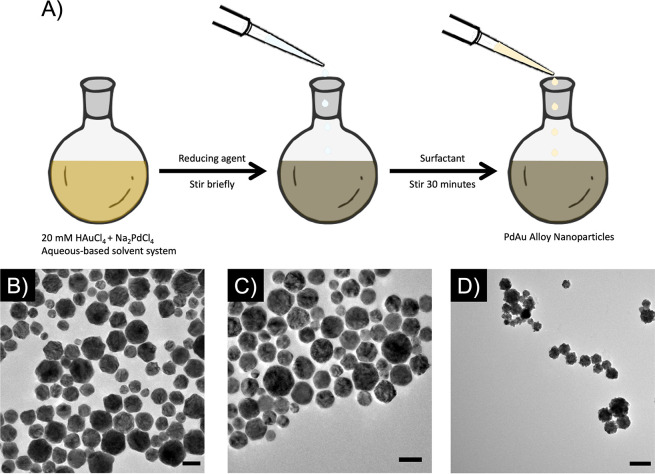
Metal nanoparticles are currently used in a variety of applications, ranging from life sciences to nanoelectronic devices to gas sensors. In particular, the use of palladium nanoparticles is gaining increasing attention due to their ability to catalyze the rapid dissociation of hydrogen, which leads to an excellent response in hydrogen-sensing applications. However, current palladium-nanoparticle-based sensors are hindered by the presence of hysteresis upon hydride formation and decomposition, as this hysteresis limits sensor accuracy. Here, we present a robust colloidal synthesis for palladium-gold alloy nanoparticles and demonstrate their hysteresis-free response when used for hydrogen detection. The obtained colloidal particles, synthesized in an aqueous, room-temperature environment, can be tailored to a variety of applications through changing the size, ratio of metals, and surface stabilization. In particular, the variation of the viscosity of the mixture during synthesis resulted in a highly tunable size distribution and contributed to a significant improvement in size dispersity compared to the state-of-the-art methods.
金属纳米颗粒目前被用于各种应用中,从生命科学到纳米电子器件再到气体传感器。特别是,钯纳米颗粒的应用越来越受到关注,因为它们能够催化氢的快速解离,这使得它们在氢传感应用中具有出色的响应。然而,目前基于钯纳米颗粒的传感器受到氢化物形成和分解时存在滞后现象的阻碍,因为这种滞后现象限制了传感器的准确性。在此,我们展示了一种用于钯金合金纳米颗粒的稳健胶体合成方法,并证明了它们在用于氢检测时无滞后响应。在水性室温环境中合成的所得胶体颗粒,可以通过改变尺寸、金属比例和表面稳定性来适应各种应用。特别是,合成过程中混合物粘度的变化导致了高度可调的尺寸分布,与现有方法相比,显著提高了尺寸分散性。