Associate Professor, Department of Community Health Sciences, Université de Sherbrooke Longueuil, QC.
Research Professional, Université de Sherbrooke, Longueuil, QC; Doctoral Student, Department of Sociology, Université du Québec à Montréal, Montréal, QC.
Healthc Policy. 2021 Aug;17(1):73-90. doi: 10.12927/hcpol.2021.26576.
This study documents the adoption of telehealth by various types of primary healthcare (PHC) providers working in teaching PHC clinics in Quebec during the COVID-19 pandemic. It also identifies the perceived advantages and disadvantages of telehealth.
A cross-sectional study was conducted between May and August 2020. The e-survey was completed by 48/50 teaching primary care clinics representing 603/1,357 (44%) PHC providers.
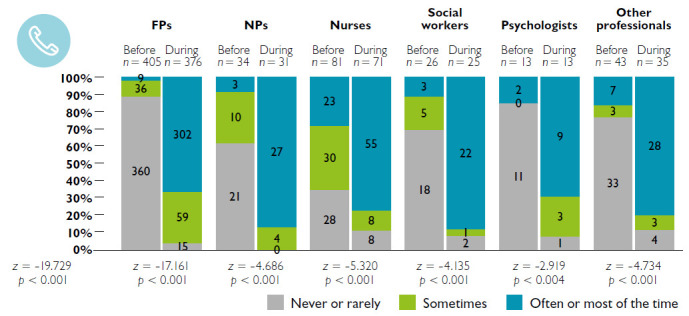
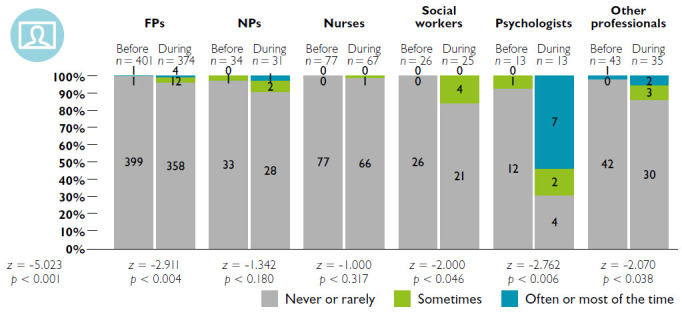
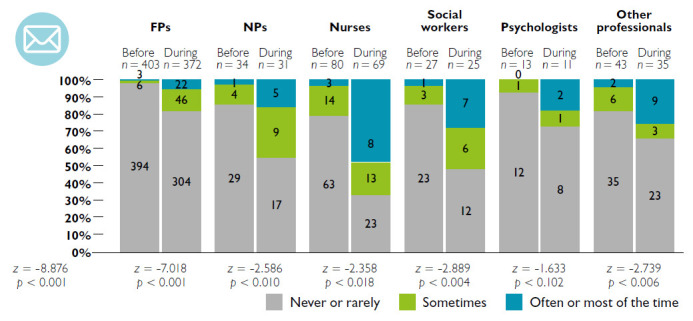
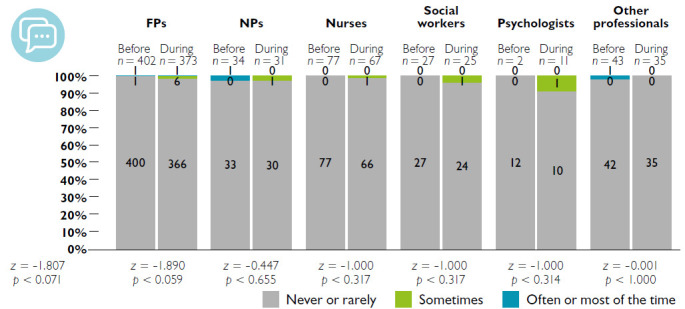
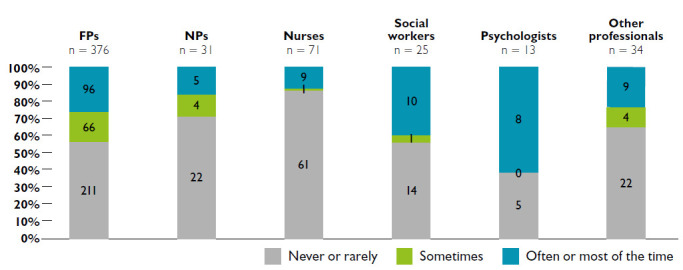
Telephone use increased the most, becoming the principal virtual modality of consultation, during the pandemic. Video consultations increased, with variations by type of PHC provider: between 2% and 16% reported using it "sometimes." The main perceived advantages of telehealth were minimizing the patient's need to travel, improved efficiency and reduction in infection transmission risk. The main disadvantages were the lack of physical exam and difficulties connecting with some patients.
The variation in telehealth adoption by type of PHC provider may inform strategies to maximize the potential of telehealth and help create guidelines for its use in more normal times.
本研究记录了在 COVID-19 大流行期间,魁北克从事教学初级保健诊所工作的各类初级保健(PHC)提供者采用远程医疗的情况。它还确定了远程医疗的优势和劣势。
这是一项在 2020 年 5 月至 8 月期间进行的横断面研究。电子调查完成于 50 个教学初级保健诊所中的 48 个,代表了 1357 名(44%)PHC 提供者中的 603 名。
在大流行期间,电话的使用增加最多,成为主要的虚拟咨询方式。视频咨询有所增加,不同类型的 PHC 提供者之间存在差异:分别有 2%至 16%的人报告有时使用它。远程医疗的主要优势在于最大限度地减少患者的出行需求、提高效率和降低感染传播风险。主要缺点是缺乏体检和与某些患者联系的困难。
不同类型的 PHC 提供者采用远程医疗的差异可能为制定最大限度发挥远程医疗潜力的策略提供信息,并有助于在更正常的时期为其使用制定指南。