Division of Psychiatry, University College London, London, United Kingdom.
Camden and Islington NHS Foundation Trust, London, United Kingdom.
PLoS One. 2021 Sep 20;16(9):e0257557. doi: 10.1371/journal.pone.0257557. eCollection 2021.
Empathy is fundamental to social cognition, driving prosocial behaviour and mental health but associations with aging and other socio-demographic characteristics are unclear. We therefore aimed to characterise associations of these characteristics with two main self-reported components of empathy, namely empathic-concern (feeling compassion) and perspective-taking (understanding others' perspective).
We asked participants in an internet-based survey of UK-dwelling adults aged ≥18 years to complete the Interpersonal Reactivity Index subscales measuring empathic concern and perspective taking, and sociodemographic and personality questionnaires. We weighted the sample to be UK population representative and employed multivariable weighted linear regression models.
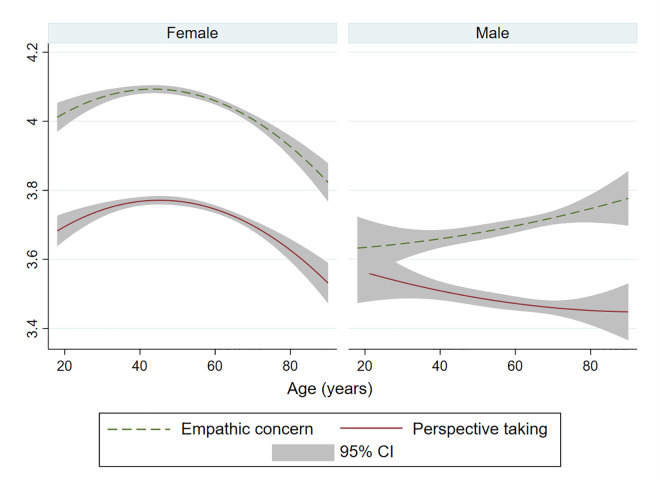
In 30,033 respondents, mean empathic concern score was 3.86 (95% confidence interval 3.85, 3.88) and perspective taking was 3.57 (3.56. 3.59); the correlation between these sub-scores was 0.45 (p < 0.001). Empathic concern and perspective taking followed an inverse-u shape trajectory in women with peak between 40 and 50 years whereas in men, perspective taking declines with age but empathic concern increases. In fully adjusted models, greater empathic concern was associated with female gender, non-white ethnicity, having more education, working in health, social-care, or childcare professions, and having higher neuroticism, extroversion, openness to experience and agreeableness traits. Perspective taking was associated with younger age, female gender, more education, employment in health or social-care, neuroticism, openness, and agreeableness.
Empathic compassion and understanding are distinct dimensions of empathy with differential demographic associations. Perspective taking may decline due to cognitive inflexibility with older age whereas empathic concern increases in older men suggesting it is socially-driven.
同理心是社会认知的基础,它推动了亲社会行为和心理健康,但它与衰老和其他社会人口特征的关系尚不清楚。因此,我们旨在描述这些特征与同理心的两个主要自我报告成分之间的关联,即共情关怀(同情)和换位思考(理解他人的观点)。
我们要求参与基于互联网的英国成年人调查的参与者完成人际反应指数量表,该量表测量共情关怀和换位思考,以及社会人口统计学和人格问卷。我们对样本进行了加权处理,使其具有英国人口代表性,并采用了多变量加权线性回归模型。
在 30033 名受访者中,共情关怀的平均得分为 3.86(95%置信区间 3.85,3.88),换位思考得分为 3.57(3.56. 3.59);这些子量表之间的相关性为 0.45(p < 0.001)。共情关怀和换位思考在女性中呈反 U 形轨迹,峰值在 40 至 50 岁之间,而在男性中,随着年龄的增长,换位思考下降,但共情关怀增加。在完全调整的模型中,更大的共情关怀与女性性别、非白色种族、受过更高的教育、从事医疗、社会关怀或儿童保育职业以及具有更高的神经质、外向性、开放性和宜人性特质有关。换位思考与年龄较小、女性性别、受教育程度较高、从事医疗或社会关怀职业、神经质、开放性和宜人性有关。
共情关怀和理解是同理心的两个不同维度,与不同的人口统计学特征有关。随着年龄的增长,换位思考可能会因认知灵活性下降而下降,而老年男性的共情关怀会增加,这表明它是由社会驱动的。