Fundamentals and Administration Department, College of Nursing, Sultan Qaboos University, Muscat, Oman.
College of Nursing, Visayas State University, Philippines.
Appl Nurs Res. 2021 Oct;61:151476. doi: 10.1016/j.apnr.2021.151476. Epub 2021 Jul 7.
Nurses in the frontline of the battle against COVID-19 are highly vulnerable to compassion fatigue (CF), which may affect their mental health, work effectiveness, and patient safety outcomes. However, no studies have investigated nurses' CF in relation to job outcomes and care quality during the pandemic.
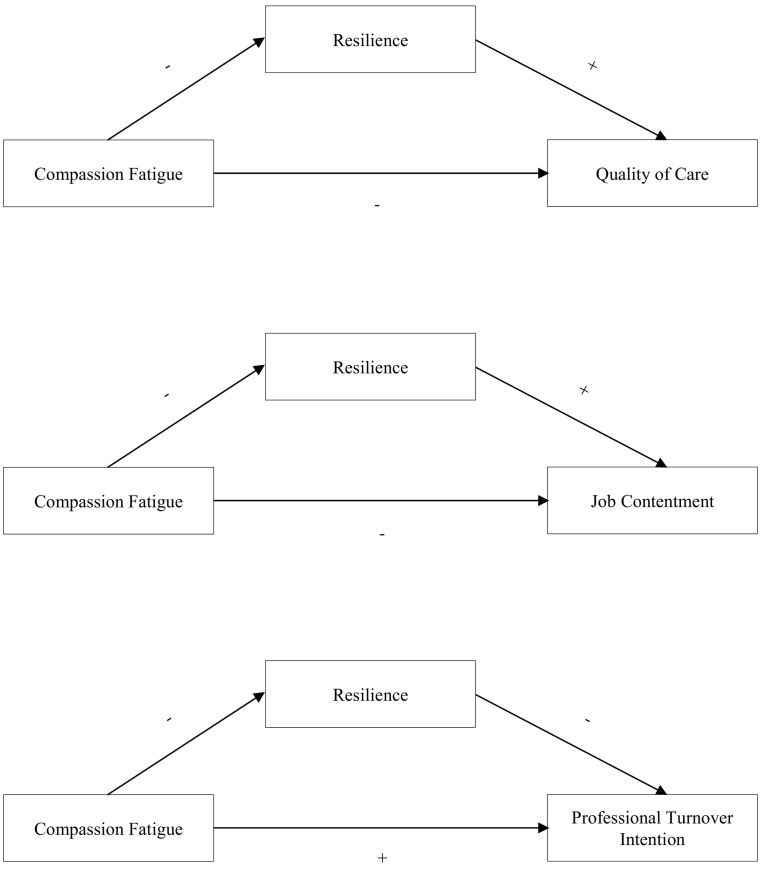
This study aims to examine the mediating role of resilience in the relationship between CF and frontline nurses' job outcomes (job satisfaction and turnover intention) and care quality.
An online, cross-sectional survey containing five self-report scales was used to collect data from 270 frontline nurses in selected hospitals in the Philippines.
Overall, 38.5% of frontline nurses experienced medium to high CF during the second wave of the pandemic. Increased CF was associated with poorer nurse-reported quality of care (β = -0.145, p = 0.019), lower job satisfaction (β = -0.317, p = 0.001), and higher organizational turnover intention (β = 0.301, p = 0.001). Moreover, resilience fully mediated the relationship between CF and quality of care (β = -0.088, p = 0.169), and partially mediated the relationship between CF and job satisfaction (β = -0.259, p = 0.001), and CF fatigue and organizational turnover intention (β = 0.272, p = 0.001).
Frontline nurses are at risk of developing CF during the pandemic. Psychological resilience reduces the negative impact of CF on frontline nurses' job satisfaction, turnover intention, and the quality of care in their assigned unit. Proactive measures to reduce CF should be prioritized by nursing administrators. Resilience-promoting interventions could foster job satisfaction and retention in nurses and, hence, the quality of care delivered in their units.
在抗击 COVID-19 的一线工作中,护士极易受到同情疲劳(CF)的影响,这可能会影响他们的心理健康、工作效率和患者安全结果。然而,在大流行期间,尚无研究调查护士 CF 与工作结果和护理质量之间的关系。
本研究旨在检验韧性在 CF 与前线护士工作结果(工作满意度和离职意向)和护理质量之间的关系中的中介作用。
采用在线横断面调查,包含五个自我报告量表,从菲律宾选定医院的 270 名前线护士中收集数据。
总体而言,38.5%的前线护士在大流行的第二波期间经历了中等到高度的 CF。CF 增加与护士报告的护理质量较差(β=-0.145,p=0.019)、工作满意度降低(β=-0.317,p=0.001)和组织离职意向增加(β=0.301,p=0.001)相关。此外,韧性完全中介了 CF 与护理质量之间的关系(β=-0.088,p=0.169),部分中介了 CF 与工作满意度之间的关系(β=-0.259,p=0.001)和 CF 疲劳与组织离职意向之间的关系(β=0.272,p=0.001)。
在大流行期间,前线护士有发生 CF 的风险。心理韧性降低了 CF 对前线护士工作满意度、离职意向和其所在单位护理质量的负面影响。护理管理人员应优先采取措施减少 CF。促进韧性的干预措施可以提高护士的工作满意度和留任率,从而提高其所在单位的护理质量。