Department of Sociology, The Catholic University of America, Washington, DC, United States; Nuffield College, University of Oxford, Oxford, United Kingdom.
Department of Sociology, The Catholic University of America, Washington, DC, United States.
Vaccine. 2021 Oct 15;39(43):6351-6355. doi: 10.1016/j.vaccine.2021.09.005. Epub 2021 Sep 7.
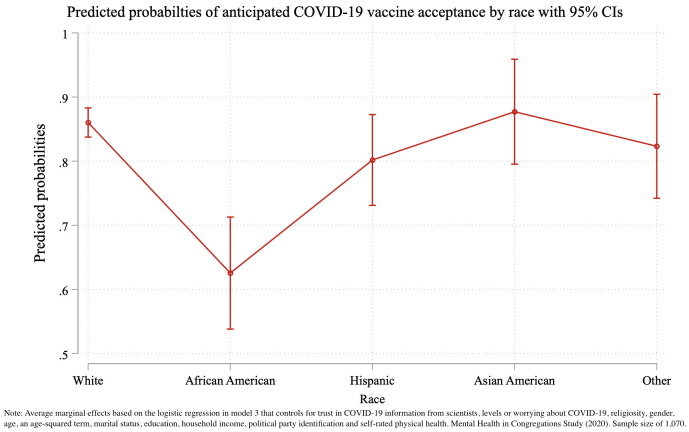
Given high COVID-19 infection and mortality ratesamong racial minorities in the US and their higher rates of religiosity, it is important to examine how the intersection of race and religion influences perceptions of COVID-19 vaccinations.Data for this study come from online surveys conducted in twelve congregations between October and December 2020 (N = 1,609). Based on logistic regression analyses, this study demonstrates a severe disparity of 24 percentage points (95% confidence interval 0.14-0.33) in anticipated COVID-19 vaccine acceptance between African Americans and White Americans, even when controlling for trust in COVID-19 information from scientists and levels of worrying about COVID-19 as well as religiosity and demographic factors. Religiosity is negatively associated with COVID-19 vaccine acceptance across racial groups. The findings suggest that the intersection of race and religion should be considered when designing immunization programs, for instance by fostering collaborations and dialogue with faith leaders of racial minority congregations.
鉴于美国少数族裔的 COVID-19 感染率和死亡率较高,以及他们的宗教信仰率较高,研究种族和宗教的交叉如何影响对 COVID-19 疫苗接种的看法非常重要。本研究的数据来自 2020 年 10 月至 12 月期间在 12 个会众中进行的在线调查(N=1609)。基于逻辑回归分析,本研究表明,即使控制了对科学家发布的 COVID-19 信息的信任度以及对 COVID-19 的担忧程度以及宗教信仰和人口统计因素,非洲裔美国人和白人美国人对 COVID-19 疫苗的预期接受率之间存在严重的差异,达到 24 个百分点(95%置信区间为 0.14-0.33)。宗教信仰与所有种族群体的 COVID-19 疫苗接种接受率呈负相关。研究结果表明,在设计免疫计划时应考虑种族和宗教的交叉问题,例如通过与少数族裔教会的宗教领袖建立合作关系和对话。