Fridman Ariel, Gershon Rachel, Gneezy Ayelet
Rady School of Management, University of California San Diego, La Jolla, California, United States of America.
PLoS One. 2021 Apr 16;16(4):e0250123. doi: 10.1371/journal.pone.0250123. eCollection 2021.
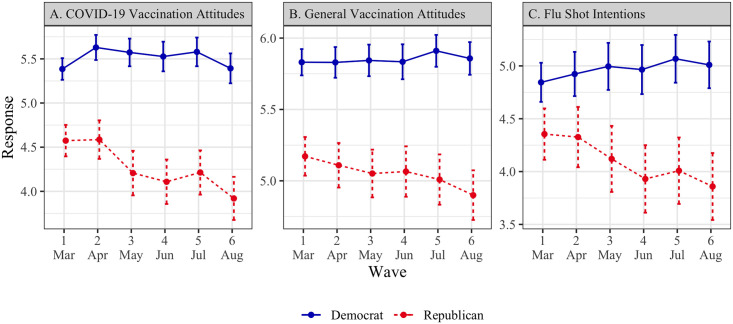
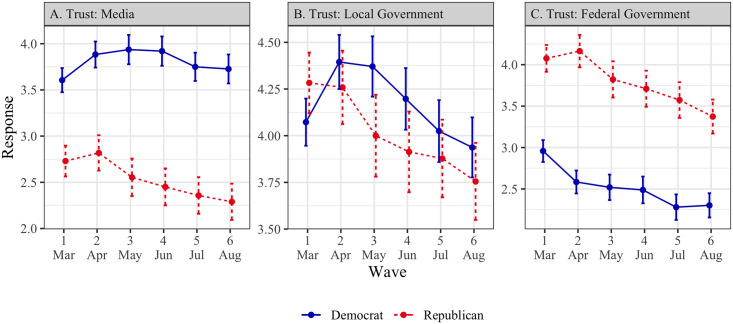
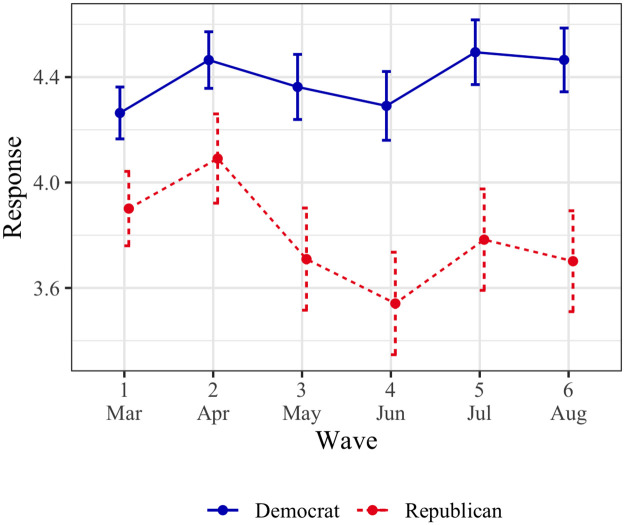
How do attitudes toward vaccination change over the course of a public health crisis? We report results from a longitudinal survey of United States residents during six months (March 16 -August 16, 2020) of the COVID-19 pandemic. Contrary to past research suggesting that the increased salience of a disease threat should improve attitudes toward vaccines, we observed a decrease in intentions of getting a COVID-19 vaccine when one becomes available. We further found a decline in general vaccine attitudes and intentions of getting the influenza vaccine. Analyses of heterogeneity indicated that this decline is driven by participants who identify as Republicans, who showed a negative trend in vaccine attitudes and intentions, whereas Democrats remained largely stable. Consistent with research on risk perception and behavior, those with less favorable attitudes toward a COVID-19 vaccination also perceived the virus to be less threatening. We provide suggestive evidence that differential exposure to media channels and social networks could explain the observed asymmetric polarization between self-identified Democrats and Republicans.
在公共卫生危机期间,人们对疫苗接种的态度是如何变化的?我们报告了在2020年新冠肺炎疫情六个月(3月16日至8月16日)期间对美国居民进行的一项纵向调查的结果。与过去的研究表明疾病威胁的显著性增加会改善对疫苗的态度相反,我们观察到当新冠疫苗可用时,接种新冠疫苗的意愿下降。我们还发现总体疫苗态度和接种流感疫苗的意愿有所下降。异质性分析表明,这种下降是由认同为共和党的参与者推动的,他们在疫苗态度和意愿上呈负面趋势,而民主党人则基本保持稳定。与风险感知和行为的研究一致,那些对新冠疫苗接种态度不太积极的人也认为该病毒的威胁较小。我们提供了一些暗示性证据,表明不同的媒体渠道和社交网络接触情况可以解释在自我认同的民主党人和共和党人之间观察到的不对称两极分化。