Department of Psychiatry and Psychotherapy, Carl Gustav Carus University Hospital, Technische Universität Dresden, Dresden, Germany.
Core-Facility Brainimaging, Faculty of Medicine, University of Marburg, Marburg, Germany.
Transl Psychiatry. 2021 Sep 20;11(1):485. doi: 10.1038/s41398-021-01598-y.
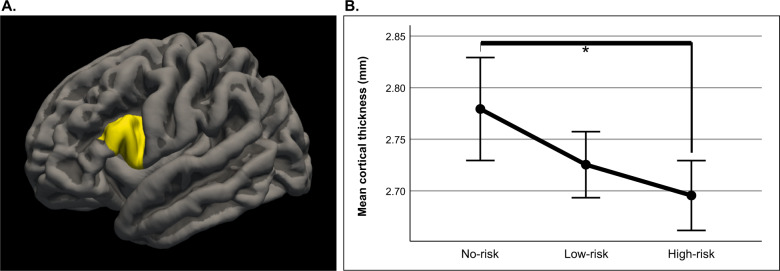
In psychiatry, there has been a growing focus on identifying at-risk populations. For schizophrenia, these efforts have led to the development of early recognition and intervention measures. Despite a similar disease burden, the populations at risk of bipolar disorder have not been sufficiently characterized. Within the BipoLife consortium, we used magnetic resonance imaging (MRI) data from a multicenter study to assess structural gray matter alterations in N = 263 help-seeking individuals from seven study sites. We defined the risk using the EPIbipolar assessment tool as no-risk, low-risk, and high-risk and used a region-of-interest approach (ROI) based on the results of two large-scale multicenter studies of bipolar disorder by the ENIGMA working group. We detected significant differences in the thickness of the left pars opercularis (Cohen's d = 0.47, p = 0.024) between groups. The cortex was significantly thinner in high-risk individuals compared to those in the no-risk group (p = 0.011). We detected no differences in the hippocampal volume. Exploratory analyses revealed no significant differences in other cortical or subcortical regions. The thinner cortex in help-seeking individuals at risk of bipolar disorder is in line with previous findings in patients with the established disorder and corresponds to the region of the highest effect size in the ENIGMA study of cortical alterations. Structural alterations in prefrontal cortex might be a trait marker of bipolar risk. This is the largest structural MRI study of help-seeking individuals at increased risk of bipolar disorder.
在精神病学领域,人们越来越关注识别高危人群。对于精神分裂症,这些努力导致了早期识别和干预措施的发展。尽管疾病负担相似,但双相情感障碍的高危人群尚未得到充分描述。在 BipoLife 联盟中,我们使用来自七个研究地点的多中心研究的磁共振成像 (MRI) 数据,评估了 263 名寻求帮助的个体的结构灰质变化。我们使用 EPIbipolar 评估工具定义了无风险、低风险和高风险,使用基于 ENIGMA 工作组两项大型多中心双相情感障碍研究结果的感兴趣区域 (ROI) 方法。我们检测到左额下回(Cohen's d = 0.47,p = 0.024)厚度在各组之间存在显著差异。与无风险组相比,高风险个体的皮层明显变薄(p = 0.011)。我们没有检测到海马体积的差异。探索性分析显示,其他皮质或皮质下区域没有差异。在有双相情感障碍风险的寻求帮助的个体中,皮层变薄与已确诊患者的先前发现一致,并且与 ENIGMA 皮质改变研究中效应量最高的区域相对应。前额叶皮层的结构改变可能是双相风险的特征标志物。这是对有更高双相情感障碍风险的寻求帮助的个体进行的最大规模的结构 MRI 研究。