Division of Fetal Medicine, Center for Maternal-Fetal, Neonatal and Reproductive Medicine, National Center for Child Health and Development, Tokyo, Japan.
Division of Neonatology, Center for Maternal-Fetal, Neonatal and Reproductive Medicine, National Center for Child Health and Development, Tokyo, Japan.
Prenat Diagn. 2021 Nov;41(12):1575-1581. doi: 10.1002/pd.6048. Epub 2021 Sep 25.
To assess long-term neurodevelopmental outcomes in children after radiofrequency ablation (RFA) for twin reversed arterial perfusion (TRAP) sequence.
This cross-sectional study included children who underwent RFA for the TRAP sequence between 2012 and 2018. We assessed neurodevelopment in children using the Kinder Infant Development Scale, a validated questionnaire. The developmental quotient (DQ) assessed in nine subscales was calculated as the developmental age divided by the chronological age. Neurodevelopmental delay (NDD) was defined as a DQ of <70 points.
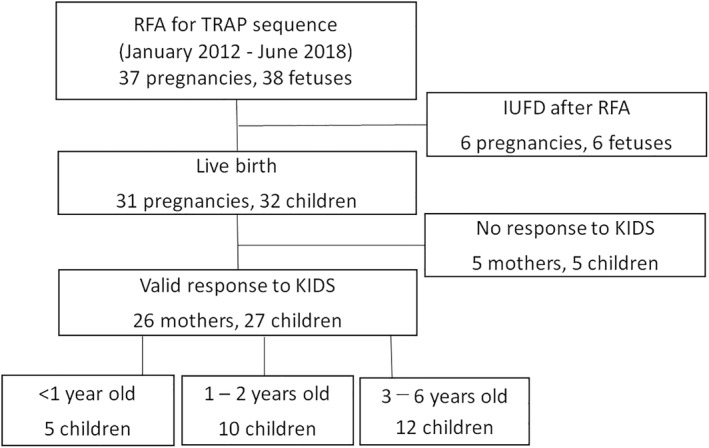
In total, 38 children from 37 pregnancies underwent RFA for the TRAP sequence during the study period; 6 fetuses died in utero. We sent the questionnaire to the parents of the 32 surviving children and obtained answers for 27 (84%). The median age at the assessment was 2 years and 5 months old. The median total DQ was 111 (80-150). Most median DQs in the nine subscales were above 70. The incidence of NDD was 0% (0/27). There were no marked differences in DQ by chorionicity.
Children who survived after RFA for TRAP sequence showed favorable long-term neurodevelopmental outcomes. Radiofrequency ablation seems to rarely affect fetal neurodevelopment. Pregnant women with TRAP sequence are encouraged to be treated by RFA.
评估射频消融(RFA)治疗双胎反向动脉灌注(TRAP)序列后儿童的长期神经发育结局。
本回顾性研究纳入了 2012 年至 2018 年期间因 TRAP 序列而行 RFA 的患儿。我们使用经过验证的儿童婴儿发育量表(Kinder Infant Development Scale)评估儿童的神经发育情况。九个分量表的发育商(DQ)计算为发育年龄除以月龄。发育迟缓(NDD)定义为 DQ<70 分。
研究期间,37 例妊娠中共有 38 例胎儿因 TRAP 序列而行 RFA,其中 6 例胎儿宫内死亡。我们向 32 例存活患儿的家长发送了问卷,并收到了 27 份(84%)的回复。评估时的中位年龄为 2 岁 5 个月。中位总 DQ 为 111(80-150)。九个分量表的中位数 DQ 大多高于 70。NDD 的发生率为 0%(0/27)。绒毛膜性对 DQ 无明显影响。
TRAP 序列行 RFA 治疗后存活的患儿神经发育长期结局良好。RFA 似乎很少影响胎儿的神经发育。建议对 TRAP 序列的孕妇进行 RFA 治疗。