Danon Nadia, Al-Gobari Muaamar, Burnand Bernard, Rodondi Pierre-Yves
Pain Center and Center for Integrative and Complementary Medicine, Department of Anesthesiology, Lausanne University Hospital and Faculty of Biology and Medicine, University of Lausanne, Lausanne, Switzerland.
Center for Primary Care and Public Health (Unisanté) and Cochrane Switzerland, University of Lausanne, Lausanne, Switzerland.
Psychooncology. 2022 Mar;31(3):345-371. doi: 10.1002/pon.5821. Epub 2021 Sep 21.
To assess whether mind-body therapies are effective for relieving cancer-related pain in adults, since at least one-third of adults with cancer are affected by moderate or severe pain.
We searched for all randomized or quasi-randomized controlled trials that included adults (≥18 years) with cancer-related pain who were treated with mind-body therapies (mindfulness, hypnosis, yoga, guided imagery, and progressive muscle relaxation) in MEDLINE, Embase, CINAHL, Cochrane Central Register of Controlled Trials (CENTRAL), Science Citation Index, Web of Science, trials registers, and reference lists. The primary outcome was pain intensity. We calculated the standardized mean differences and 95% confidence intervals (CIs) and assessed the risk of bias.
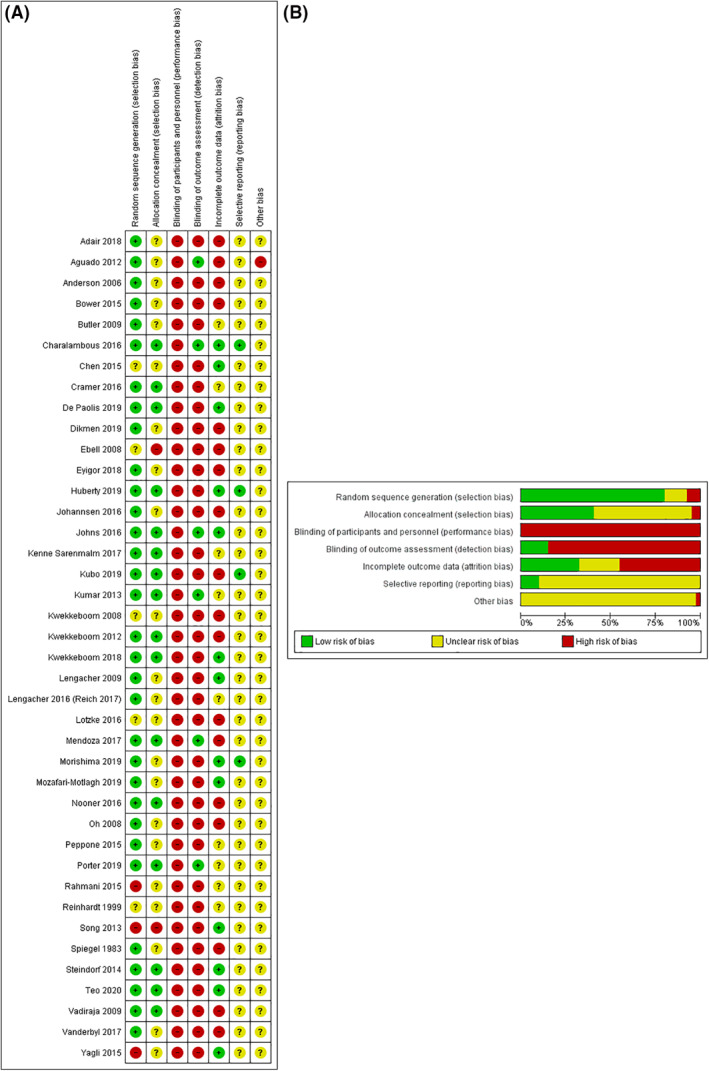
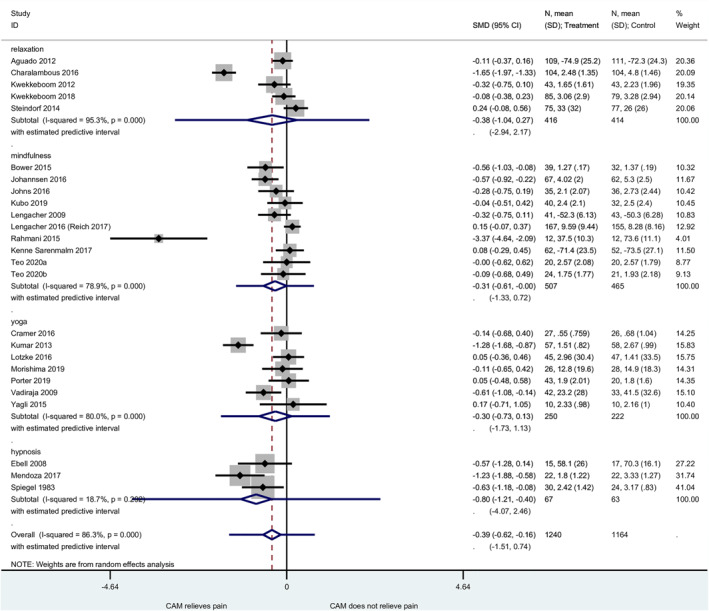
We identified 40 primary studies involving a total of 3569 participants. The meta-analysis included 24 studies (2404 participants) and showed a significant effect of -0.39 (95% CI -0.62 to -0.16) with considerable heterogeneity (I = 86.3%, p < 0.001). After we excluded four "outlier" studies in sensitivity analyses, the effect size remained significant but weaker. There was a high risk of bias in all studies, for example, performance bias due to lack of participant blinding. Patients in multiple settings were included but many studies were of low quality.
Mind-body therapies may be effective in improving cancer pain, but the quality of the evidence is low. There is a need for further high-quality clinical trials.
评估身心疗法对缓解成人癌症相关疼痛是否有效,因为至少三分之一的成年癌症患者受到中度或重度疼痛的影响。
我们在MEDLINE、Embase、CINAHL、Cochrane对照试验中央注册库(CENTRAL)、科学引文索引、科学网、试验注册库和参考文献列表中搜索了所有随机或半随机对照试验,这些试验纳入了患有癌症相关疼痛的成年人(≥18岁),他们接受了身心疗法(正念、催眠、瑜伽、引导意象和渐进性肌肉松弛)治疗。主要结局是疼痛强度。我们计算了标准化均数差和95%置信区间(CI),并评估了偏倚风险。
我们确定了40项主要研究,共涉及3569名参与者。荟萃分析纳入了24项研究(2404名参与者),结果显示有显著效果,标准化均数差为-0.39(95%CI为-0.62至-0.16),异质性相当大(I² = 86.3%,p < 0.001)。在敏感性分析中排除四项“异常值”研究后,效应量仍然显著但较弱。所有研究均存在较高的偏倚风险,例如,由于缺乏参与者盲法导致的实施偏倚。纳入了多种环境下的患者,但许多研究质量较低。
身心疗法可能对改善癌症疼痛有效,但证据质量较低。需要进一步开展高质量的临床试验。