Exercise Science and Health Promotion, Arizona State University, 500 North 3rd Street Phoenix, Tempe, AZ 85004, USA.
Mays Cancer Center, University of Texas San Antonio MD Anderson, 7979 Wurzbach Road, San Antonio, TX, 78229, USA.
BMC Complement Altern Med. 2019 Jun 7;19(1):121. doi: 10.1186/s12906-019-2530-8.
Myeloproliferative neoplasm (MPN) patients suffer from significant symptoms, inflammation and reduced quality of life. Yoga improves these outcomes in other cancers, but this hasn't been demonstrated in MPNs. The purpose of this study was to: (1) explore the limited efficacy (does the program show promise of success) of a 12-week online yoga intervention among MPN patients on symptom burden and quality of life and (2) determine feasibility (practicality: to what extent a measure can be carried out) of remotely collecting inflammatory biomarkers.
Patients were recruited nationally and randomized to online yoga (60 min/week of yoga) or wait-list control (asked to maintain normal activity). Weekly yoga minutes were collected with Clicky (online web analytics tool) and self-report. Those in online yoga completed a blood draw at baseline and week 12 to assess inflammation (interleukin-6, tumor necrosis factor-alpha [TNF-α]). All participants completed questionnaires assessing depression, anxiety, fatigue, pain, sleep disturbance, sexual function, total symptom burden, global health, and quality of life at baseline, week seven, 12, and 16. Change from baseline at each time point was computed by group and effect sizes were calculated. Pre-post intervention change in inflammation for the yoga group was compared by t-test.
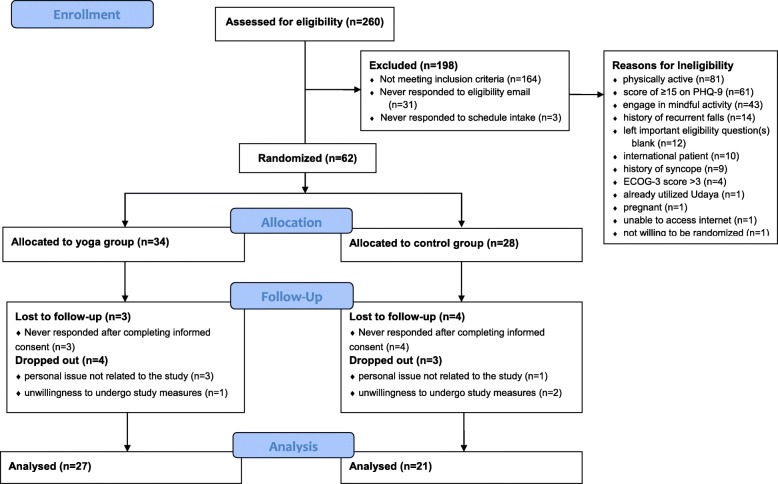
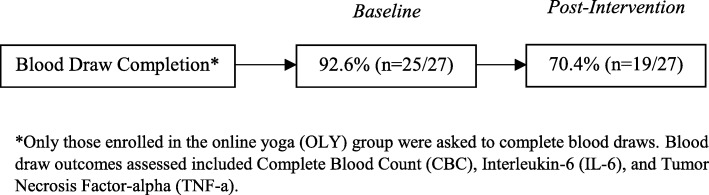
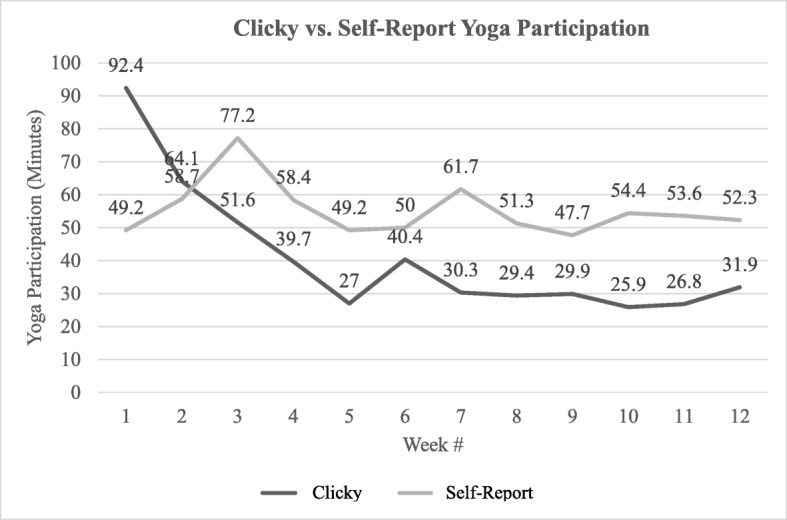
Sixty-two MPN patients enrolled and 48 completed the intervention (online yoga = 27; control group = 21). Yoga participation averaged 40.8 min/week via Clicky and 56.1 min/week via self-report. Small/moderate effect sizes were generated from the yoga intervention for sleep disturbance (d = - 0.26 to - 0.61), pain intensity (d = - 0.34 to - 0.51), anxiety (d = - 0.27 to - 0.37), and depression (d = - 0.53 to - 0.78). A total of 92.6 and 70.4% of online yoga participants completed the blood draw at baseline and week 12, respectively, and there was a decrease in TNF-α from baseline to week 12 (- 1.3 ± 1.5 pg/ml).
Online yoga demonstrated small effects on sleep, pain, and anxiety as well as a moderate effect on depression. Remote blood draw procedures are feasible and the effect size of the intervention on TNF-α was large. Future fully powered randomized controlled trials are needed to test for efficacy.
This trial was retrospectively registered with clinicaltrials.gov (ID: NCT03503838 ) on 4/19/2018.
骨髓增殖性肿瘤(MPN)患者存在严重的症状、炎症和生活质量下降。瑜伽在其他癌症中改善了这些结果,但在 MPN 中尚未得到证实。本研究的目的是:(1)探索为期 12 周的在线瑜伽干预对 MPN 患者症状负担和生活质量的有限疗效(该方案是否有成功的希望);(2)确定远程收集炎症生物标志物的可行性(实用性:在多大程度上可以实施)。
患者在全国范围内招募并随机分为在线瑜伽组(每周 60 分钟瑜伽)或候补对照组(要求保持正常活动)。通过 Clicky(在线网络分析工具)和自我报告来收集每周的瑜伽分钟数。参加在线瑜伽的患者在基线和第 12 周进行血液检查,以评估炎症(白细胞介素 6、肿瘤坏死因子-α[TNF-α])。所有参与者在基线、第 7 周、第 12 周和第 16 周完成评估抑郁、焦虑、疲劳、疼痛、睡眠障碍、性功能、总症状负担、总体健康和生活质量的问卷。通过组计算每个时间点的基线变化,并计算效应大小。通过 t 检验比较瑜伽组干预前后炎症的变化。
共有 62 名 MPN 患者入组,48 名患者完成了干预(在线瑜伽组=27;对照组=21)。瑜伽参与平均每周通过 Clicky 记录 40.8 分钟,通过自我报告记录 56.1 分钟。瑜伽干预对睡眠障碍(d=-0.26 至-0.61)、疼痛强度(d=-0.34 至-0.51)、焦虑(d=-0.27 至-0.37)和抑郁(d=-0.53 至-0.78)有较小/中等的效果。共有 92.6%和 70.4%的在线瑜伽参与者分别在基线和第 12 周完成了血液检查,并且从基线到第 12 周 TNF-α 水平下降(-1.3±1.5pg/ml)。
在线瑜伽对睡眠、疼痛和焦虑有较小的影响,对抑郁有中等的影响。远程采血程序是可行的,该干预对 TNF-α 的效果大小较大。未来需要进行完全随机对照试验来测试疗效。
该试验于 2018 年 4 月 19 日(ID:NCT03503838)在 clinicaltrials.gov 上进行了回顾性注册。