Tommasi Chiara, Pellegrino Benedetta, Boggiani Daniela, Sikokis Angelica, Michiara Maria, Uliana Vera, Bortesi Beatrice, Bonatti Francesco, Mozzoni Paola, Pinelli Silvana, Squadrilli Anna, Viani Maria Vittoria, Cassi Diana, Maglietta Giuseppe, Meleti Marco, Musolino Antonino
Medical Oncology and Breast Unit, University Hospital of Parma, Parma, Italy.
Department of Medicine and Surgery, University of Parma, Parma, Italy.
Front Oncol. 2021 Sep 6;11:700853. doi: 10.3389/fonc.2021.700853. eCollection 2021.
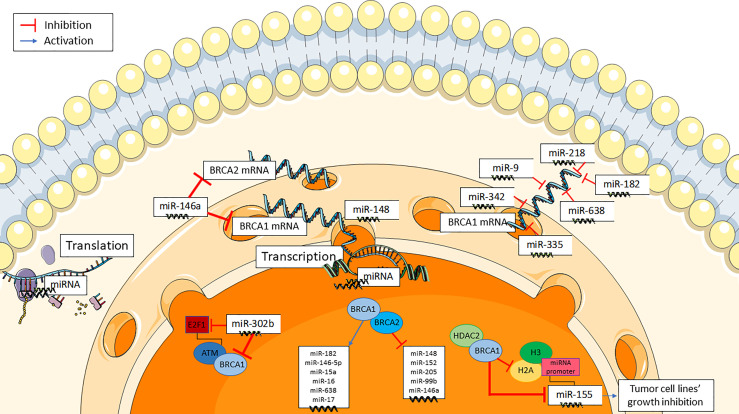
Women with pathogenic germline mutations in and genes have an increased risk to develop breast and ovarian cancer. There is, however, a high interpersonal variability in the modality and timing of tumor onset in those subjects, thus suggesting a potential role of other individual's genetic, epigenetic, and environmental risk factors in modulating the penetrance of BRCA mutations. MicroRNAs (miRNAs) are small noncoding RNAs that can modulate the expression of several genes involved in cancer initiation and progression. MiRNAs are dysregulated at all stages of breast cancer and although they are accessible and evaluable, a standardized method for miRNA assessment is needed to ensure comparable data analysis and accuracy of results. The aim of this review was to highlight the role of miRNAs as potential biological markers for BRCA mutation carriers. In particular, biological and clinical implications of a link between lifestyle and nutritional modifiable factors, miRNA expression and germline and mutations are discussed with the knowledge of the best available scientific evidence.
携带BRCA1和BRCA2基因致病性种系突变的女性患乳腺癌和卵巢癌的风险增加。然而,这些受试者肿瘤发生的方式和时间存在很大的个体差异,因此提示其他个体的遗传、表观遗传和环境风险因素在调节BRCA突变的外显率方面可能发挥作用。微小RNA(miRNA)是一类小的非编码RNA,可调节多个参与癌症发生和进展的基因的表达。miRNA在乳腺癌的各个阶段均失调,尽管它们易于获取和评估,但仍需要一种标准化的miRNA评估方法以确保数据分析具有可比性和结果的准确性。本综述的目的是强调miRNA作为BRCA突变携带者潜在生物学标志物的作用。特别是,结合现有最佳科学证据,讨论了生活方式和营养可改变因素、miRNA表达与种系BRCA1和BRCA2突变之间联系的生物学和临床意义。