Xu Huiting, Chen Runzhi, Shen Qian, Yang Dongmei, Peng Hui, Tong Jin, Fu Qiang
Department of Abdominal Oncology, Hubei Cancer Hospital, Wuhan, China.
Department of Oncology, Tongji Hospital, Tongji Medical College, Huazhong University of Science and Technology, Wuhan, China.
Front Oncol. 2021 Sep 6;11:754146. doi: 10.3389/fonc.2021.754146. eCollection 2021.
Erlotinib, a small-molecule epidermal growth factor receptor (EGFR) tyrosine kinase inhibitor, demonstrated therapeutic efficacy against pancreatic cancer. However, acquired resistance to erlotinib in pancreatic cancer is widely observed, and the exact mechanisms have not been fully explored until now. We examined the role of circular RNA circ_0013587 in the acquired resistance to erlotinib in pancreatic cancer cells and explored the underlying mechanisms.
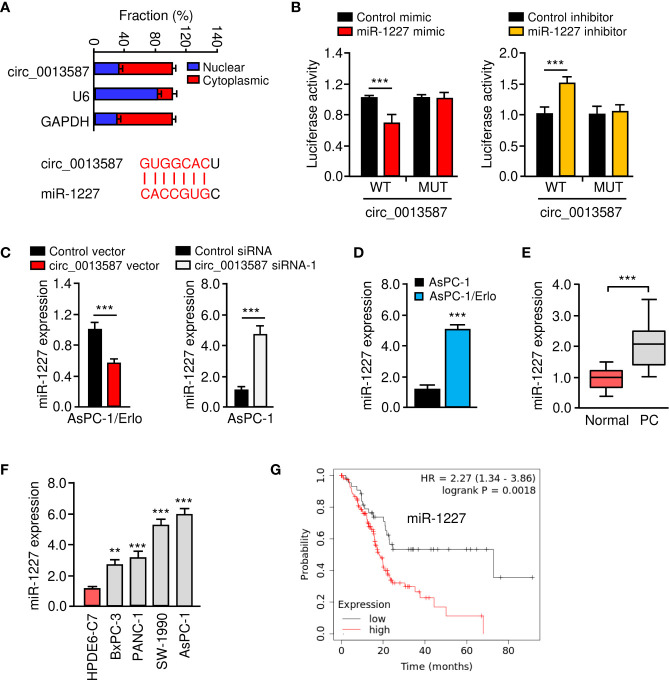
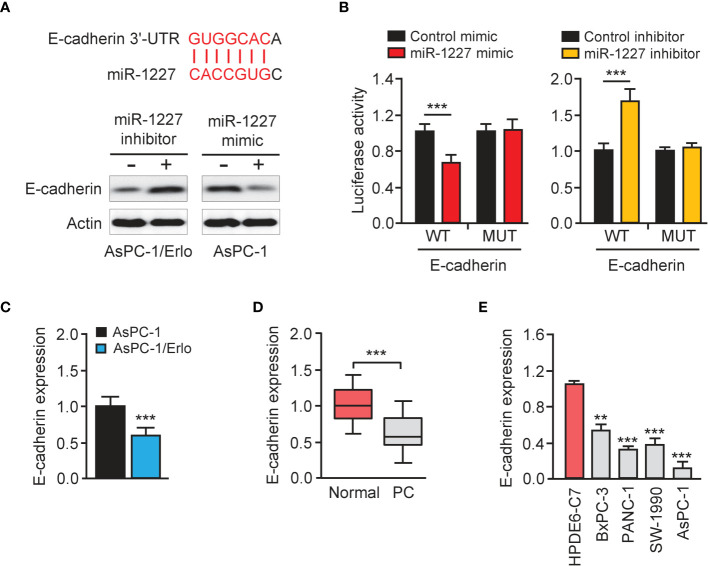
We selected erlotinib-resistant pancreatic cancer cells from the AsPC-1 cell line. The expression of circ_0013587 was examined by qRT-PCR assays. The effects of circ_0013587 on pancreatic cancer cell proliferation, invasion, and erlotinib resistance were assessed by cell functional assays. Bioinformatic analysis and dual-luciferase reporter assays identified circ_0013587 and E-cadherin as direct targets of miR-1227. Mouse xenograft models were employed to investigate the function of circ_0013587 in erlotinib resistance of tumors .
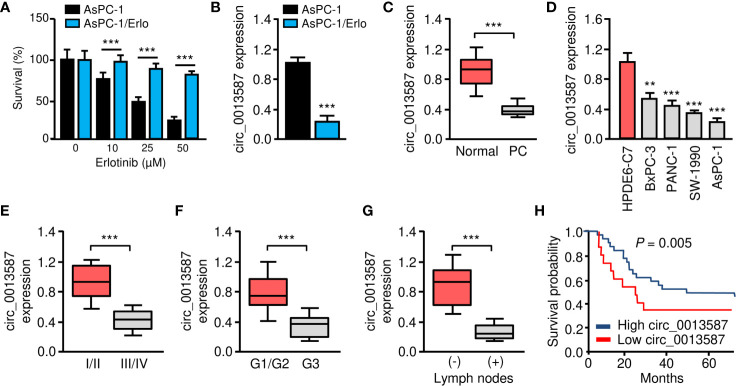
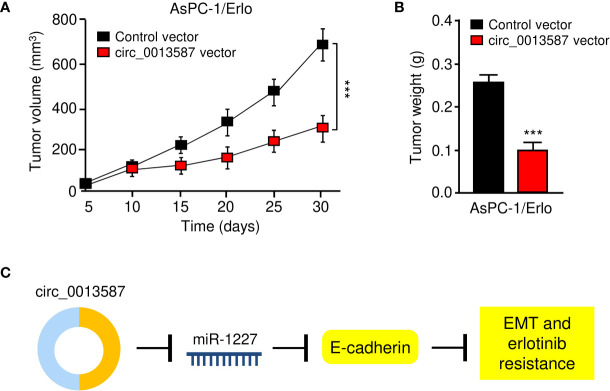
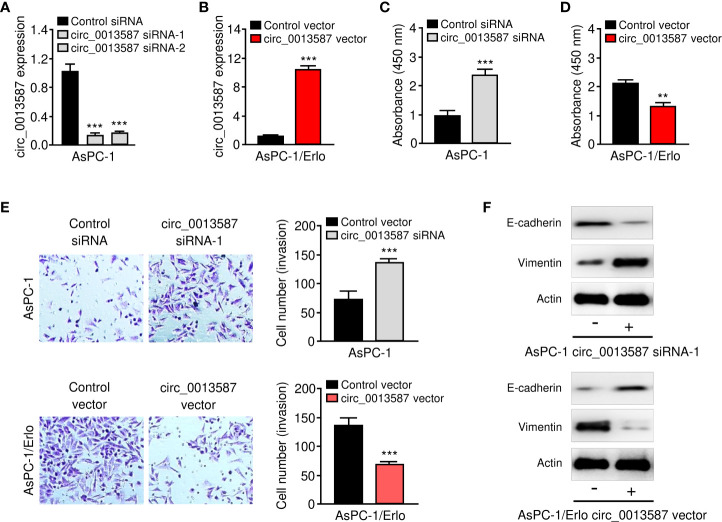
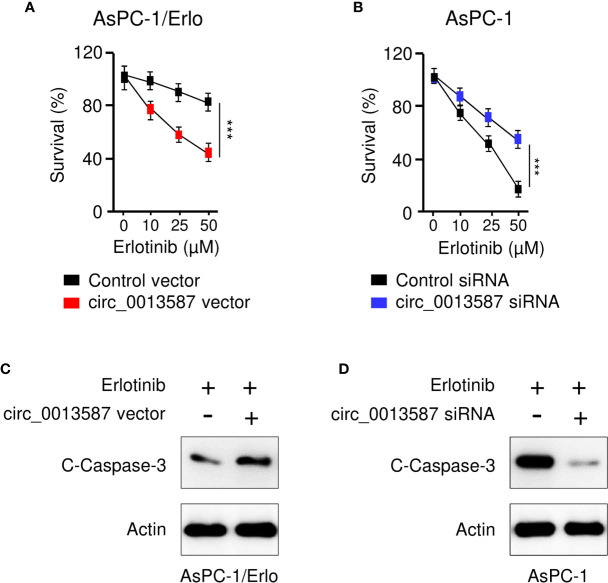
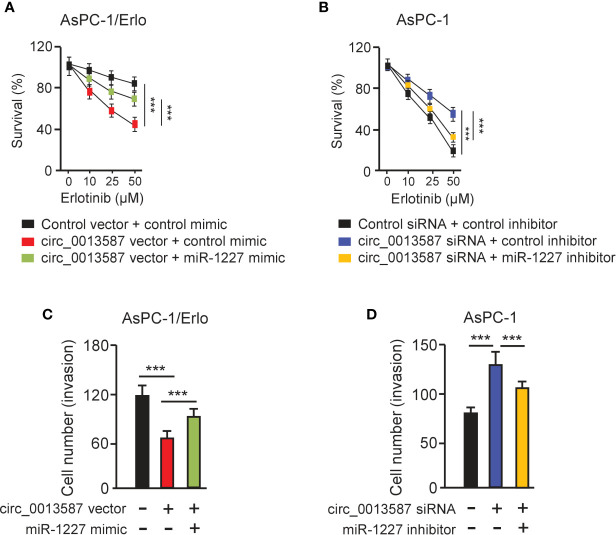
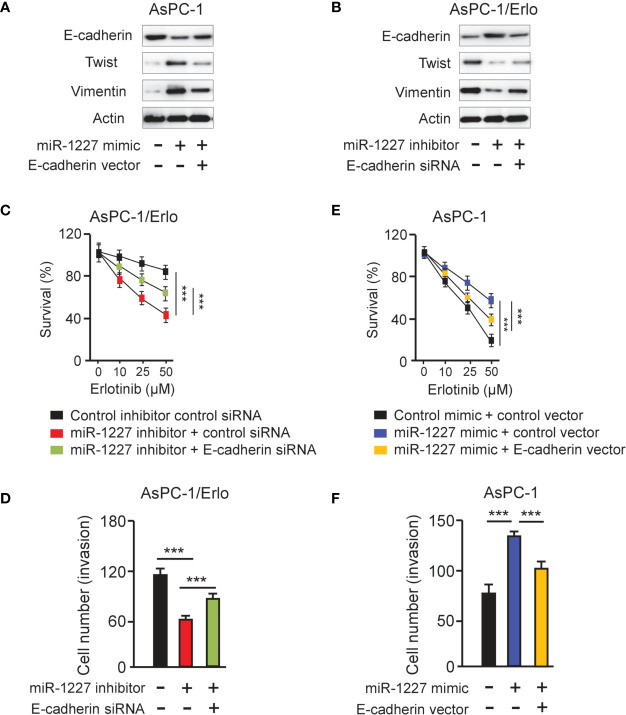
Circ_0013587 expression was significantly reduced in erlotinib-resistant AsPC-1 cells. We found that increasing circ_0013587 levels in erlotinib-resistant AsPC-1 cells re-sensitized them, whereas reducing circ_0013587 levels in erlotinib-sensitive AsPC-1 cells made them resistant. Mechanically, circ_0013587 released E-cadherin from the suppression of miR-1227, leading to E-cadherin up-regulation. Rescue assays highlighted that circ_0013587 reversed erlotinib resistance in pancreatic cancer cells by increasing E-cadherin levels through reducing the expression of miR-1227. Furthermore, circ_0013587 overexpression sensitized erlotinib-resistant AsPC-1 cells to erlotinib in xenograft models.
Our results demonstrated that down-regulation of circ_0013587 contributes to acquired resistance to erlotinib in pancreatic cancer cells through mediating the miR-1227/E-cadherin pathway and that circ_0013587 is a potential target molecular to overcome erlotinib resistance.
厄洛替尼是一种小分子表皮生长因子受体(EGFR)酪氨酸激酶抑制剂,已证明对胰腺癌具有治疗效果。然而,胰腺癌对厄洛替尼的获得性耐药广泛存在,确切机制至今尚未完全阐明。我们研究了环状RNA circ_0013587在胰腺癌细胞对厄洛替尼获得性耐药中的作用,并探索其潜在机制。
我们从AsPC-1细胞系中筛选出对厄洛替尼耐药的胰腺癌细胞。通过qRT-PCR检测circ_0013587的表达。通过细胞功能实验评估circ_0013587对胰腺癌细胞增殖、侵袭及对厄洛替尼耐药性的影响。生物信息学分析和双荧光素酶报告基因实验确定circ_0013587和E-钙黏蛋白是miR-1227的直接靶点。采用小鼠异种移植模型研究circ_0013587在肿瘤对厄洛替尼耐药中的作用。
在对厄洛替尼耐药的AsPC-1细胞中,circ_0013587表达显著降低。我们发现,提高对厄洛替尼耐药的AsPC-1细胞中circ_0013587水平可使其重新敏感,而降低对厄洛替尼敏感的AsPC-1细胞中circ_0013587水平则使其产生耐药。机制上,circ_0013587使E-钙黏蛋白从miR-1227的抑制中释放出来,导致E-钙黏蛋白上调。挽救实验表明,circ_0013587通过降低miR-1227表达、提高E-钙黏蛋白水平,逆转胰腺癌细胞对厄洛替尼的耐药性。此外,在异种移植模型中,circ_0013587过表达使对厄洛替尼耐药的AsPC-1细胞对厄洛替尼敏感。
我们的结果表明,circ_0013587下调通过介导miR-1227/E-钙黏蛋白途径导致胰腺癌细胞对厄洛替尼产生获得性耐药,且circ_0013587是克服厄洛替尼耐药的潜在靶点分子。