National Institute for Health Research Birmingham Liver Biomedical Research Unit, Institute of Immunology and Immunotherapy, University of Birmingham, Birmingham, United Kingdom.
Centre for Liver and Gastrointestinal Research, Institute of Immunology and Immunotherapy, University of Birmingham, Birmingham, United Kingdom.
Semin Liver Dis. 2022 Feb;42(1):61-76. doi: 10.1055/s-0041-1733876. Epub 2021 Sep 22.
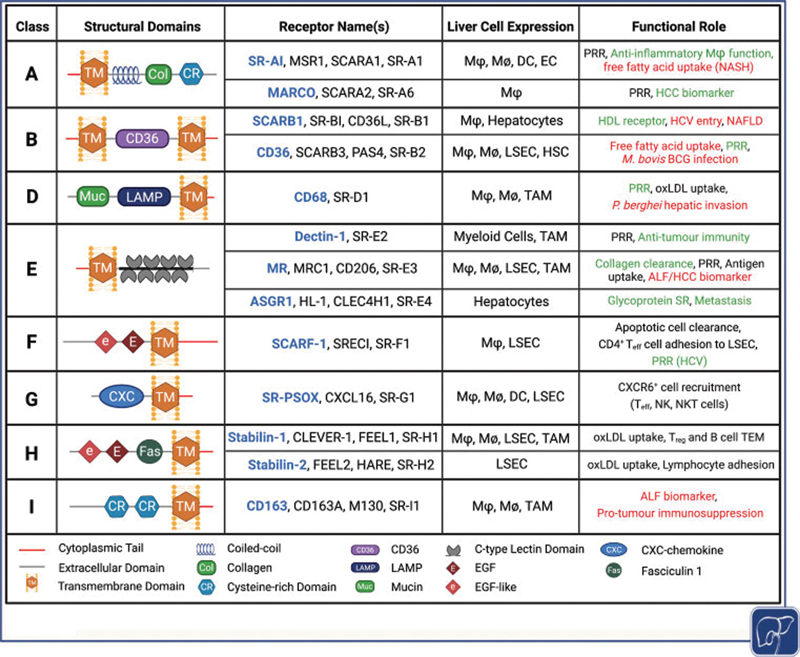
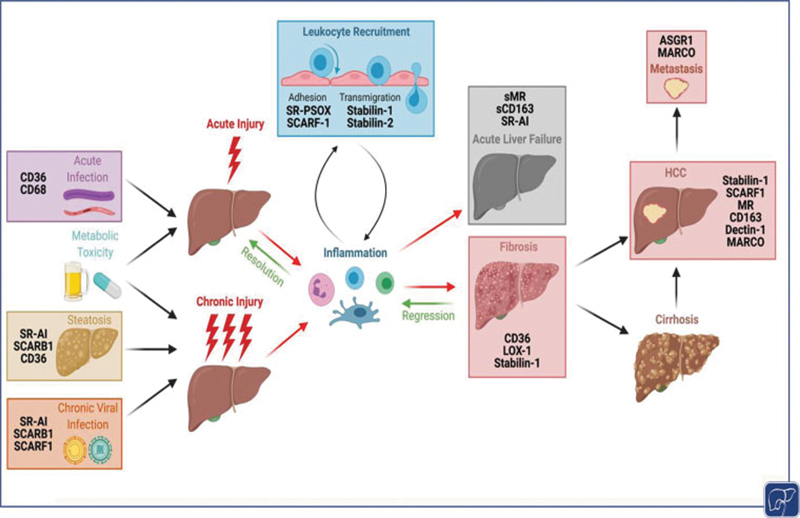
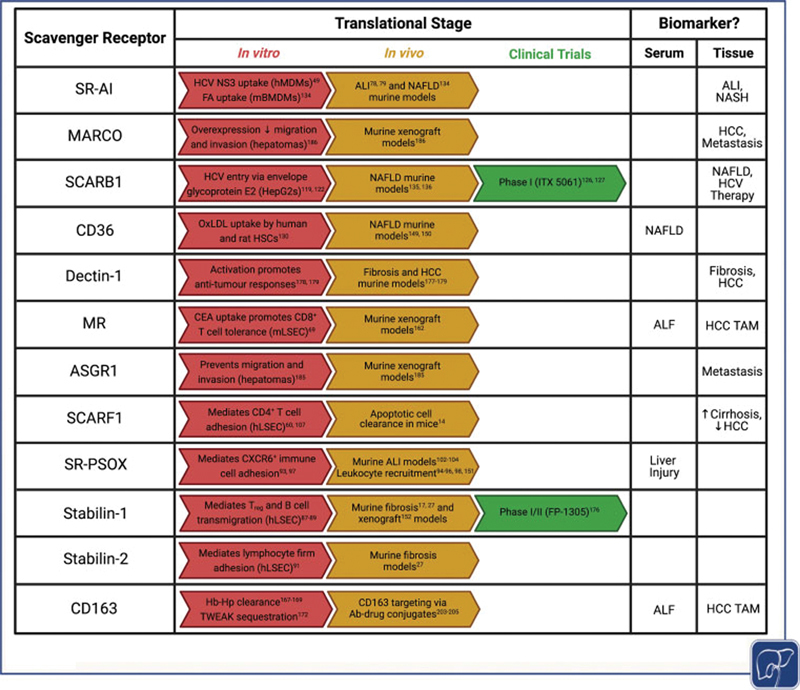
The scavenger receptor superfamily represents a highly diverse collection of evolutionarily-conserved receptors which are known to play key roles in host homeostasis, the most prominent of which is the clearance of unwanted endogenous macromolecules, such as oxidized low-density lipoproteins, from the systemic circulation. Members of this family have also been well characterized in their binding and internalization of a vast range of exogenous antigens and, consequently, are generally considered to be pattern recognition receptors, thus contributing to innate immunity. Several studies have implicated scavenger receptors in the pathophysiology of several inflammatory diseases, such as Alzheimer's and atherosclerosis. Hepatic resident cellular populations express a diverse complement of scavenger receptors in keeping with the liver's homeostatic functions, but there is gathering interest in the contribution of these receptors to hepatic inflammation and its complications. Here, we review the expression of scavenger receptors in the liver, their functionality in liver homeostasis, and their role in inflammatory liver disease and cancer.
清道夫受体超家族是一组高度多样化的进化保守受体,已知它们在宿主内稳态中发挥关键作用,其中最突出的作用是清除系统循环中不需要的内源性大分子,如氧化型低密度脂蛋白。该家族的成员在结合和内化广泛的外源性抗原方面也得到了很好的描述,因此通常被认为是模式识别受体,从而有助于先天免疫。几项研究表明,清道夫受体与几种炎症性疾病(如阿尔茨海默病和动脉粥样硬化)的病理生理学有关。与肝脏的稳态功能一致,肝固有细胞群体表达多种清道夫受体,但人们越来越关注这些受体对肝炎症及其并发症的贡献。在这里,我们综述了清道夫受体在肝脏中的表达、它们在肝脏内稳态中的功能以及它们在炎症性肝病和癌症中的作用。