The Key Laboratory of Molecular Biology for High Cancer Incidence Coastal Chaoshan Area, Department of Biochemistry and Molecular Biology, Shantou University Medical College, Shantou, Guangdong, 515041, P. R. China.
Institute of Basic Medical Science, Cancer Research Center, Shantou University Medical College, Shantou, Guangdong, 515041, P. R. China.
Cancer Commun (Lond). 2021 Dec;41(12):1398-1416. doi: 10.1002/cac2.12221. Epub 2021 Sep 23.
Fascin is crucial for cancer cell filopodium formation and tumor metastasis, and is functionally regulated by post-translational modifications. However, whether and how Fascin is regulated by acetylation remains unclear. This study explored the regulation of Fascin acetylation and its corresponding roles in filopodium formation and tumor metastasis.
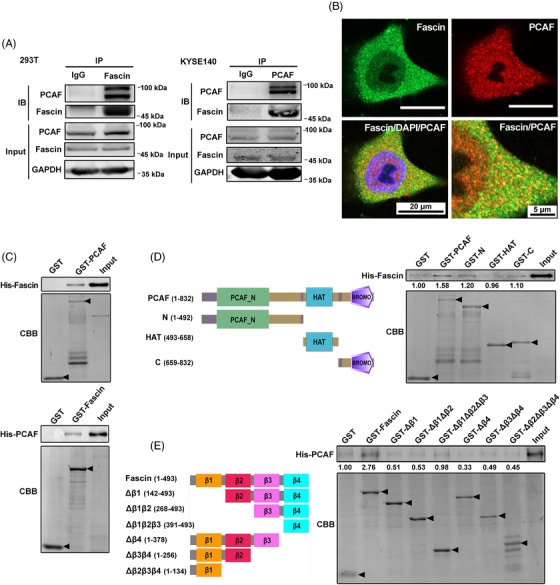
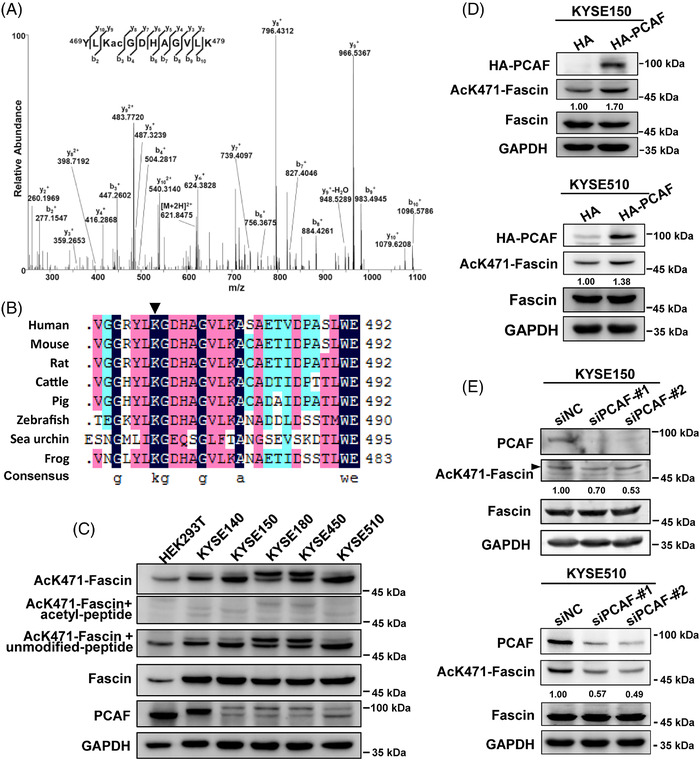
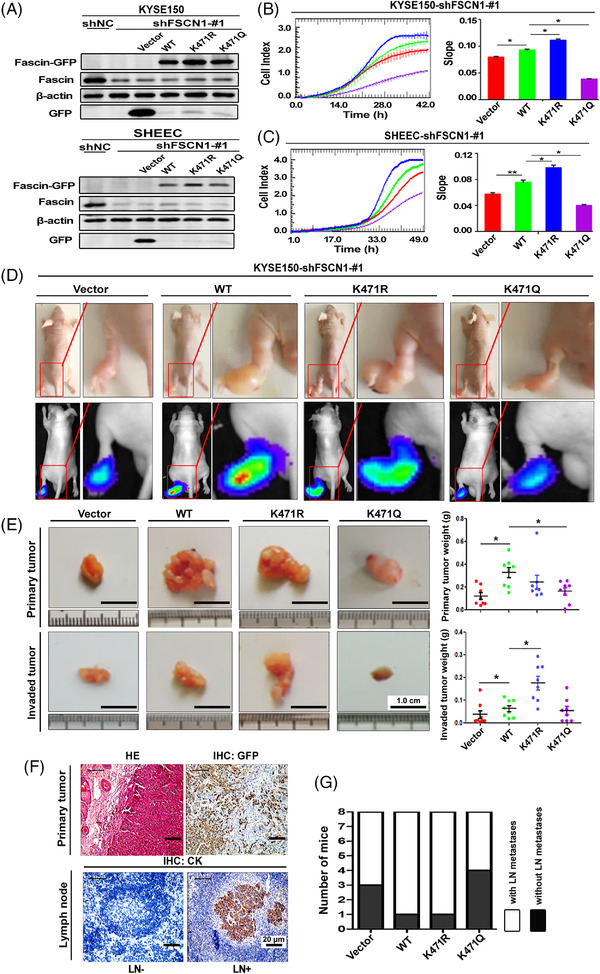
Immunoprecipitation and glutathione-S-transferase pull-down assays were performed to examine the interaction between Fascin and acetyltransferase P300/CBP-associated factor (PCAF), and immunofluorescence was used to investigate their colocalization. An in vitro acetylation assay was performed to identify Fascin acetylation sites by using mass spectrometry. A specific antibody against acetylated Fascin was generated and used to detect the PCAF-mediated Fascin acetylation in esophageal squamous cell carcinoma (ESCC) cells using Western blotting by overexpressing and knocking down PCAF expression. An in vitro cell migration assay was performed, and a xenograft model was established to study in vivo tumor metastasis. Live-cell imaging and fluorescence recovery after photobleaching were used to evaluate the function and dynamics of acetylated Fascin in filopodium formation. The clinical significance of acetylated Fascin and PCAF in ESCC was evaluated using immunohistochemistry.
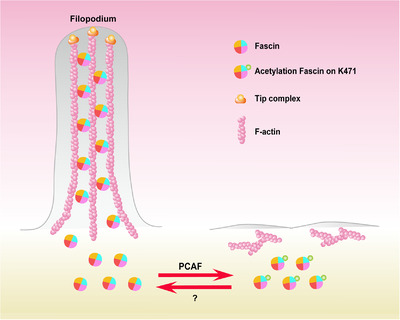
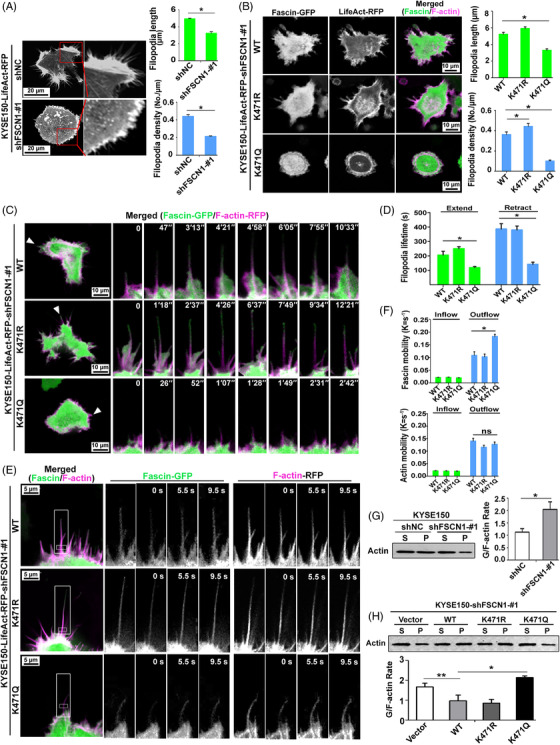
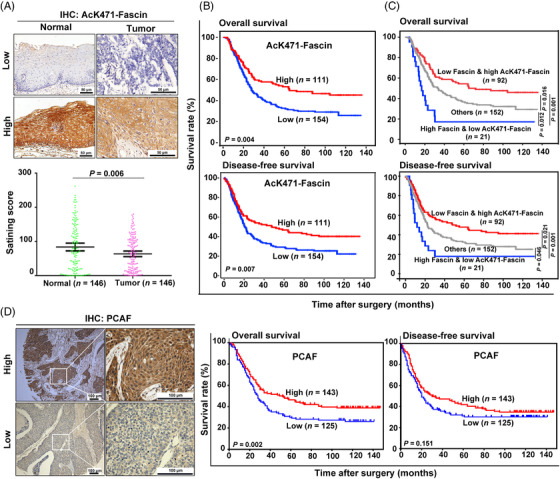
Fascin directly interacted and colocalized with PCAF in the cytoplasm and was acetylated at lysine 471 (K471) by PCAF. Using the specific anti-AcK471-Fascin antibody, Fascin was found to be acetylated in ESCC cells, and the acetylation level was consequently increased after PCAF overexpression and decreased after PCAF knockdown. Functionally, Fascin-K471 acetylation markedly suppressed in vitro ESCC cell migration and in vivo tumor metastasis, whereas Fascin-K471 deacetylation exhibited a potent oncogenic function. Moreover, Fascin-K471 acetylation reduced filopodial length and density, and lifespan of ESCC cells, while its deacetylation produced the opposite effect. In the filipodium shaft, K471-acetylated Fascin displayed rapid dynamic exchange, suggesting that it remained in its monomeric form owing to its weakened actin-bundling activity. Clinically, high levels of AcK471-Fascin in ESCC tissues were strongly associated with prolonged overall survival and disease-free survival of ESCC patients.
Fascin interacts directly with PCAF and is acetylated at lysine 471 in ESCC cells. Fascin-K471 acetylation suppressed ESCC cell migration and tumor metastasis by reducing filopodium formation through the impairment of its actin-bundling activity.
Fascin 对于癌细胞丝状伪足的形成和肿瘤转移至关重要,并且其功能受到翻译后修饰的调节。然而,Fascin 是否以及如何被乙酰化调节尚不清楚。本研究探讨了 Fascin 乙酰化的调节及其在丝状伪足形成和肿瘤转移中的作用。
通过免疫沉淀和谷胱甘肽 S-转移酶下拉实验检测 Fascin 与乙酰转移酶 P300/CBP 相关因子(PCAF)之间的相互作用,并通过免疫荧光观察它们的共定位。通过质谱分析进行体外乙酰化实验,确定 Fascin 的乙酰化位点。生成针对乙酰化 Fascin 的特异性抗体,通过过表达和敲低 PCAF 表达,使用 Western blot 检测食管鳞状细胞癌(ESCC)细胞中 PCAF 介导的 Fascin 乙酰化。进行体外细胞迁移实验,并建立异种移植模型研究体内肿瘤转移。通过活细胞成像和光漂白后荧光恢复评估乙酰化 Fascin 在丝状伪足形成中的功能和动力学。通过免疫组织化学评估 ESCC 中乙酰化 Fascin 和 PCAF 的临床意义。
Fascin 在细胞质中与 PCAF 直接相互作用并共定位,并被 PCAF 乙酰化赖氨酸 471(K471)。使用特异性抗 AcK471-Fascin 抗体,发现 ESCC 细胞中 Fascin 乙酰化,过表达 PCAF 后乙酰化水平增加,敲低 PCAF 后乙酰化水平降低。功能上,Fascin-K471 乙酰化显著抑制 ESCC 细胞体外迁移和体内肿瘤转移,而 Fascin-K471 去乙酰化则表现出强烈的致癌功能。此外,Fascin-K471 乙酰化减少 ESCC 细胞丝状伪足的长度和密度以及寿命,而去乙酰化则产生相反的效果。在丝状伪足轴中,K471-乙酰化 Fascin 显示快速动态交换,表明由于其减弱的肌动蛋白束形成活性,它仍处于单体形式。临床上,ESCC 组织中 AcK471-Fascin 水平高与 ESCC 患者的总生存和无病生存时间延长密切相关。
Fascin 在 ESCC 细胞中直接与 PCAF 相互作用,并在赖氨酸 471 处乙酰化。Fascin-K471 乙酰化通过降低其肌动蛋白束形成活性来减少丝状伪足形成,从而抑制 ESCC 细胞迁移和肿瘤转移。