Segrelles-Calvo Gonzalo, de S Araújo Glauber R, Llopis-Pastor Estefanía, Carrillo Javier, Hernández-Hernández Marta, Rey Laura, Melean Nestor Rodríguez, Escribano Inés, Antón Esther, Zamarro Celia, García-Salmones Mercedes, Frases Susana
Servicio de Neumología, Hospital Universitario Rey Juan Carlos, Madrid, Spain; Instituto de Investigación Biomédica, Fundación Jiménez Díaz, Madrid, Spain.
Laboratório de Biofísica de Fungos, Instituto de Biofísica Carlos Chagas Filho, Universidad Federal Do Rio de Janeiro, Rio de Janeiro, RJ, Brazil.
Respir Med. 2021 Nov;188:106619. doi: 10.1016/j.rmed.2021.106619. Epub 2021 Sep 17.
Invasive fungal infections (IFI) are increasing in prevalence in recent years. In the last few months, the rise of COVID-19 patients has generated a new escalation in patients presenting opportunistic mycoses, mainly by Aspergillus. Candida infections are not being reported yet.
We aimed to determine the prevalence of systemic candidiasis in patients admitted to ICUs due to severe pneumonia secondary to SARS-CoV-2 infection and the existence of possible associated risk factors that led these patients to develop candidiasis.
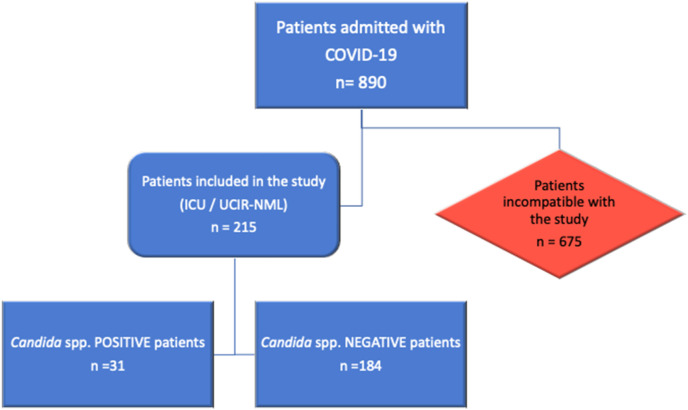
PATIENTS/METHODS: We designed a study including patients with a confirmed diagnosis of COVID-19.
The prevalence of systemic candidiasis was 14.4%, and the main isolated species were C. albicans and C. parapsilosis. All patients that were tested positive for Candida spp. stayed longer in the ICU in comparison to patients who tested negative. Patients with candidiasis had higher MuLBSTA score and mortality rates and a worse radiological involvement. In our study, Candida spp. isolates were found in patients that were submitted to: tocilizumab, tocilizumab plus systemic steroids, interferon type 1β and Lopinavir-Ritonavir.
Results suggested a high prevalence of systemic candidiasis in severe COVID-19-associated pneumonia patients. Patients with Candidiasis had the worst clinical outcomes. Treatment with tocilizumab could potentialize the risk to develop systemic candidiasis.
近年来,侵袭性真菌感染(IFI)的患病率不断上升。在过去几个月里,新冠病毒病(COVID-19)患者的增加导致机会性真菌病患者数量出现新的增长,主要由曲霉菌引起。目前尚未报告念珠菌感染情况。
我们旨在确定因严重急性呼吸综合征冠状病毒2(SARS-CoV-2)感染继发严重肺炎而入住重症监护病房(ICU)的患者中系统性念珠菌病的患病率,以及导致这些患者发生念珠菌病的可能相关危险因素。
患者/方法:我们设计了一项研究,纳入确诊为COVID-19的患者。
系统性念珠菌病的患病率为14.4%,主要分离出的菌种为白色念珠菌和近平滑念珠菌。与检测结果为阴性的患者相比,所有念珠菌属检测呈阳性的患者在ICU的停留时间更长。念珠菌病患者的MuLBSTA评分和死亡率更高,放射学受累情况更严重。在我们的研究中,在接受托珠单抗、托珠单抗加全身用类固醇、1β型干扰素和洛匹那韦-利托那韦治疗的患者中发现了念珠菌属分离株。
结果表明,在严重的COVID-19相关性肺炎患者中,系统性念珠菌病的患病率较高。念珠菌病患者的临床结局最差。使用托珠单抗治疗可能会增加发生系统性念珠菌病的风险。