Molecular Parasitology Laboratory, Infectious Diseases Program, QIMR Berghofer Medical Research Institute, Brisbane, Australia.
Department of Parasitology, Faculty of Medicine and Allied Sciences, Rajarata University of Sri Lanka, Saliyapura, Sri Lanka.
Infect Dis Poverty. 2021 Sep 23;10(1):121. doi: 10.1186/s40249-021-00905-5.
Zoonotic schistosomiasis, caused by Schistosoma japonicum, remains a major public health problem in the Philippines. This study aimed to evaluate the commercially available rapid diagnostic point-of-care circulating cathodic antigen (POC-CCA) test in detecting individuals infected with S. japonicum in a human cohort from an endemic area for schistosomiasis japonica in the Philippines.
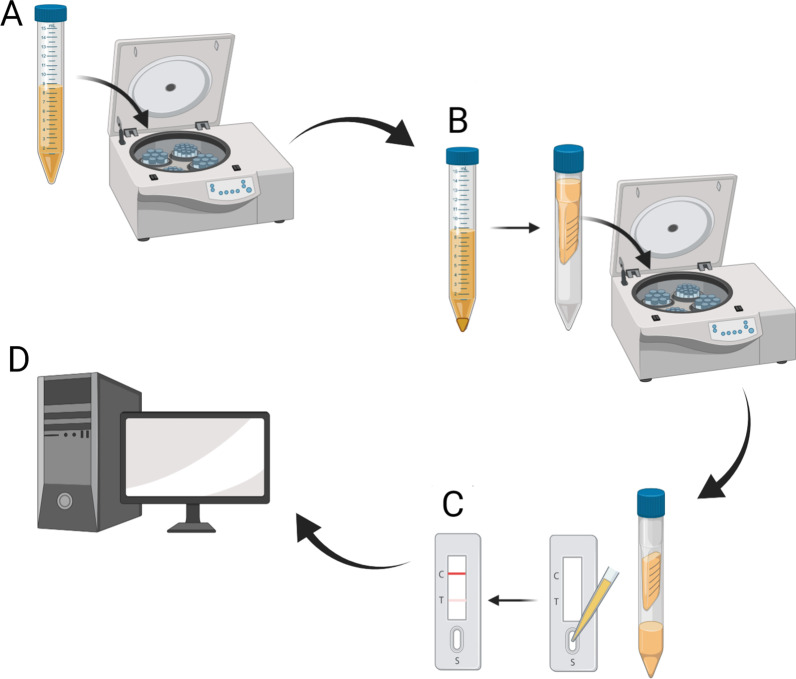
Clinical samples were collectedin 18 barangays endemic for S. japonicum infection in Laoang and Palapag municipalities, Northern Samar, the Philippines, in 2015. The presence of CCA in filter-concentrated urine samples (n = 412) was evaluated using the commercial kits and the results were converted to images, which were further analyzed by ImageJ software to calculate R values. The diagnostic performance of the immunochromatographic POC-CCA test was compared using the Kato-Katz (KK) procedure, in-house enzyme-linked immunosorbent assays (ELISAs) and droplet digital (dd) PCR assays as reference.
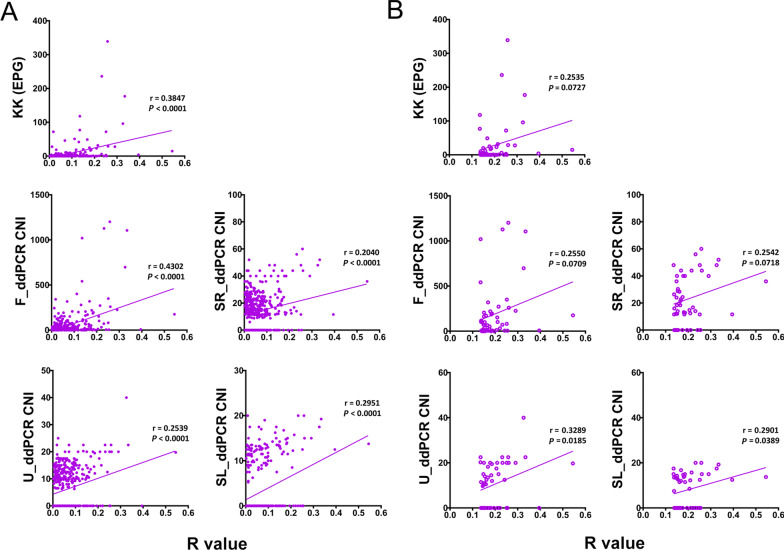
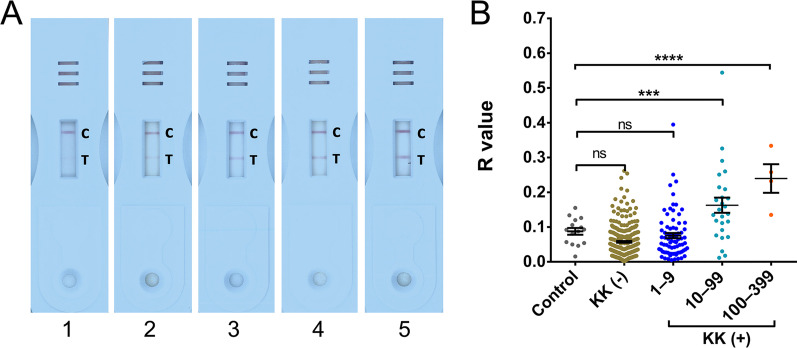
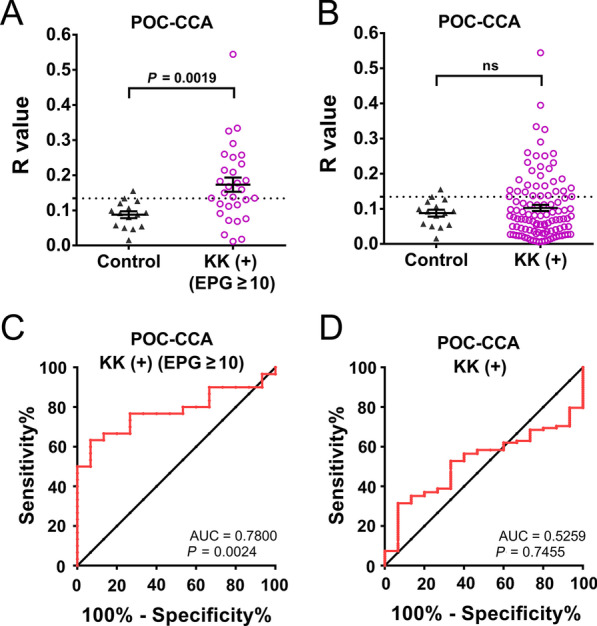
The POC-CCA test was able to detect S. japonicum-infected individuals in the cohort with an eggs per gram of faeces (EPG) more than or equal to 10 with sensitivity/specificity values of 63.3%/93.3%. However, the assay showed an inability to diagnose schistosomiasis japonica infections in all cohort KK-positive individuals, of which the majority had an extremely low egg burden (EPG: 1-9). The prevalence of S. japonicum infection in the total cohort determined by the POC-CCA test was 12.4%, only half of that determined by the KK method (26.2%). When compared with the ELISAs and ddPCR assays as a reference, the POC-CCA assay was further shown to be a test with low sensitivity. Nevertheless, the assay exhibited significant positive correlations with egg burden determined by the KK technique and the target gene copy number index values determined by the ddPCR assays within the entire cohort.
By using in silico image analysis, the POC-CCA cassette test could be converted to a quantitative assay to avoid reader-variability. Because of its low sensitivity, the commercially available POC-CCA assay had limited potential for determining the status of a S. japonicum infection in the target cohort. The assay should be applied with caution in populations where schistosome parasites (especially S. japonicum) are present at low infection intensity.
由日本血吸虫引起的动物源性血吸虫病仍然是菲律宾的一个主要公共卫生问题。本研究旨在评估市售快速诊断点检测循环阴极抗原(POC-CCA)检测试剂盒在检测菲律宾日本血吸虫流行区人群中感染日本血吸虫的个体中的应用。
2015 年,在菲律宾北萨马省 Laoang 和 Palapag 市的 18 个日本血吸虫感染流行村收集临床样本。使用商业试剂盒评估滤过浓缩尿样中 CCA 的存在(n=412),并将结果转换为图像,然后使用 ImageJ 软件进一步分析以计算 R 值。使用加藤厚涂片(KK)法、内部酶联免疫吸附试验(ELISA)和液滴数字(dd)PCR 法作为参考,比较免疫层析 POC-CCA 检测试剂盒的诊断性能。
POC-CCA 检测试剂盒能够检测到队列中粪便卵计数(EPG)≥10 的日本血吸虫感染个体,其灵敏度/特异性值分别为 63.3%/93.3%。然而,该检测试剂盒无法诊断所有 KK 阳性个体的日本血吸虫病感染,其中大多数个体的卵负荷极低(EPG:1-9)。POC-CCA 检测试剂盒在总队列中检测到的日本血吸虫感染率为 12.4%,仅为 KK 方法(26.2%)的一半。与 ELISA 和 ddPCR 检测试剂盒作为参考相比,POC-CCA 检测试剂盒的灵敏度进一步显示较低。然而,该检测试剂盒与整个队列中 KK 技术确定的卵负荷和 ddPCR 检测试剂盒确定的靶基因拷贝数指数值之间存在显著的正相关。
通过使用计算机图像分析,POC-CCA 检测试剂盒可以转换为定量检测方法,以避免检测者的差异。由于其灵敏度低,市售的 POC-CCA 检测试剂盒在确定目标人群中日本血吸虫感染状况方面的潜力有限。该检测试剂盒应谨慎应用于感染强度较低的人群。