Molecular Parasitology Laboratory, QIMR Berghofer Medical Research Institute, Brisbane, QLD, Australia.
Rural Health and Medical Research Institute, Charles Sturt University, Orange, NSW, Australia.
Front Immunol. 2023 Apr 3;14:1165480. doi: 10.3389/fimmu.2023.1165480. eCollection 2023.
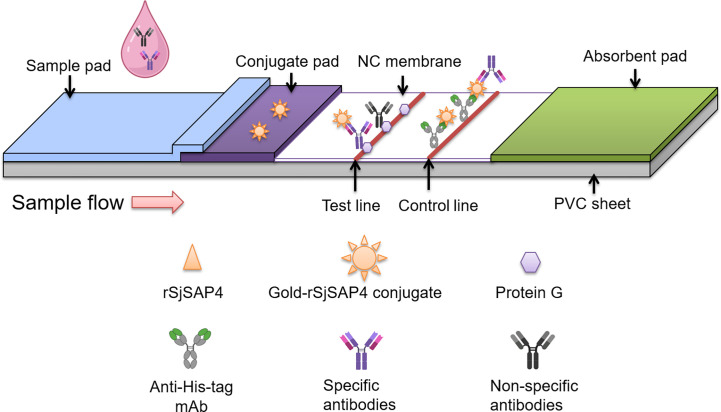
The neglected zoonosis, schistosomiasis japonica, remains a major public health problem in the Philippines. The current study aims to develop a novel gold immunochromatographic assay (GICA) and evaluate its performance in the detection of infection.
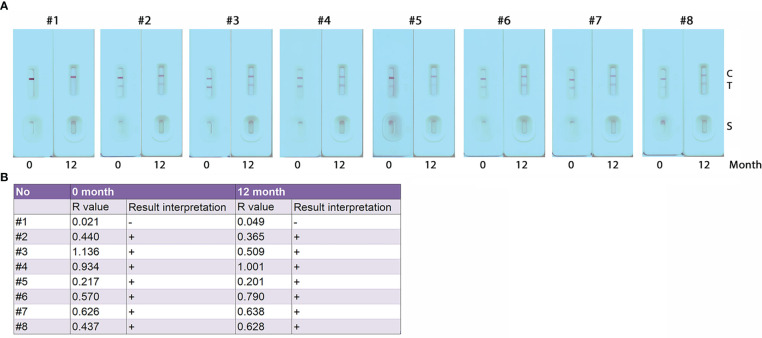
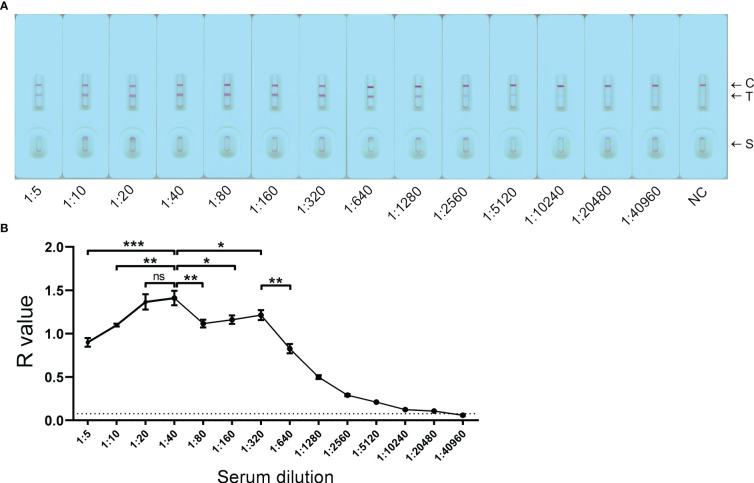
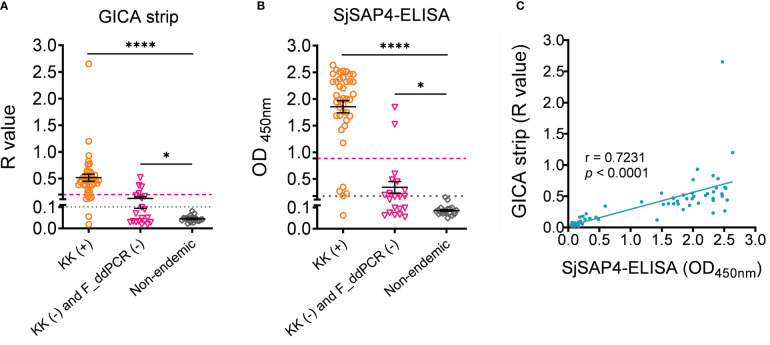
A GICA strip incorporating a saposin protein, SjSAP4 was developed. For each GICA strip test, diluted serum sample (50 µl) was loaded and strips were scanned after 10 min to convert the results into images. ImageJ was used to calculate an R value, which was defined as the signal intensity of the test line divided by the signal intensity of the control line within the cassette. After determination of optimal serum dilution and diluent, the GICA assay was evaluated with sera collected from non-endemic controls (n = 20) and individuals living in schistosomiasis-endemic areas of the Philippines (n = 60), including 40 Kato Katz (KK)-positive participants and 20 subjects confirmed as KK-negative and faecal droplet digital PCR assay (F_ddPCR)-negative at a dilution of 1:20. An ELISA assay evaluating IgG levels against SjSAP4 was also performed on the same panel of sera.
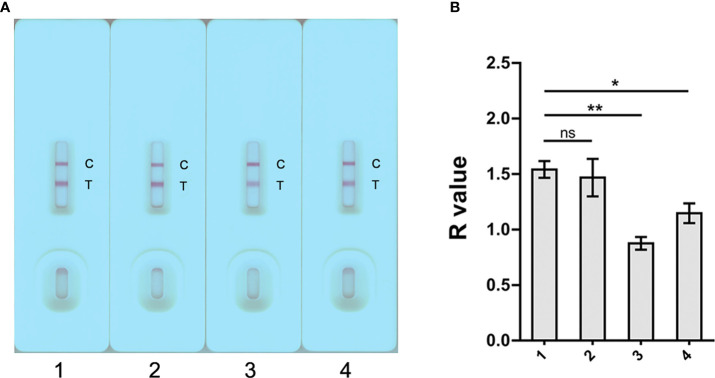
Phosphate-buffered saline (PBS) and 0.9% NaCl were determined as optimal dilution buffer for the GICA assay. The strips tested with serial dilutions of a pooled serum sample from KK-positive individuals (n = 3) suggested that a relatively wide range of dilutions (from 1:10 to 1:320) can be applied for the test. Using the non-endemic donors as controls, the GICA strip showed a sensitivity of 95.0% and absolute specificity; while using the KK-negative and F_ddPCR-negative subjects as controls, the immunochromatographic assay had a sensitivity of 85.0% and a specificity of 80.0%. The SjSAP4-incorperated GICA displayed a high concordance with the SjSAP4-ELISA assay.
The developed GICA assay exhibited a similar diagnostic performance with that of the SjSAP4-ELISA assay, yet the former can be performed by local personnel with minimal training with no requirement for specialised equipment. The GICA assay established here represents a rapid, easy-to-use, accurate and field-friendly diagnostic tool for the on-site surveillance/screening of infection.
被忽视的人畜共患寄生虫病日本血吸虫病仍然是菲律宾的一个主要公共卫生问题。本研究旨在开发一种新型金免疫层析检测(GICA)方法,并评估其在感染检测中的性能。
本研究开发了一种包含 Saposin 蛋白(SjSAP4)的 GICA 条带。对于每个 GICA 条带测试,加载稀释的血清样本(50 µl),并在 10 分钟后扫描条带,将结果转换为图像。使用 ImageJ 计算 R 值,该值定义为测试线的信号强度除以试剂盒内控制线的信号强度。确定最佳血清稀释度和稀释液后,使用来自非流行区对照者(n = 20)和菲律宾血吸虫病流行区个体(n = 60)的血清评估 GICA 检测方法,包括 40 名加藤厚涂片(Kato Katz,KK)阳性参与者和 20 名 KK 阴性和粪便液滴数字 PCR 检测(F_ddPCR)阴性者,稀释度为 1:20。还对同一组血清进行了评估 SjSAP4 特异性 IgG 水平的 ELISA 检测。
磷酸盐缓冲盐水(PBS)和 0.9%NaCl 被确定为 GICA 检测的最佳稀释缓冲液。用来自 KK 阳性个体的混合血清系列稀释的条带测试表明,相对较宽的稀释范围(1:10 至 1:320)可用于该检测。以非流行区供体作为对照,GICA 条带的灵敏度为 95.0%,绝对特异性为 100%;而以 KK 阴性和 F_ddPCR 阴性者作为对照,免疫层析检测的灵敏度为 85.0%,特异性为 80.0%。包含 SjSAP4 的 GICA 与 SjSAP4-ELISA 检测具有高度一致性。
本研究开发的 GICA 检测方法与 SjSAP4-ELISA 检测方法具有相似的诊断性能,但前者可由经过最少培训的当地人员使用,无需特殊设备即可进行。在此建立的 GICA 检测方法代表了一种快速、易于使用、准确且适用于现场的诊断工具,可用于现场监测/筛查 感染。