Servicio de Respiratorio, Hospital Galdakao-Usansolo, Galdakao, Bizkaia, Spain.
Unidad de Investigación Hospital Galdakao-Usansolo, Galdakao, Bizkaia, Spain.
Rev Clin Esp (Barc). 2022 Jan;222(1):22-30. doi: 10.1016/j.rceng.2021.04.009. Epub 2021 Sep 9.
There is controversy regarding the best predictors of clinical deterioration in COVID-19.
This work aims to identify predictors of risk factors for deterioration in patients hospitalized due to COVID-19.
Nested case-control study within a cohort.
13 acute care centers of the Osakidetza-Basque Health Service.
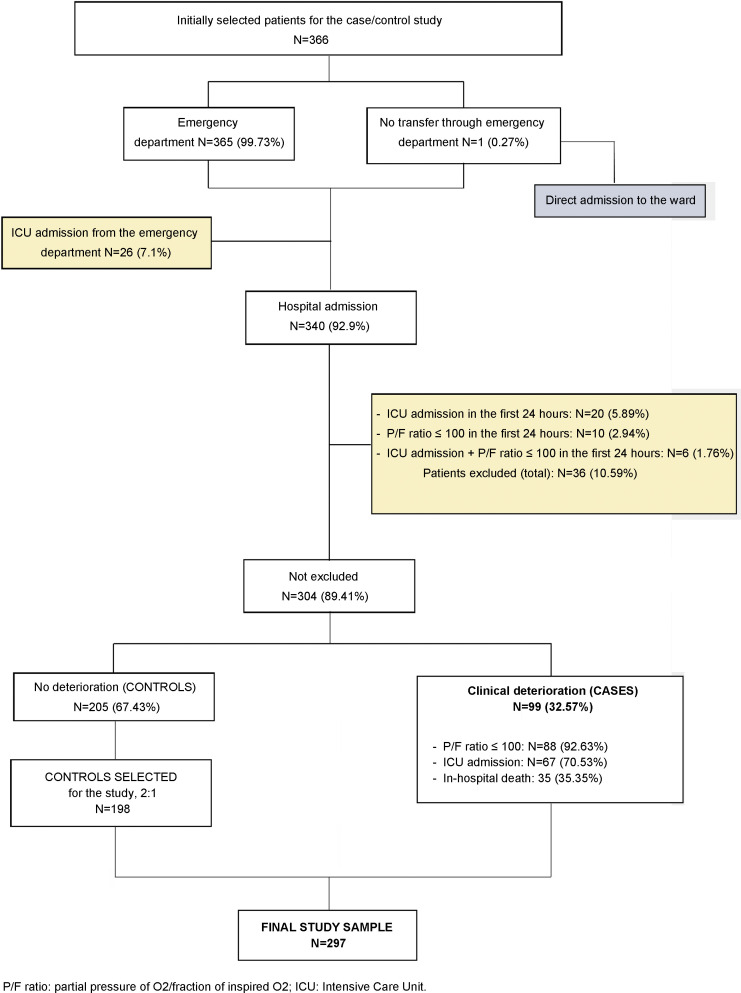
patients hospitalized for COVID-19 with clinical deterioration-defined as onset of severe ARDS, ICU admission, or death-were considered cases. Two controls were matched to each case based on age. Sociodemographic data; comorbidities; baseline treatment; symptoms; date of onset; previous consultations; and clinical, analytical, and radiological variables were collected. An explanatory model of clinical deterioration was created by means of conditional logistic regression.
A total of 99 cases and 198 controls were included. According to the logistic regression analysis, the independent variables associated with clinical deterioration were: emergency department O saturation ≤90% (OR 16.6; 95%CI 4-68), pathological chest X-ray (OR 5.6; 95%CI 1.7-18.4), CRP > 100 mg/dL (OR 3.62; 95%CI 1.62-8), thrombocytopenia with <150,000 platelets (OR 4; 95%CI 1.84-8.6); and a medical history of acute myocardial infarction (OR 15.7; 95%CI, 3.29-75.09), COPD (OR 3.05; 95%CI 1.43-6.5), or HT (OR 2.21; 95%CI 1.11-4.4). The model's AUC was 0.86. On the univariate analysis, female sex and presence of dry cough and sore throat were associated with better clinical progress, but were not found to be significant on the multivariate analysis.
The variables identified could be useful in clinical practice for the detection of patients at high risk of poor outcomes.
关于 COVID-19 临床恶化的最佳预测因素存在争议。
本研究旨在确定因 COVID-19 住院的患者恶化风险因素的预测因子。
队列内嵌套病例对照研究。
奥萨基塔萨巴斯克卫生服务的 13 个急性护理中心。
临床恶化的 COVID-19 住院患者(定义为严重 ARDS 发作、入住 ICU 或死亡)被视为病例。根据年龄,每个病例匹配了 2 个对照。收集了人口统计学数据;合并症;基线治疗;症状;发病日期;先前就诊;以及临床、分析和影像学变量。通过条件逻辑回归创建临床恶化的解释模型。
共纳入 99 例病例和 198 例对照。根据逻辑回归分析,与临床恶化相关的独立变量包括:急诊科 O 饱和度≤90%(OR 16.6;95%CI 4-68)、病理性胸部 X 线(OR 5.6;95%CI 1.7-18.4)、CRP>100mg/dL(OR 3.62;95%CI 1.62-8)、血小板计数<150,000/μL(OR 4;95%CI 1.84-8.6);以及急性心肌梗死(OR 15.7;95%CI,3.29-75.09)、COPD(OR 3.05;95%CI 1.43-6.5)或 HT(OR 2.21;95%CI 1.11-4.4)的病史。该模型的 AUC 为 0.86。在单变量分析中,女性和干咳和喉咙痛的存在与更好的临床进展相关,但在多变量分析中未发现有统计学意义。
确定的变量在临床实践中可能有助于检测预后不良风险较高的患者。