Nephrology Section, San Francisco Veterans Affairs Medical Center and Division of Nephrology, University of California San Francisco, San Francisco, California.
Nephrology Division, Department of Medicine and Translational Transplant Research Center, Icahn School of Medicine at Mount Sinai, New York, New York.
J Am Soc Nephrol. 2021 Dec 1;32(12):2994-3015. doi: 10.1681/ASN.2021070988.
In response to a national call for re-evaluation of the use of race in clinical algorithms, the National Kidney Foundation (NKF) and the American Society of Nephrology (ASN) established a Task Force to reassess inclusion of race in the estimation of GFR in the United States and its implications for diagnosis and management of patients with, or at risk for, kidney diseases.
The Task Force organized its activities over 10 months in phases to ( 1 ) clarify the problem and evidence regarding eGFR equations in the United States (described previously in an interim report), and, in this final report, ( 2 ) evaluate approaches to address use of race in GFR estimation, and ( 3 ) provide recommendations. We identified 26 approaches for the estimation of GFR that did or did not consider race and narrowed our focus, by consensus, to five of those approaches. We holistically evaluated each approach considering six attributes: assay availability and standardization; implementation; population diversity in equation development; performance compared with measured GFR; consequences to clinical care, population tracking, and research; and patient centeredness. To arrive at a unifying approach to estimate GFR, we integrated information and evidence from many sources in assessing strengths and weaknesses in attributes for each approach, recognizing the number of Black and non-Black adults affected.
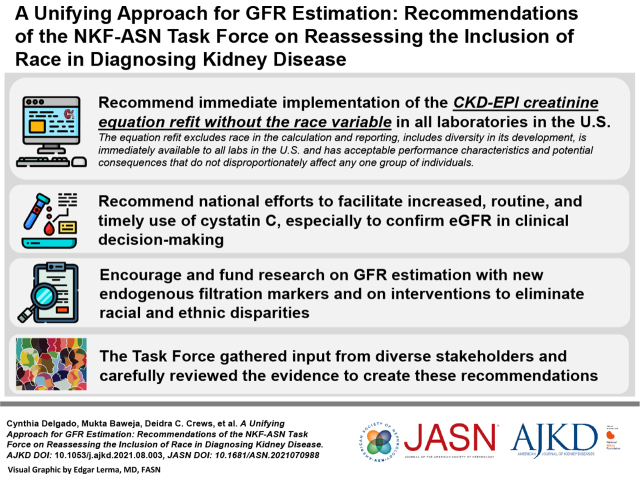
( 1 ) For US adults (>85% of whom have normal kidney function), we recommend immediate implementation of the CKD-EPI creatinine equation refit without the race variable in all laboratories in the United States because it does not include race in the calculation and reporting, included diversity in its development, is immediately available to all laboratories in the United States, and has acceptable performance characteristics and potential consequences that do not disproportionately affect any one group of individuals. ( 2 ) We recommend national efforts to facilitate increased, routine, and timely use of cystatin C, especially to confirm eGFR in adults who are at risk for or have CKD, because combining filtration markers (creatinine and cystatin C) is more accurate and would support better clinical decisions than either marker alone. If ongoing evidence supports acceptable performance, the CKD-EPI eGFR-cystatin C (eGFRcys) and eGFR creatinine-cystatin C (eGFRcr-cys_R) refit without the race variables should be adopted to provide another first-line test, in addition to confirmatory testing. ( 3 ) Research on GFR estimation with new endogenous filtration markers and on interventions to eliminate race and ethnic disparities should be encouraged and funded. An investment in science is needed for newer approaches that generate accurate, unbiased, and precise GFR measurement and estimation without the inclusion of race, and that promote health equity and do not generate disparate care.
This unified approach, without specification of race, should be adopted across the United States. High-priority and multistakeholder efforts should implement this solution.
为响应全国范围内对重新评估临床算法中种族使用的呼吁,美国国家肾脏基金会(NKF)和美国肾脏病学会(ASN)成立了一个工作组,重新评估种族在美国肾小球滤过率(GFR)估计中的纳入情况,以及其对肾脏疾病患者或有患病风险患者的诊断和管理的影响。
该工作组在 10 个月的时间里分阶段组织活动,(1)澄清在美国使用 eGFR 方程的问题和证据(此前在中期报告中进行了描述),并在本最终报告中,(2)评估解决种族在 GFR 估计中使用的方法,以及(3)提供建议。我们确定了 26 种用于估计 GFR 的方法,这些方法考虑或不考虑种族,并通过共识将我们的重点缩小到其中的五种方法。我们全面评估了每种方法,考虑了六个属性:检测方法的可用性和标准化;实施情况;方程开发中的人群多样性;与实测 GFR 的比较性能;对临床护理、人群跟踪和研究的影响;以及以患者为中心。为了找到一个统一的方法来估计 GFR,我们综合了来自许多来源的信息和证据,评估了每种方法的属性的优缺点,同时考虑到受影响的黑人和非黑人成年人的数量。
(1)对于美国成年人(>85%的成年人肾功能正常),我们建议立即在美国所有实验室实施 CKD-EPI 肌酐方程重新拟合,而不使用种族变量,因为该方法在计算和报告中不包括种族,其开发中包含多样性,所有美国实验室都可以立即使用,并且具有可接受的性能特征和潜在后果,不会不成比例地影响任何一个群体的个人。(2)我们建议国家努力促进更广泛、常规和及时地使用胱抑素 C,特别是用于确认有或患有 CKD 风险的成年人的 eGFR,因为结合滤过标志物(肌酐和胱抑素 C)比单独使用任何一种标志物更准确,并能支持更好的临床决策。如果持续的证据支持可接受的性能,应采用 CKD-EPI eGFR-胱抑素 C(eGFRcys)和 eGFR 肌酐-胱抑素 C(eGFRcr-cys_R)重新拟合,而不使用种族变量,以提供另一种一线测试,除了确认测试。(3)应鼓励和资助有关使用新内源性滤过标志物进行 GFR 估计的研究,以及消除种族和族裔差异的干预措施的研究。需要对能够生成准确、无偏和精确的 GFR 测量和估计而不包含种族,并促进健康公平而不会产生不同护理的新方法进行投资。
这种不指定种族的统一方法应在美国各地采用。应优先采取多利益攸关方措施来实施这一解决方案。