Department of Neurology, College of Medicine, Soonchunhyang University Bucheon Hospital, Bucheon, Republic of Korea.
Department of Neurology, Dongtan Sacred Heart Hospital, Hallym University College of Medicine, 7, Keunjaebong-gil, Hwaseong, Gyeonggi-do, 18450, Republic of Korea.
Sci Rep. 2021 Sep 23;11(1):18976. doi: 10.1038/s41598-021-98540-5.
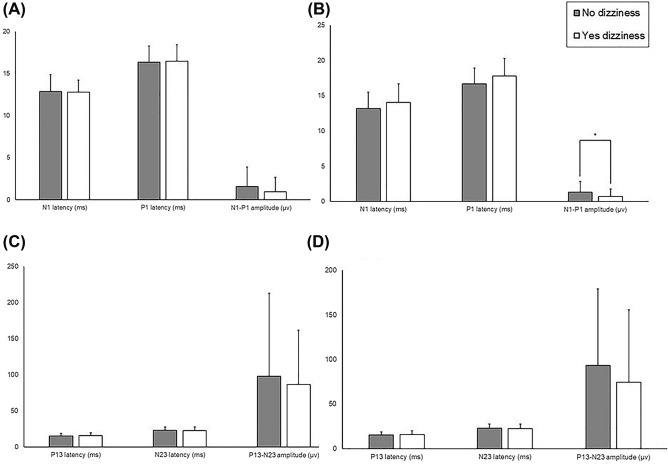
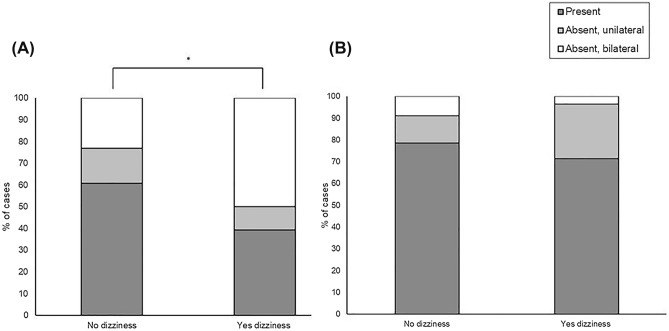
Dizziness is common in Parkinson's disease (PD) patients. It is known that orthostatic hypotension (OH) is the main cause of such dizziness, but even without OH, quite a few PD patients complain of dizziness in the clinic. It can be regarded as non-specific because most of these patients have no neurological abnormalities. We hypothesized that this type of dizziness would be associated with vestibular function, although included patients did not have clinically confirmed vestibulopathy. We studied 84 patients without OH among 121 PD patients. Their clinical features and function were compared between patients with and without dizziness. Hoehn and Yahr stage (H&Y stage), the Unified Parkinson's Disease Rating Scale (UPDRS) part III, the Korean version of the Mini-Mental State Examination (K-MMSE), education years, disease duration, total levodopa equivalent daily dose (LEDD), the presence of dizziness, the dizziness severity, and orthostatic hypotension were tested. Vestibular evoked myogenic potentials (VEMPs) were used to characterize vestibular function. Ocular (oVEMPs) and cervical (cVEMPs) were recorded. oVEMPs in the right side showed significantly reduced potentials (p = 0.016) in PD patients with dizziness, but cVEMPs did not (all ps > 0.2). Bilateral absent oVEMP responses were more common in PD patients with dizziness (p = 0.022), but the frequencies of bilateral absent cVEMP responses were not different between the dizzy and non-dizzy groups (p = 0.898). Dizziness in PD patients without orthostatic hypotension may be associated with vestibular hypofunction. Our results provide evidence that can aid clinicians when making a treatment plan for patients with dizziness. i.e., strategies to enhance reduced vestibular function may be helpful, but this suggestion remains to be evaluated.
头晕在帕金森病(PD)患者中很常见。已知直立性低血压(OH)是引起此类头晕的主要原因,但即使没有 OH,相当多的 PD 患者在诊所也会抱怨头晕。这种头晕可以被认为是非特异性的,因为这些患者大多数没有神经系统异常。我们假设这种类型的头晕与前庭功能有关,尽管纳入的患者没有经临床证实的前庭病。我们研究了 121 名 PD 患者中 84 名无 OH 的患者。比较了有头晕和无头晕患者的临床特征和功能。Hoehn 和 Yahr 分期(H&Y 分期)、帕金森病统一评定量表(UPDRS)第三部分、韩国简易精神状态检查(K-MMSE)、受教育年限、病程、左旋多巴等效日剂量(LEDD)、头晕的存在、头晕的严重程度和直立性低血压。使用前庭诱发肌源性电位(VEMPs)来描述前庭功能。记录眼(oVEMPs)和颈(cVEMPs)。有头晕的 PD 患者右侧 oVEMPs 的电位明显降低(p=0.016),但 cVEMPs 没有(所有 p>0.2)。有头晕的 PD 患者双侧 oVEMP 反应缺失更为常见(p=0.022),但头晕和不头晕组的双侧 cVEMP 反应缺失频率无差异(p=0.898)。无直立性低血压的 PD 患者头晕可能与前庭功能低下有关。我们的结果为临床医生为头晕患者制定治疗计划提供了证据,即增强降低的前庭功能的策略可能是有帮助的,但这一建议仍有待评估。