Perlman George, Tanti Arnaud, Mechawar Naguib
Neurobiol Stress. 2021 Aug 12;15:100380. doi: 10.1016/j.ynstr.2021.100380. eCollection 2021 Nov.
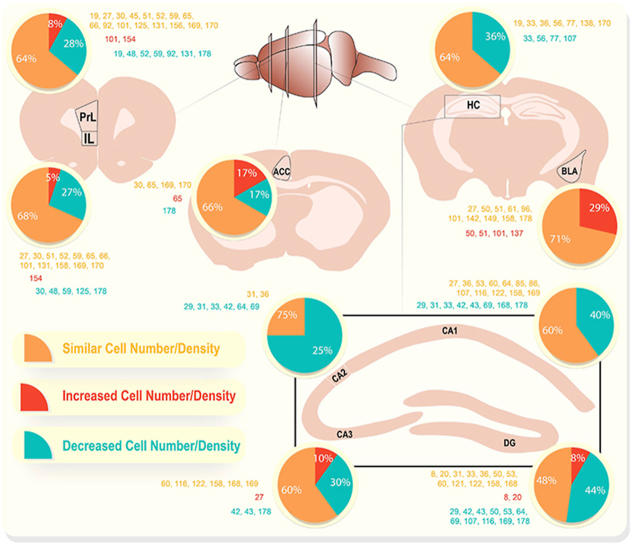
Stress-related psychiatric disorders including depression involve complex cellular and molecular changes in the brain, and GABAergic signaling dysfunction is increasingly implicated in the etiology of mood disorders. Parvalbumin (PV)-expressing neurons are fast-spiking interneurons that, among other roles, coordinate synchronous neuronal firing. Mounting evidence suggests that the PV neuron phenotype is altered by stress and in mood disorders. In this systematic review, we assessed PV interneuron alterations in psychiatric disorders as reported in human postmortem brain studies and animal models of environmental stress. This review aims to 1) comprehensively catalog evidence of PV cell function in mood disorders (humans) and stress models of mood disorders (animals); 2) analyze the strength of evidence of PV interneuron alterations in various brain regions in humans and rodents; 3) determine whether the modulating effect of antidepressant treatment, physical exercise, and environmental enrichment on stress in animals associates with particular effects on PV function; and 4) use this information to guide future research avenues. Its principal findings, derived mainly from rodent studies, are that stress-related changes in PV cells are only reported in a minority of studies, that positive findings are region-, age-, sex-, and stress recency-dependent, and that antidepressants protect from stress-induced apparent PV cell loss. These observations do not currently translate well to humans, although the postmortem literature on the topic remains limited.
包括抑郁症在内的与应激相关的精神障碍涉及大脑中复杂的细胞和分子变化,并且γ-氨基丁酸能信号功能障碍在情绪障碍的病因中越来越受到关注。表达小白蛋白(PV)的神经元是快速放电的中间神经元,其作用之一是协调神经元同步放电。越来越多的证据表明,PV神经元表型会因应激和情绪障碍而改变。在本系统综述中,我们评估了人类死后大脑研究和环境应激动物模型中所报道的精神障碍中PV中间神经元的改变。本综述旨在:1)全面梳理情绪障碍(人类)和情绪障碍应激模型(动物)中PV细胞功能的证据;2)分析人类和啮齿动物不同脑区中PV中间神经元改变的证据强度;3)确定抗抑郁治疗、体育锻炼和环境富集对动物应激的调节作用是否与对PV功能的特定影响相关;4)利用这些信息指导未来的研究方向。其主要发现主要来自啮齿动物研究,即只有少数研究报道了PV细胞与应激相关的变化,阳性结果取决于脑区、年龄、性别和应激近期性,并且抗抑郁药可防止应激诱导的明显PV细胞丢失。尽管关于这一主题的死后研究文献仍然有限,但目前这些观察结果在人类中还不能很好地得到印证。