Yang Yin, Qi Jinlei, Ruan Zengliang, Yin Peng, Zhang Shiyu, Liu Jiangmei, Liu Yunning, Li Rui, Wang Lijun, Lin Hualiang
Department of Epidemiology, School of Public Health, Sun Yat-sen University, No. 74 Zhongshan Road 2, Yuexiu District, Guangzhou 510080, China.
National Center for Chronic and Noncommunicable Disease Control and Prevention, Chinese Center for Disease Control and Prevention, No. 27 Nanwei Road, Xicheng District, Beijing 100050, China.
Innovation (Camb). 2020 Nov 4;1(3):100064. doi: 10.1016/j.xinn.2020.100064. eCollection 2020 Nov 25.
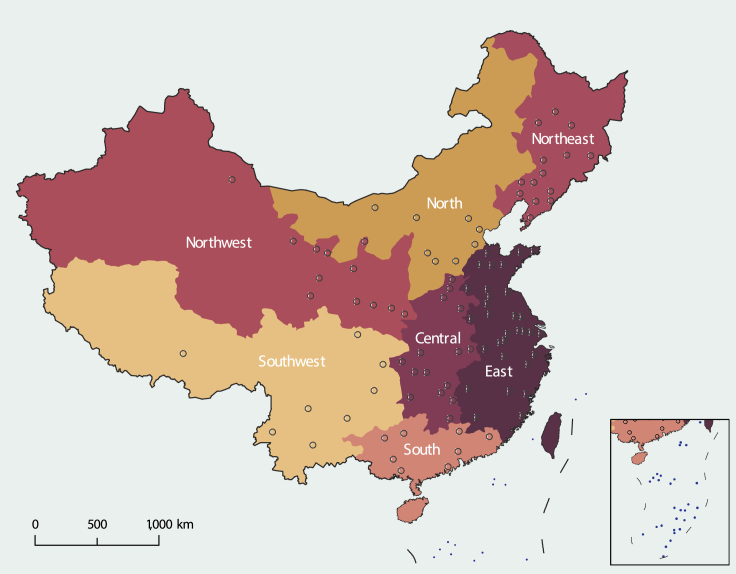
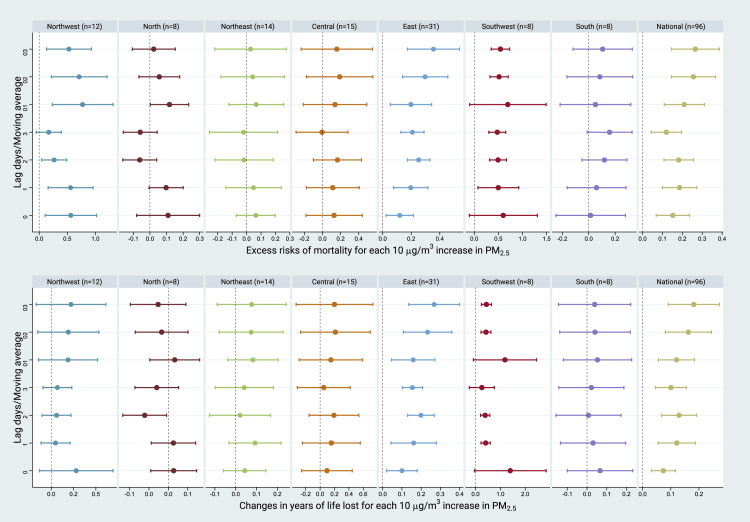
Although exposure to air pollution increases the risk of premature mortality and years of life lost (YLL), the effects of daily air quality improvement to the life expectancy of respiratory diseases remained unclear. We applied a generalized additive model (GAM) to assess the associations between daily PM exposure and YLL from respiratory diseases in 96 Chinese cities during 2013-2016. We further estimated the avoidable YLL, potential gains in life expectancy, and the attributable fraction by assuming daily PM concentration decrease to the air quality standards of China and World Health Organization. Regional and national results were generated by random-effects meta-analysis. A total of 861,494 total respiratory diseases and 586,962 chronic obstructive pulmonary disease (COPD) caused death from 96 Chinese cities were recorded during study period. Each 10 μg/m increase of PM in 3-day moving average (lag02) was associated with 0.16 (95% CI: 0.08, 0.24) years increment in life expectancy from total respiratory diseases. The highest effect was observed in Southwest region with 0.42 (95% CI: 0.22, 0.62) years increase in life expectancy. By attaining the WHO's Air Quality Guidelines, we estimated that an average of 782.09 (95% CI: 438.29, 1125.89) YLLs caused by total respiratory death in each city could be avoided, which corresponded to 1.15% (95% CI: 0.67%, 1.64%) of the overall YLLs, and 0.12 (95% CI: 0.07, 0.17) years increment in life expectancy. The results of COPD were generally consistent with total respiratory diseases. Our findings indicate that reduction in daily PM concentrations might lead to longer life expectancy from respiratory death.
尽管暴露于空气污染会增加过早死亡风险和寿命损失年数(YLL),但每日空气质量改善对呼吸系统疾病预期寿命的影响仍不明确。我们应用广义相加模型(GAM)来评估2013 - 2016年期间中国96个城市每日PM暴露与呼吸系统疾病导致的寿命损失年数之间的关联。我们进一步通过假设每日PM浓度降至中国和世界卫生组织的空气质量标准,估算了可避免的寿命损失年数、预期寿命的潜在增加以及归因比例。通过随机效应荟萃分析得出区域和全国结果。在研究期间,记录了中国96个城市总共861,494例呼吸系统疾病和586,962例慢性阻塞性肺疾病(COPD)导致的死亡。3天移动平均值(滞后0 - 2天)中PM每增加10μg/m³,与呼吸系统疾病导致的预期寿命增加0.16年(95%置信区间:0.08,0.24)相关。在西南地区观察到的影响最大,预期寿命增加0.42年(95%置信区间:0.22,0.62)。通过达到世界卫生组织的空气质量指南,我们估计每个城市因呼吸系统疾病死亡导致的平均782.09例(95%置信区间:438.29,1125.89)寿命损失年数可以避免,这相当于总寿命损失年数的1.15%(95%置信区间:0.67%,1.64%),以及预期寿命增加0.12年(95%置信区间:0.07,0.17)。COPD的结果与呼吸系统疾病总体情况基本一致。我们的研究结果表明,每日PM浓度的降低可能会延长因呼吸系统疾病死亡导致的预期寿命。