School of Medicine and Sarver Heart Center Clinical Research Office University of Arizona Tucson AZ.
Department of Medicine University of Arizona Tucson AZ.
J Am Heart Assoc. 2021 Oct 5;10(19):e020820. doi: 10.1161/JAHA.121.020820. Epub 2021 Sep 24.
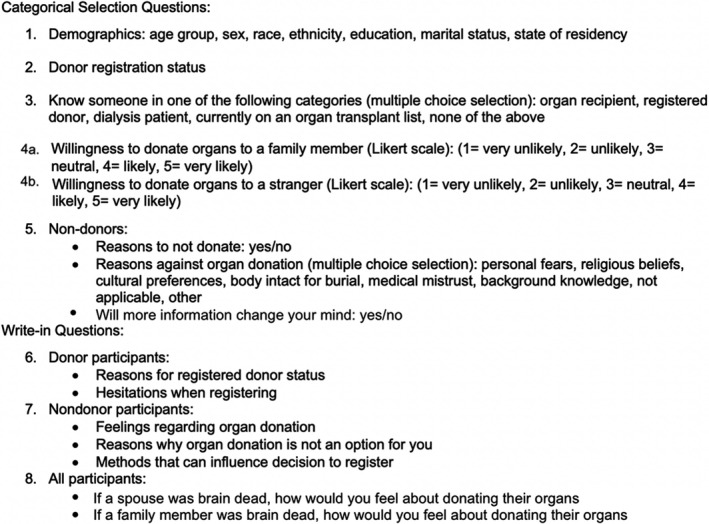
Background The majority of living organ donors are women, but few are deceased organ donors, which increases risks associated with sex mismatched organs. We sought to identify reasons for sex disparities in organ donation and strategies for equity. Methods and Results Using Amazon's Mechanical Turk, we examined US adults' perceptions regarding donation in a mixed-methods survey study. Results were compared by sex with Fisher's exact test and T-tests for quantitative results and qualitative descriptive analyses for write-in responses. Among 667 participants (55% women), the majority of men (64.8%) and women (63.4%) self-identified as registered donors. Women's willingness to donate their own organs to family members (=0.03) or strangers (=0.03) was significantly higher than men. Donors from both sexes were guided by: desire to help, personal experience, and believing organs would be useless to deceased donors. Non-donors from both sexes were guided by: no reason, medical mistrust, contemplating donation. When considering whether to donate organs of a deceased family member, women were equally guided by a family member's wishes and believing the family member had no further use for organs. Men had similar themes but valued the family member's wishes more. Among non-donors, both sexes would consider donation if more information was provided. Conclusions In a national survey, both sexes had similar reasons for becoming and not becoming an organ donor. However, compared with men, women were more willing to donate their organs to family members and strangers. Improving education and communicating wishes regarding organ donation with direct relatives may increase sex equity in deceased organ donation.
大多数活体器官捐献者为女性,但很少有已故器官捐献者,这增加了器官性别不匹配带来的风险。我们试图确定器官捐献中性别差异的原因,并制定公平的策略。
我们使用亚马逊的 Mechanical Turk 在一项混合方法调查研究中,调查了美国成年人对捐赠的看法。使用 Fisher 精确检验和 T 检验比较了按性别分类的结果,对于书面回复进行了定性描述分析。在 667 名参与者中(55%为女性),大多数男性(64.8%)和女性(63.4%)自认为是注册捐赠者。女性愿意将自己的器官捐献给家人(=0.03)或陌生人(=0.03)的意愿明显高于男性。男性和女性的捐赠者都受到以下因素的驱动:帮助他人的愿望、个人经历和相信器官对已故捐赠者没有用处。男性和女性的非捐赠者都受到以下因素的驱动:没有原因、对医疗的不信任、考虑捐赠。在考虑是否捐献已故家庭成员的器官时,女性同样受到家庭成员的意愿和相信家庭成员不再需要器官的指导。男性也有类似的主题,但更重视家庭成员的意愿。在非捐赠者中,如果提供更多信息,双方都可能会考虑捐赠。
在一项全国性调查中,男性和女性成为和不成为器官捐献者的原因相似。然而,与男性相比,女性更愿意将自己的器官捐献给家人和陌生人。通过改善教育和与直系亲属沟通器官捐献意愿,可能会增加已故器官捐献中的性别公平性。