Rheumatology Division, Hospital das Clínicas da Faculdade de Medicina da Universidade de São Paulo, São Paulo, Brazil.
RDO Diagnósticos Médicos, São Paulo, Brazil.
BMC Musculoskelet Disord. 2021 Sep 24;22(1):822. doi: 10.1186/s12891-021-04706-7.
Platelet-rich plasma (PRP) has a still conflicting efficacy for knee osteoarthritis (KOA) and might be a minimally invasive and safe treatment alternative. The potential benefit of only plasma (non-enriched) has never been investigated. Our aim was to evaluate the efficacy of intra-articular platelet-rich plasma (PRP) and plasma to improve pain and function in participants with KOA over 24 weeks.
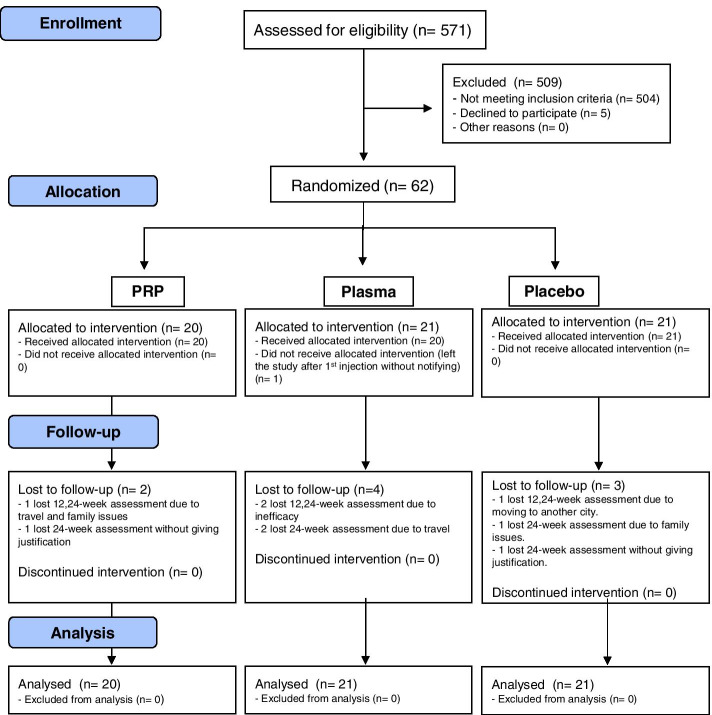
Randomized, double-blind, placebo-controlled trial with 3 groups (n = 62): PRP (n = 20), plasma (n = 21) and saline (n = 21). Two ultrasound-guided knee injections were performed with a 2-week interval. The primary outcome was visual analog scale 0-10 cm (VAS) for overall pain at week 24, with intermediate assessments at weeks 6 and 12. Main secondary outcomes were: KOOS, OMERACT-OARSI criteria and TUGT.
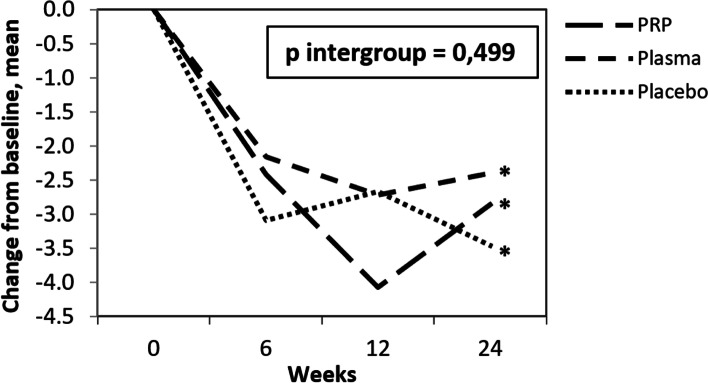
At baseline, 92% of participants were female, with a mean age of 65 years, mean BMI of 28.0 Kg/mand mean VAS pain of 6.2 cm. Change in pain from baseline at week 24 were -2.9 (SD 2.5), -2.4 (SD 2.5) and -3.5 cm (SD 3.3) for PRP, plasma and saline, respectively (p intergroup = 0.499). There were no differences between the three groups at weeks 6 and 12. Similarly, there were no differences between groups regarding secondary outcomes. The PRP group showed higher frequency of adverse events (65% versus 24% and 33% for plasma and saline, respectively, p = 0.02), mostly mild transitory increase in pain.
PRP and plasma were not superior to placebo for pain and function improvement in KOA over 24 weeks. The PRP group had a higher frequency of mild transitory increase in pain.
ClinicalTrials.gov, NCT03138317 , 03/05/2017.
富含血小板的血浆(PRP)治疗膝骨关节炎(KOA)的疗效仍存在争议,可能是一种微创且安全的治疗选择。尚未研究仅使用血浆(非富血小板)的潜在益处。我们的目的是评估关节内富含血小板的血浆(PRP)和血浆在 24 周内改善 KOA 患者疼痛和功能的效果。
随机、双盲、安慰剂对照试验,分为 3 组(n = 62):PRP(n = 20)、血浆(n = 21)和盐水(n = 21)。两组患者均接受 2 周间隔的两次超声引导下膝关节注射。主要结局是 24 周时视觉模拟量表 0-10cm(VAS)的总体疼痛,中间评估时间为 6 周和 12 周。主要次要结局为:KOOS、OMERACT-OARSI 标准和 TUGT。
基线时,92%的参与者为女性,平均年龄 65 岁,平均 BMI 为 28.0kg/m2,平均 VAS 疼痛为 6.2cm。与基线相比,PRP、血浆和盐水组在 24 周时的疼痛变化分别为-2.9(SD 2.5)、-2.4(SD 2.5)和-3.5cm(SD 3.3)(p intergroup = 0.499)。在第 6 周和第 12 周时,三组之间无差异。同样,三组之间在次要结局方面也无差异。PRP 组不良反应发生率较高(分别为 65%、24%和 33%,与血浆和盐水组相比,p = 0.02),主要是轻度短暂疼痛增加。
在 24 周内,PRP 和血浆在改善 KOA 疼痛和功能方面并不优于安慰剂。PRP 组有较高的轻度短暂疼痛增加发生率。
ClinicalTrials.gov,NCT03138317,2017 年 3 月 5 日。