Bensa Alessandro, Previtali Davide, Sangiorgio Alessandro, Boffa Angelo, Salerno Manuela, Filardo Giuseppe
Service of Orthopaedics and Traumatology, Department of Surgery, EOC, Lugano, Switzerland.
Università della Svizzera Italiana, Faculty of Biomedical Sciences, Lugano, Switzerland.
Am J Sports Med. 2025 Mar;53(3):745-754. doi: 10.1177/03635465241246524. Epub 2025 Jan 3.
Platelet-rich plasma (PRP) has emerged as a promising therapeutic intervention for knee osteoarthritis (OA), attracting substantial clinical and research attention. However, the clinical relevance of the treatment benefit remains controversial.
To evaluate the effectiveness of PRP compared with placebo in patients with knee OA in terms of minimal clinically important difference (MCID) and to investigate the possible influence of platelet concentration on the clinical outcome.
Meta-analysis. Level of evidence 1.
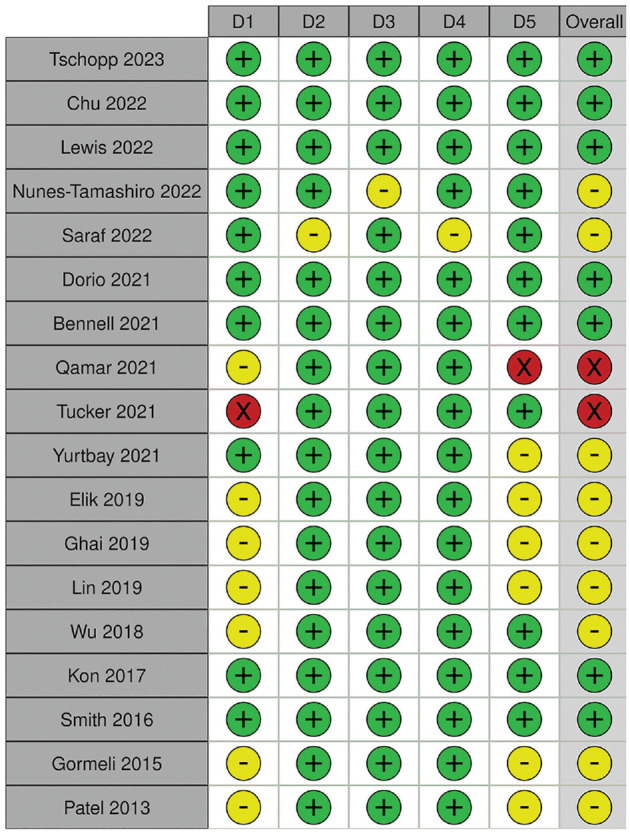
The search was conducted on 5 databases (PubMed, Cochrane Library, Scopus, Embase, Web of Science) using the PRISMA (Preferred Reporting Items for Systematic Reviews and Meta-Analyses) guidelines. Inclusion criteria were randomized controlled trials comparing PRP and placebo injections to treat knee OA, written in the English language, with no time limitation. The effects were quantified at 1-, 3-, 6-, and 12-month follow-up points. Visual analog scale (VAS) for pain and Western Ontario and McMaster Universities Osteoarthritis Index (WOMAC) scores were used, with subanalyses based on platelet concentration performed using a 1,000,000 ± 20% platelets/µL cutoff. The MCID values (VAS, 1.37; WOMAC, 6.4) were used to interpret clinical improvement. The articles' quality was assessed using the Revised Tool for Risk of Bias in Randomized Trials and the Grading of Recommendations Assessment, Development and Evaluation guidelines.
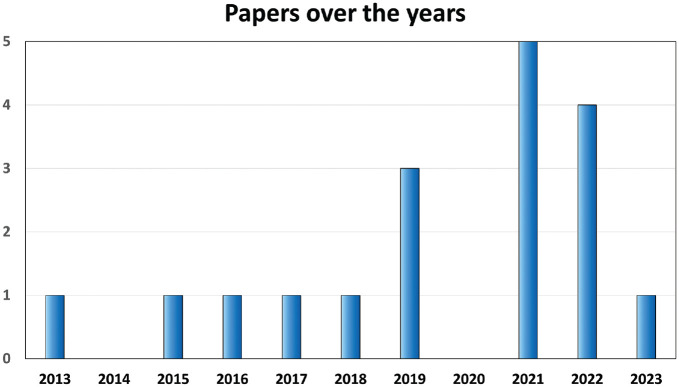
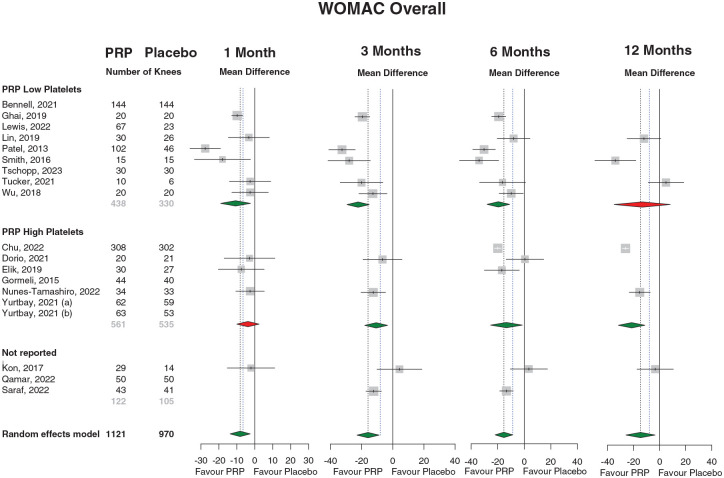
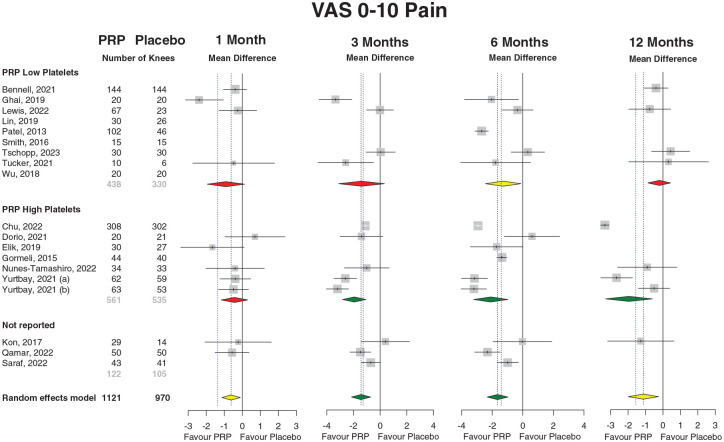
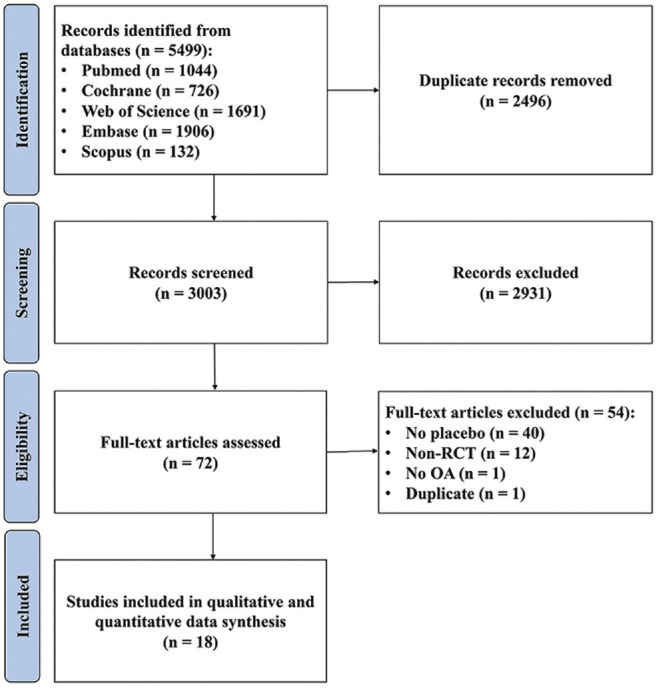
Among the 5499 articles retrieved, 18 randomized controlled trials (1995 patients) were included. PRP presented statistically superior improvements in VAS and WOMAC scores compared with placebo at all follow-up points, exceeding the MCID at 3- and 6-month follow-up points for VAS and at all follow-up points for WOMAC. The subanalysis based on platelet concentration showed that high-platelet PRP provided clinically significant pain relief with the improvement exceeding the MCID compared with placebo at 3-, 6-, and 12-month follow-up points. In contrast, low-platelet PRP failed to offer a clinically perceivable benefit in terms of VAS score. WOMAC results showed that both products provided a clinically significant improvement at 3 and 6 months of follow-up. This benefit was maintained up to the 12-month follow-up in the high-platelet group but not in the low-platelet group, where the improvement compared with placebo did not reach statistical significance.
This meta-analysis showed that PRP offered clinically relevant functional improvement at 1-, 3-, 6-, and 12-month follow-up points and pain relief at 3- and 6-month follow-up points compared with placebo for the treatment of knee OA. Platelet concentration was found to influence treatment efficacy, with high-platelet PRP providing superior pain relief and more durable functional improvement compared with low-platelet PRP.
富血小板血浆(PRP)已成为膝骨关节炎(OA)一种有前景的治疗手段,吸引了大量临床和研究关注。然而,治疗益处的临床相关性仍存在争议。
在最小临床重要差异(MCID)方面评估PRP与安慰剂相比对膝OA患者的有效性,并研究血小板浓度对临床结果的可能影响。
荟萃分析。证据级别1。
按照PRISMA(系统评价和荟萃分析的首选报告项目)指南在5个数据库(PubMed、Cochrane图书馆、Scopus、Embase、科学网)进行检索。纳入标准为比较PRP和安慰剂注射治疗膝OA的随机对照试验,英文撰写,无时间限制。在1、3、6和12个月随访点对疗效进行量化。使用疼痛视觉模拟量表(VAS)和西安大略和麦克马斯特大学骨关节炎指数(WOMAC)评分,并使用血小板浓度1,000,000±20%血小板/微升的临界值进行基于血小板浓度的亚组分析。MCID值(VAS为1.37;WOMAC为6.4)用于解释临床改善情况。使用随机试验偏倚风险修订工具和推荐分级评估、制定与评价指南评估文章质量。
在检索到的5499篇文章中,纳入了18项随机对照试验(1995例患者)。与安慰剂相比,PRP在所有随访点的VAS和WOMAC评分上均有统计学上更显著的改善,在3个月和6个月随访点的VAS以及所有随访点的WOMAC均超过了MCID。基于血小板浓度的亚组分析表明,高血小板PRP在3、6和12个月随访点与安慰剂相比提供了具有临床意义的疼痛缓解,改善超过了MCID。相比之下,低血小板PRP在VAS评分方面未能提供临床上可感知的益处。WOMAC结果显示,两种产品在随访3个月和6个月时均有临床上显著的改善。这种益处在高血小板组中维持到12个月随访,但在低血小板组中没有,与安慰剂相比的改善未达到统计学意义。
这项荟萃分析表明,与安慰剂相比,PRP在治疗膝OA的1、3、6和12个月随访点提供了具有临床相关性的功能改善,在3个月和6个月随访点提供了疼痛缓解。发现血小板浓度会影响治疗效果,与低血小板PRP相比,高血小板PRP提供了更好的疼痛缓解和更持久的功能改善。